
Translated material
Lingva Violent

The main character of the painting by Sergey Paratov “Aika”, just shown in the competition of the Cannes festival, is a young woman from Kyrgyzstan, which lives in Moscow illegally. Registration has long been expired, Aiku is not hired, and blood flows through her feet after childbirth. The unwanted child had to be left in the hospital. Infantry lenders follow the trail.
A documentary working in a feature, Palace is fascinated by the reproduction of life: in the film “Tulip” (2008) he was born, died and gave birth to lambs again, “Aiku” opens and closes the scene in the maternity ward, and in the middle - a veterinary clinic, where the dog is infinitely long, until complete saturation, feeds newborn puppies. Like the Dardenn brothers, whose works have already been compared repeatedly, Palace avoids manipulative techniques, imprinting the diversity of life not in the wild steppe (as in the films “Tulip” or “Happiness”), but in the stone jungle of Moscow. Aika is not a social construct to which compassion should be experienced; It seems to be nature itself, sharpened in a concrete basement.
As a vaccination of humanism to Russian society, the film was ten years old. But there is one detail that becomes noticeable to the middle and makes you really get scared. The picture looks at the world through the eyes of Aiki, hears Aiki's ears and speaks mainly in a rihirgizic one, but sometimes Russian speech is heard from the screen, and its sounds leave no doubt: this language is an instrument of violence, humiliation and suppression. In Russian, police officers checking registration say; The host of the hostel, constantly tightening the rules; an employer who did not pay for several days of slave labor; an arrogant girl on an expensive car, offering a part -time job; The doctor of the veterinary clinic, in the same tone, the leading dialogue simultaneously with Aika and with a ward dog. There is no political statement here, following life is suggested by the switching regime of languages: Russian speech that sounds in the imperial capital means an imminent threat to a disenfranchised girl from the colony.
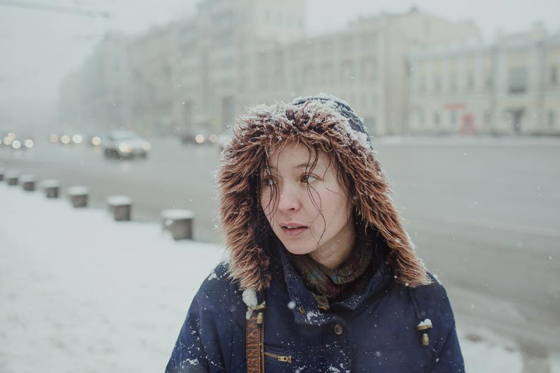 © Denis Sinyakov Hard from the movie "Aika"
By completely opposite methods, Sergey Loznitsa in the Donbass, which opened the Cannes program “Special Gazhing”, also comes to similar methods about the current state of the Russian language.
The documentary, like Paratov, in this film Loznitsa, is rather fascinated by the reproduction of death and moves from - and not to what we are used to considering reality. Donbass is a set of domestic scenes related or not interconnected, which takes place in the first months (or years) of the war in the east of Ukraine. Each of these staging episodes has one or another recognizable audiovisual prototype : a propaganda television report with the participation of the “victims” ( AKA “Crucified Boy”), a video from a militia’s wedding, an interview with a foreign journalist with dressed by Russian military.
Fragments of the video and fragments of the bodies (which are recalled in the previous film Loznitsa, in the Mole )-the main product of this war, which unfolds in a small territory in the physical world and in the endless space of television and Internet broadcasts. The director and his actors reconstruct the videos by the means of playing a reality themselves, being either deliberately directed by someone (as a television interview with the “victims”), or not directed by anyone specifically, but created under the influence of the stamps of the Soviet and post-Soviet massaculture. An elderly woman continues to sit in the basement, because she is a victim of “fascist aggression”, even when a daughter on an expensive foreign car descends to her and persuades her to go home, where they are warm and do not shoot. Based on each of the few formats of the Donbass videos (“complaints of the victims”, “wedding”, “interviews with the heroes”), the luster, as it were, spreads the boundaries of their timing, pulling out the videos from the meat, exposing the technique: we see what pretended to be the moment of the characters in the camera lens, and that followed later (already in the first in the first The scene of the picture of the actors, who will soon answer questions from the correspondent, make up in a special trailer). It even seems that Loznitsa managed to discover a new type of movie - the realism of double distillation, where life and its screen representation have entered a state of mutual diffusion.
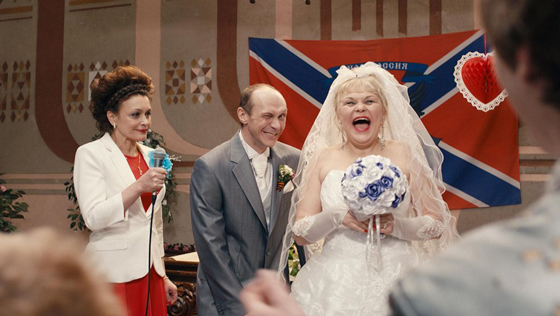 © Pyramide International Frame from the movie "Donbass"
Donbass works with meanings and forms at ultrasound frequencies that are indistinguishable without special equipment - and this is especially true for the language fabric of the picture (but not every eye distinguishes the camouflage of the Russian military who pretend to be militias, from a few more baroque camouflage of local ones). This is not the first time the Loznitsa is faced with the fatal non -transformability of its extremely accurate observations. In the documentary “Maidan” (2014), impassively telling about the revolution in Kyiv, the most exciting element of the audiovisual canvas was precisely a spontaneous switch between Russian and Ukrainian, between the cultural codes of the two countries (performed from the “Chervona Ruta” scene - a restaurant hit for the Russian ear and the revolutionary song of the tormented KGB of Vladimir Ivasyuk - for the Ukrainian). Alas, the audience at international festivals reads English or French credits that do not distinguish between languages on the screen and do not help (if they do not interfere) with the decoding of language layers; In Russia, where they could understand more, these films see units.
If the Russian language becomes a tool of violence, then the Loznitsa is to a greater extent a means of manipulation: a tool of a hybrid war, Molotov cocktail from empty verbal constructions and emotional recycling. The exaggerated characters of the feature cinema are indistinguishable from the real characters of You T Ube Rolikov, the exaggerated dialogs sound as a concentrate of the modern Russian language, consisting of a mat, a thieves feni, patriotic stamps with a slight intricate of church vocabulary. “We have one mother, she is sick. Our Motherland is sick. Fascist climbs on her leprosy. ” "They fell through the whole Russian world - not a heel of the Earth, no ***." “I am the vice president of the Holy Martyr Foundation Theodosius of Kherson. I brought the icon of the Holy Churila Pretkikovich. " "They took the car for temporary use before the victory over the Nazis." A language that was reduced before a set of manipulative stamps can no longer be used to describe positive experience and positive emotions - for this it is no longer enough plasticity. “Life is becoming more beautiful, more beautiful,” the deputy of the local parliament Oksana Potsik recites at the wedding of his comrades, who does not have even two multicolble synonyms in his vocabulary (the Ukrainian language sounds in two scenes of the film, in one of which becomes the language of sophisticated mutual insults).
The war in the east of Ukraine began largely under the slogan of the protection of the Russian language, but it seems, led to exactly the opposite results (it would be interesting to listen to the Ukrainian version of the Russian, if it survives, today, breaking away from the chancellery of Russian television and stamps of Russian pop culture, it has already begun to develop in an independent direction). A dead, decaying language cannot be a means of communication and a means of representation - it makes no sense to talk about the political subjectivity of a society that does not have a linguistic subjectivity.
Loznitsa and Paratseva are documentary actors from one generation who grew up in the Soviet Union and brought up by Russian culture, but located on its periphery (one in Belarus and Ukraine, the other in Kazakhstan); Both of them, pushing away from reality and moving in opposite directions, notice the same thing in their new films: in the days of doubt, in the days of painful thoughts about the fate of the Motherland, the last support disappears - a great, mighty, truthful and free Russian language.