
Translated material
In the USSR, sex was
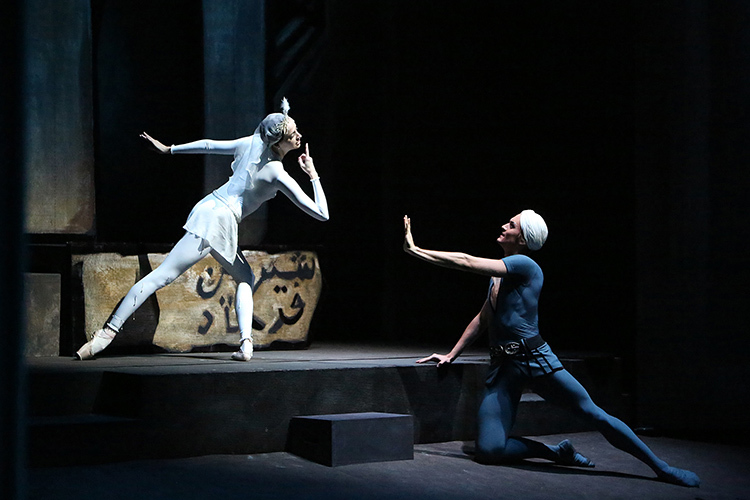
The Bolshoi Theater resumed the "Legend of Love" by Yuri Grigorovich. “Resumed”, of course, it is said loudly: there was nothing to gallop from the grave - this ballet never disappeared from the repertoire for a long time. Rather, this is a way to emphasize it once again. To remind us what event the prime minister of “Legends” was in 1961, and to some extent let us feel like its eyewitnesses. Because-and this is the main thing in the current premiere-“Legend” still makes a very strong impression.
And if someone conquers, that it is, they say, the next back in USSR , we ask those mercy to the premiere of the real rebel from hell - the “Copper Horseman”, promised this season at the Mariinsky Theater.
In 1961, the Leningrad Kirov Theater "Legend" was taken ecstatically. The fifties are one of the most miserable and gloomy decades in the history of the Russian ballet, their darkness was cut out by the artistic flashes of performances by ballerinas stars, but they only emphasized darkness and forced talented people to ask again the question: is it really-that’s all? Fat awards and orders for the terrible performances, aggressive mediocrity of successful choreographers and the miserable existence of those who had something to say (but they shut up their mouths, and even then thanks: they could send), the jealous self -goodness of the “veterans”, from one glance that they will only go forward from the theater, and you will have to grow old on the second. roles. But most importantly, cowardly and evil mediocrity, mediocrity, mediocrity, spilled everywhere, like the November rainy fog. All these first -therams are “native fields” and “copper horseman” with your dreams. Is this really the ballet?
And suddenly a Parisian troupe, then New York, arrived on tour. And the Soviet ones saw what all these years there, behind the iron curtain, were engaged in the former “ours” - Sergey Lifar and George Balanchin.
The guests stunned. The twentieth century whistled, sparkling and rumbling, past the provincial half -end, as the Soviet post -war ballet was.
 © Damir Yusupov / Bolshoi Theater
Everyone understood this, even notebook monsters. They rushed to scribble for the "White Guard" of the Lifar newspaper denunciations. Lifar, of course, is in Paris, but at least for the ostrand of ballet Komsomol members. Late, late - Damage Done : Soviet ballet youth has already seen the promised land, and the old people - that if there was a talent, then profan and life was wasted.
The exemplary Soviet ballet nomenclature Leonid Lavrovsky, of those few in whom it was still smoldering from the sacred fire, rushed to "catch up with America." He recognized himself bankrupt. He admitted that all his life he went “in the wrong way”. He set the ballet “in the manner of Balanchin”, proving to himself that you could still jump on the train on the train, and soon died of a heart attack, or rather, from his own honesty (the words “stress” were not yet known).
Yuri Grigorovich's heart was young and healthy. He already managed to release the Stone Flower in the Leningrad Kirovsky Theater. He promised a lot. He longed for these promises to hold back.
In general, his then artistic behavior is the top of dignity. Imagine: a deceived son in front of a scattered father. And Grigorovich makes an act to match Nikolai Rostov: he accepts a ruined inheritance.
What inheritance are we talking about. The whole end of the XIX century, the Russian ballet, its only active choreographer Marius Petipa, was looking for the form of a multi -act performance with the “History”. So that and “it”, and “it”, and the beginning, and the middle, the end, and the shade of the “higher meaning”. And somehow they dance. Then this powerful river bifurcated. Mikhail Fokin taught how to make one -act ballets, Fedor Lopukhov - plot. These were great discoveries. They only interfered with the fact that Lopukhov had no talent for a choreographic composition (the ability to add grammatical exercises in classical dance and call them “variation” - this is not a talent), and Fokin possessed the talent “small, but pretty” (as they liked to call it at that time). But the strong and large possessed Balanchins, who combined these two discoveries. And they determined the face of the ballet of the twentieth century. Western ballet.
The Soviet ballet, meanwhile, rolled along the second channel-the channel of multi-act ballet historians. And by the time of the first Soviet tour, Balanchin was completely shallow. Again: by an example, go to the “Copper Horseman” to Mariinka, make sure how terrible the crisis was, as a crushing bankruptcy. Experienced Leonid Lavrovsky, putting his single -acting plot of neoclassical ballet, recognized him and renounced him. Young Grigorovich accepted debt obligations for himself.
Oh, the Soviet man had something to tell about the sweets to be alone, without a corps de ballet, with an eye in a keyhole and denunciation ready.
At first glance, the “legend of love” follows the western ballet of the twentieth century, as the then ballet Komsomol members saw it. A minimum of scenery: they strive for zero, these are just large shields. Costumes are also striving for zero: a dull skeleton from the throat to the ankles. The accents in the classic PA are shifted - not yet a modernist ballet, but close. And even Arif Melikov, on his communal kitchenette, boldly builds a Sudochka A-Naturel: here he has Ravel’s “Bolero”, there is even something jazz, and then the naked rhythm of the named “Spring” Stravinsky, for whose notes they still deprived the Komsomol ticket in the Leningrad Conservatory.
But the “Legend of Love” is also a completely Russian ballet, with a pedigree, ascending to the “big ballets” of a pet. Ballet with history, and she has the beginning, middle, end, "characters, fate and conversation." The ballet is multi -acted.
Grigorovich - which neither criticism of the premiere or subsequent historians did not notice at all - radically rethinks the method of Petip. At Petipa, the action went through the festive marches and pantomime scenes, suddenly beat on the brakes - the gateways opened, letting out the cordobilus in neutral packs, the scene flooded the large classic PA with soloists and cordobalet. These Gran-pa were an “internal” action: like a dream, they raised a secret, not expressed by words, the life of thoughts and feelings. And after the codes with the final group, as after awakening, the “external” action with its palm trees, snakes or what was on the agenda of the plot flashed again.
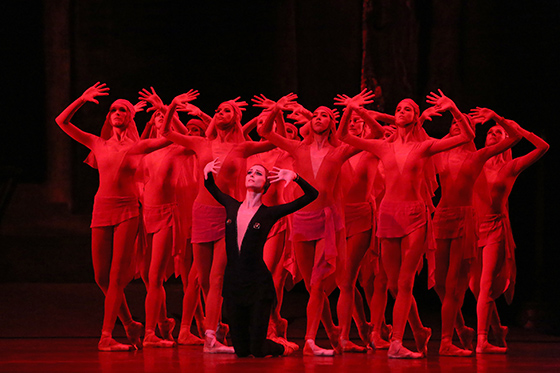
In the same way, Grigorovich does in the Legend. But it goes even further. Pantomime scenes are compressed by two or three laconic gestures. And the “internal” action in the conflict with the “external”. Grigorovich is not only an “external” action, but even the orchestra stops. Instead, a chamber ensemble plays in the wings, and this sound gives even more similarity to sleep. And where Petip had a crowded gran-pa, Grigorovich had a trio of the main characters in the semi-panty and near Surdinka. Oh, the Soviet man had something to tell about the sweets to be alone, without a corps de ballet, with an eye in a keyhole and denunciation ready.
 © Damir Yusupov / Bolshoi Theater
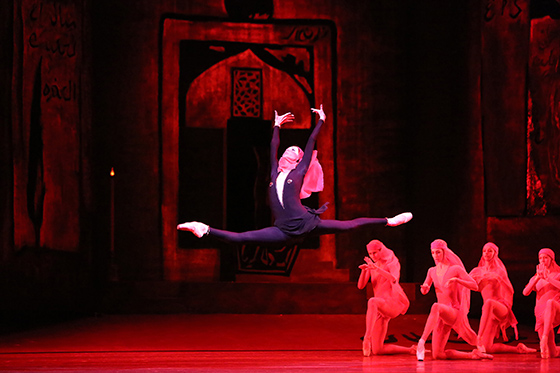
But the crowded processions became the apotheosis of the state, leisurely and heavily rotating its wheels and gears. When I first got into a large “legend”, Moscow friends with embarrassed smiles put me in a chair: they say, there they are, well, you understand, that is ... “they” and “such” were people who began to scream from somewhere from the tiers during the procession: “Grigorovich-genius!”. It has already been customary to ironize and apologize to St. Petersburg friends. But do you know what? In processions, Grigorovich really takes the height of the ingenious. The most acute installation, the camera grabs chains of four or eight dancers. Plans replace each other. People arrive and arrive (although in fact a relatively small cor deucade is busy). The music is bifted up to the firing roar of copper. On the stage, it seems stuffy and nothing to breathe. From the hot embrace of the authorities, it drys out in the throat. And the dancers of the big also perform it ecstatically. In a word, yes, a genius. And yes, this ballet is a diamond in a large repertoire. Although the Legend was born in St. Petersburg, there she is dancing too well, fresh. As a verse set for cramming a teacher in literature. In a large one, this is a completely alive performance.
“Living”, perhaps, the main word. A man of impeccable taste Pavel Gershenzon once wrote that the “legend” can be turned into a masterpiece, stinging to a couple of acts. Purely compositionally - maybe; There are longs in the "Legend". But not good taste gives rise to masterpieces. The Legend has many advantages, there are disadvantages, but it captures the power of passion, directness and frankness. How frank the overturned twine of Mehmene-Ban, languishing with love hunger. By this, the “legend”, in fact, was frightened by the premiere (and not only by the fact that there was no sex in the USSR then, and the twine in the ballet too). Grigorovich was thrown out of Leningrad in two accounts.
But the Bolshoi Theater received its best performance. And so he remains for many years. Enjoy.