
Translated material
Jonah, Benedict ... Cyril?
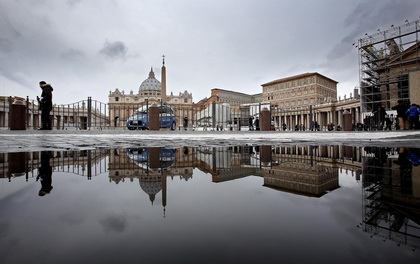
Seeing the news of Benedict XVI voluntary departure from the post of Roman bishop, I somehow did not correlate what happened to our situation at first. What can be the connection here? But the reaction to the news in blogs and social networks prompted me to certain thoughts ... No, I do not take into account all sorts of flat and vulgar jokes that link Benedict's resignation and scandals associated with Patriarch Kirill. It is much more interesting that both among the conditional church “liberals”, and among the conditional “conservatives” there were those whom Benedict's departure prompted the idea of hypothetical departure from his post Cyril. The former, even if they are not quite seriously, see Benedict’s incident of the speedy change of the patriarch in the Russian Church, and the latter, on the contrary, fear that Benedict's resignation can somehow bring Cyril's resignation. There are no decisively any rational arguments that allow you to connect these two events among themselves - real and imaginary. Moreover, when in July 2012, under the pressure of his Synod, he resigned the first hierarch of the Orthodox Church in America, no one even jokingly tried to project this story to the Russian Church. But, apparently, the news of the Roman bishop revealed some kind of underlying layers of public consciousness.
It is impossible to draw some reasonable parallels between the Pontificate of Benedict and the patriarchate of Cyril-in addition to the fact that both of them (formally Benedict still remains at their post) are at the head of the largest Christian churches. Benedict leaves his post himself, of his own free will. His image in the European media is not accurately, but claims to him are excessive conservatism and loyalty to Christian values. That is almost praise. We must have a rich fantasy to imagine a Roman bishop, which would remain today in his post after even a small part of public scandals that fell to the share of Patriarch Kirill. The decades spent by the Roman church under the magnifier of hostile secular media have taught the Vatican to take care of the good testimony from the external ones. Formally, the powers of the Roman bishop are unusually broad, but in practice they are limited by a sober sense of churchness developed in the Roman Church over many centuries. Benedict XVI sees his ministry as part of the general ministry of the Church, and therefore found the strength to transfer it to someone else.
Patriarch Kirill demonstrates a completely different approach to his service. I can’t imagine the Lord of Cyril, who voluntarily goes to rest for the church good. Because, watching his actions and words, we can conclude: for Cyril, the church good is the only one in his stay in the post of Patriarch. Patriarch Kirill is a bold and enthusiastic church reformer. Yes, despite all his election promises not to arrange any reforms, the patriarch redraws the structures of the church management at his own discretion, not giving anyone a report in his activities. For example, this is a new parish charter, the introduction of the Metropolitan districts, the actual abolition of the local cathedral, and the institution of the Supreme Church Council. It would be not true to say that all the reforms of Patriarch Kirill are definitely bad and unsuccessful. But it was promised something else. However, in Russia, apparently, such a tradition - pre -election promises are forgotten immediately after the elections ... But for Cyril, whose manner of leading the election campaign was called eyewitnesses “the style of the steam skating rink”, church reforms - only part of the special ministry, a special mission in which he, as many believe, sees his purpose. The ideology of the “Russian world” occupies no less, or even a large role in its rhetoric.
A detailed study of this deeply secondary and lifeless ideology goes beyond this article. I only note that any church criticism of the “Russian world” is the strictest taboo. You can carefully advocate for liturgical reforms, you can quietly complain about the diminution of collegiality, you can finally moderately criticize some bishops, as well as figures close to the patriarch. You can even criticize the current regime. All this will put a church author to a bad account, but if you do not get carried away, it will not lead to ambulances. And only any public speeches are not even criticizing the ideology of the “Russian world” as a whole, but simply contrary to part of its provisions, lead to immediate and serious consequences. The black label from the patriarch personally, even through the heads of diocesan bishops, is guaranteed. Apparently, this ideology is very close to Cyril, and any attempts to challenge it are perceived by the patriarch very painfully. In this light, by the way, the connection of Cyril with such deeply ambiguous public phenomena as the World Russian People’s Cathedral, the very possibility of which was to a large extent, was provided by Metropolitan Kirill in 1993, as well as a scandalous Russian doctrine, which was born with the support of Metropolitan Kirill in 2007 and is now well -being forgotten.
Perplexity is not the very presence of such projects that have every right to exist. Another thing raises questions - the substantial part of these projects is often incompatible with Orthodoxy and compromises the church, but Cyril continues to support them. Such actions can only be explained by the commitment of ideology, in some issues that is contrary to the Orthodox creed. One gets the impression that Patriarch Kirill sees himself the only leader of the conditional “Russian world”. And the voluntary departure from the post of Patriarch for him is the betrayal of this case, which he will never go to.
So there is little in common between Benedict and Cyril. It is impossible to compare the humble minister of the Church, who sees the difficult responsibility in his vast powers, and the enthusiastic charismatic who believed in his own special purpose and his own special role in the history of the church. If we have to draw analogies, then we must recall the recent resignation of the First Hierarch of the Orthodox Church of America Metropolitan Jonah (Puffhausen), which I mentioned above. Let me remind you that for the past few years, all kinds of scandals have been shaking the pickers, which pour out, including in excessively frequent replacements of its primary hierarch. Metropolitan Iona took the post of head of the Church in 2008, replacing Metropolitan Herman (Svaiko). The latter was forced to rest because of accusations of financial abuses. Metropolitan Jonah had high hopes, but they, alas, were not destined to justify themselves.
Metropolitan Jonah, converted to Orthodoxy in 1978 from the Protestants, spent part of his monastic path in the USSR, and then in Russia, where he gained not only the experience of monastic life, but also very specific views on the role of the primary hierarch in the life of the Church. Jonah did not strive to manage PCC, but, being at the head, behaved in accordance with the Russian traditions of church authoritarianism. For a PC, configured to the construction of a church organization in accordance with canons and collegiality, this behavior was unacceptable. In July 2012, members of the PCC Synod demanded from Metr. Jonah resign, and he was forced to obey this requirement. Formally, the resignation was voluntary.
To illustrate the opinion of the Synod about Meter's reign. Ions, we will quote a number of documents. For example, the statement of the PCC Synod, in particular, states: “For almost four years, Metropolitan Jonah has repeatedly acted as the head of our church, contrary to the prudence and wishes of his colleagues-episics ... For several years, Metropolitan Jonah has entered into practice, it was not reckoning with the opinions of other bishops and the recommendations of the Holy Synod and Church. lawyers ". The head of the department of external and inter -church relations of the PCs Archpriest Leonid Kishkovsky in an interview says : “Very often there was not even the appearance of a consensus between the bishops ... Metropolitan Iona began to publicly say that our way out was to become part of the Moscow Patriarchate. He believed that it was necessary to abandon autocephaly, that is, complete independence, and join the Moscow Patriarchate as an autonomous church. And this in the church, starting with bishops, was not perceived positively. "
So, guilty of Metr. Iona made precisely claims of unlimited power in the church, to the right to issue her own opinion for the opinion of the Council of the Council, to the right to single -handedly decide the further fate of the Church. Formal actions of Metr. Ions did not allow him to deprive him of a dignity for violating some canons, but the PCS synod, which feels moral right, managed to force the First Hierarch to leave his post.
Is such a situation possible in the Russian Church? At first glance, it is completely impossible. Bishops, a considerable part of which by their departments owes Patriarch Kirill personally at the Bishop Cathedral, obediently and unanimously vote for all Cyril’s initiatives, and the older -generation bishops do not show any protest against the complete usurpation of church authorities Cyril (however, this usurpation began under his predecessor, Alexia II). At least, nothing is heard of such disagreements. Nevertheless, if you carefully look at the actions of Patriarch Kirill, you can make sure that he, apparently, is not too sure of his complete invulnerability. In any case, this is evidenced by his following steps: the creation of the Supreme Church Council and the further complication of the charter procedure of the church court over the Patriarch. The highest church council, which is entrusted with a considerable part of the functions previously related to the leading of the Synod, consists for the most part of people who are personally obligated to Patriarch Kirill personally. These are the bishops set by the current Patriarch, and the bishops who received enviable church posts with Cyril with the advent of Cyril, and former APC employees, and laity personally devoted to Cyril. The probability that they will object to the Patriarch when considering some administrative issues is significantly lower than in the case of venerable Metropolitans of the Synod, who see their brother in Cyril, and not a father and lord.
As for the procedure of the church court over the patriarch, Cyril has been working to make such a court as much likely for many years. According to the Charter of 1988, the right of a church court over the patriarch belonged to the local cathedral. In 2000, the Bishop Cathedral, in violation of the charter at that time, adopted amendments to the Charter developed by Metropolitan Cyril. In particular, these amendments transferred the right of the court over the Patriarch of the Bishop Cathedral. But it seemed to Cyril insufficient. The new procedure suggests that the court is carried out by the bishop's cathedral, and the decision made must be approved 2/3 of the members of the local cathedral. There is no need to be deceived, this is not an expansion of the rights of the local cathedral, but new obstacles to the possible detachment of the Patriarch, whose actions will harm the church. By the way, the possibility of deposition of the patriarch in case of dissatisfaction of the entire fullness of the Church by his rule is not provided at all. These steps of Patriarch Kirill themselves indirectly indicate that he admits the possibility of the occurrence of a domestic opposition, dissatisfied with his style of government, and tries to protect himself.
In the Russian Church, the deaf dissatisfaction with its current Primate is spilled today. Unfortunately, the wrong understanding of the role of the Patriarch in the Local Orthodox Church does not allow this discontent to find expression to begin with words, and then in actions within the framework of church canons. Instead, dissatisfaction drives inward, which leads to burnout and self -destruction of many caring church people, both laity and clergy. To change this situation, you must stop looking at the Patriarch as an intermediary between God and the Church and see in him just an administrator whom the Church instructs to engage in its everyday affairs. And if the administrator unsatisitionly copes with his duties and does not misunderstand his functions - he can and should be asked to free his place. And even abolish the position - according to sound conciliar reasoning.