
Translated material
Uncle's dog
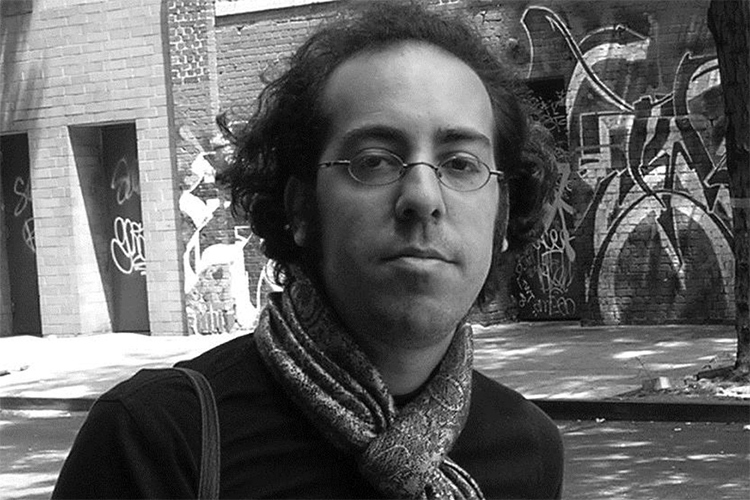
The Israeli playwright, the writer and translator of Roy Hyun transferred Pushkin’s “little tragedies” to Hebrew - and talked about what it means to devote ten years to work that “will definitely not change the world”, about why the translator is the author and the owner of the author, and how to properly translate the word “Jew”.
Linor Goralik: I would like to ask right away: “Lord have mercy that it made a strongly busy translator, writer and playwright take up such a huge work?” How did you get into it?
Roi Hyun: Let's start from the very beginning. I met Pushkin when I was four years old. It was a dog of my uncle. I had no idea that somewhere there there is some crazy people, for whom Pushkin’s name is not the name of a curly dog, but the name of the national poet. Pushkin-Pushkin, Pushkin-Pushkin-it was our dog. In the village, where I went to my uncle of the most honest rules (wait, now this story will go in cycles). And then, at the age of 14, I was visiting my friend.
Goralik: You did not speak Russian then, right? I would like to remind the reader that you are not from a Russian -speaking family at all.
Hyun: Yes, I did not speak Russian, of course. And so I stood at a friend in the cabin and died with laughter: I suddenly saw a book that my uncle’s dog wrote. I asked: “Listen, what is it? This is my uncle's dog! Who is this at all? " I did not just know Pushkin - I did not know anything at all: I seem to have not read a single book until 13 years old.
Goralik: Yes, and why?
Hyun: Exactly. What is the point? I was so amused that I opened this book. It was “Eugene Onegin” (I promised that the story would be focused). I started reading - and I was very funny again: there was also an uncle there! Well, that's it, I disappeared. Then something happened to me. And later I found out that Pushkin was also a kind of Chernozhopets among the Russians - that's how I am now.
Goralik: There was a moment of a conscious decision-“What would I transfer to me from Alexander Pushkin”?
Hyun: No, there was another turn of the spiral. I then worked with the Tel Aviv Malenka Theater, which suggested that I create a performance on “Little Tragedies”. In Hebrew, of course, there was no such text. And I began to translate. It was 10 years ago. We created a performance, the performance came out, the book is not. It took many, many years of work before I felt confidence that my translation was accurate. And then I dedicated the book to the dog of my uncle.
Goralik: is the dog alive?
Hyun: No! For a long time no longer.
Goralik: Why was there ten years of life? For what?
Hyun: Because this book needed a translation into Hebrew.
Goralik: And the reader? It is customary to ask: "What, according to your feeling, will be the cultural consequences of this translation, how many people will read it?"
Hyun: And I did not do this for people, I did it for myself. That is, I am very glad that some people will read this translation. But I believe that the translation is a chain of letters. Translating someone else's text, I de facto translate the letter that someone wrote to people in the 19th century: to whom it is interesting-that letter will receive. Israel is a very reading country, now, it seems to me, they read more than before, they just read another and differently. Here, in this country, we have such a small church: the Church of readers of such books, this book. Whoever comes to this church for service will sit on a bench and open “small tragedies”. Basically, the most important thing in this is to understand that you are what you started. Understand that you are busy with a business that is not that the world will not change - maybe it will almost never sound at all. And, frankly, it was so pleasant for a person who fills the hall for eight hundred places every day to create a book that could read, perhaps, only one person. By accident, maybe in some bugsist store someone will open it in twenty years-and suddenly read it. This is more than enough for me.
Goralik: One of the most interesting aspects in this story is language. Any translator makes complex decisions regarding what language to translate the book of the 19th century - the language of the 19th century? And to what extent? And what compromises with the modern language to go to? But in your case, things are even more interesting: as if there is no such layer of Hebrew, which would easily correlate with the original language of “small tragedies”, and each translator to Hebrew understands this problem in his own way. How did Rohi Hyn dealt with her?
Hyun: Roi Hyun is a translator who has been working in the theater for many years. And “little tragedies” are a very theatrical work. And in some ways I was not afraid to translate it so that it could be heard from the stage, and not just read it. It was important to me. Therefore, the Hebrew, which translated this text, is not only “classic”, but from time to time also arrogant - where it is appropriate. Because both the original text in places is impudent, and the author was arrogant.
Goralik: What position was the work made from - fusion with the text or, conversely, with a removal? Ten years is a serious period for any cohabitation.
Hyun: One of the main topics of “little tragedies” is jealousy, and this feeling is very characteristic of the translator. So there was plenty of fusion with my real life. In this sense, gasoline did not run out of my 10 years. All the time I was interested in understanding who Mozart is and who Salieri in this game with Pushkin. Who will poison anyone.
Goralik: And how?
Hyun: The devil knows him.
Goralik: So far, everyone is alive?
Hyun: As for me - who reads, he will say. As for Pushkin, I don’t know (laughs) .
Goralik: Are you ready to contact Pushkin yet?
Hyn: At the moment - no, no and no. I translated Harms, the “Kolyma stories” of Shalamov, “Dark Alleys” by Bunin, Chekhov - all the short plays, “Poor People” of Dostoevsky and now - Pushkin. And very tired. For this, it’s not that they don’t pay - you still spend money yourself to do this. Do not understand the wrong thing: the book went out in a very good publishing house, I got all the grants possible, I even (and it was very pleasant) The Likhachev fund from St. Petersburg invited me to St. Petersburg, they waited for me to the lyceum, opened it for me, I walked, looked at Pushkin’s side - but, damn it, I no longer want to. Huge work, hardest. Schizophrenia simply takes out the brain at every step.
Goralik: But about schizophrenia in more detail.
Hyun: You must be both a servant and a master - all the time. It is difficult to be both a servant and a master. A servant is one who serves Pushkin. It is very important in this system. And the master is the one who tells Pushkin: “Wait, but you don’t know Hebrew, right, Alexander Sergeyevich? Therefore, wait a second, I tell you: it sounds better. " And the servant replies: “Sorry, I represent the interests of my master, and if you spoil his text, I will wait for you for a curtain with a small dagger.”
Goralik: Can I have an example from the text?
Hyun: I remember my texts very poorly. I don’t remember anything at all, I really don’t even remember my childhood. I write in order to see and see that I still lived. But he remembered: this applies to the "feast during the plague." In the "Feast" Pushkin - and the poet, and the translator, and the playwright, because the "Feast" is the English work " The City of The Plague " . It’s just a play, and Pushkin translated it to some extent, shifted it. I found an original work, I read it - everything is in place. I find out, the break of the mountain of Pushkinist books standing at my house, that he had this particular book that I read, find a specific copy: you can see where he read it and where he did not read, it can be seen where his knife did not cut the paper (that is, he was also lazy). And I see that in front of me is the work of Pushkin-translator. This is not the same Pushkin who writes the “Stone Guest”, not the one who read Byron and Moliere, not Pushkin, who writes about Mozart and Salieri (that is, not Pushkin, who was from a small newspaper note that Salieri poisoned Mozart, creates his work). This is Pushkin-translator, a person is much more lazy. But the "feast" is one of my favorite works! And I begin to suffer: who am I translating - Pushkin or the original? Who is more true at all? And how to make the original through the translation of Pushkin nevertheless? I have a double task, so. But the most difficult thing is that there is also a Pushkin-author! Because in the Pushkin “feast” there are two points that are not translated: this is the song and the anthem in honor of the plague. These are the best moments of this work, this is the author’s text of Pushkin, which was not in the original. And then I decide that I will translate the whole work through the prism of these two excerpts. And I start a translation from them in order to first make Pushkin-poet sound, and only then-Pushkin-translator and in order to raise the whole text to the level of these passages.
Goralik: With such an alkaline, there were some big surprises in the text?
Hyun: Well, let's say, at first I was sure that “little tragedies” was a serious work. But the name is actually ironic, as an “ordinary miracle”: Oxymoron, in advance in the text. Tragedy - but small, small. And you begin to better understand Pushkin's wit. Later, when I began to read the letters that Pushkin wrote from Boldin in the same period, this understanding only deepens: Natalie he complains about longing and plague (that is, to Holer), and his friend writes - how good to sit in the village, do nothing, write, read, the owner. And suddenly you see where in his texts what comes. And you also understand that this person who has not left Russia still walks around the world with his work.
Goralik: This is a great example of what to be a “servant”. And the "master"?
Hyun: Take the word "feast", o'key? A small word that can be made in this text is the main thing. His It can be translated as “Micheste”, “Hilula”, “Saud”, “Hagiga” - and also, probably, you can find pieces of fifteen words. But even before the start of a walk along the semantic field, there are simply exact words, and there are many of them. And I had to choose one thing. And I chose Michete - because Plato's Feast was also translated and because it was this word in the Bible, in the book of Daniel’s Prophet, the Valtasar's feast is a very important feast for Hebrew, the end of the world. I needed to work with the associative ranks of the Ivrit reader. I took French, English, Italian translations, read all of them, looked at what the translators chose - they all have quite everyday words from them for the “feast”, and I wanted to subconsciously lead a person by the end of the world. Another word is “plague”. “Magef”, “Devar”, “waved” ... I chose “Devar”-both because of rhythm and because of writing, due to the fact that some visual series comes with this word. It is rigid and angular. And another example, the most beloved, is a Jew Solomon in the "stingy knight." I tried to choose the desired level of anti -Semitism in order to translate regarding its excerpt and especially the line “damned Jew, respectable Solomon”. He began to read everything about Pushkin’s relationship with the Jews and Pushkin’s attitude towards the Jews (recall the brilliant “Christ risen, my Rebekah”). And I introduced into the text the word "Yehudonon."
Goralik: in Hebrew “Yehudi” - “Jew”, “Yehudon” - “Jewish” or “Jew”, “Yehudonon” - even more contemptuous and smaller - “Zhidishko”. Why was such a choice made?
Hyun: Because I remembered that I was translating for the theater. I can imagine how it sounds from the scene in Russian: “damned Jew, respectable Solomon” - there are two “P”, which are very important.
Goralik: This can be pronounced with an Ermanic tone with accents for every word.
Hyun: Yes, absolutely true. And when you say “Yehudonon” - there is everything you need: the inner rhyme with the name “Solomon”, and “venerable/damned” - in a word, there, in the right proportion, high and low, mocking and poetic are mixed.
Goralik: What was the hardest thing? There is some example of what did not go, did not go, did not go, did not go?
Hyn: "Genius and Angry." “Genius and villainy” simply killed me, because these words are very long in Hebrew. In the end, I made it so that instead of “two things are inconvenient” in Hebrew sound “not to get along in one heart”. But the problem was not only in rhythm: it was worse that the expression “genius and villainy” itself - it is very non -Jewish. Jews have no geniuses. These are others about us that we are geniuses, and we do not use this word, except to designate great rabbis, “Gaons”. If you write “Gaon” - this is not Mozart or Salieri at once, but Vilnius Gaon. And Mozart is not Gaon, but simply a very talented Austrian boy. That's from this I climbed onto the wall.
Goralik: And all this time, while you climbed onto the wall, the text lived some of its own lives: the first option was put on stage, later came out in magazines, they were read by editors. How was it felt?
Hyun: I had two editors: one - Professor Aminadav Dikman, the second - Rinen Sonis, who translated the “Luzhin’s defense”, a student of Dikman, younger and heavier. Each fell in love with some moments of translation and hated others, one had a more classic look, the other had a more modern look. It was an important lesson.
Goralik: Was it scary to finish?
Hyun: Not the same word. In the end, I hated Pushkin and everything that was connected with him - but I hated how only the most beloved woman can be hated with whom you lived all my life and was afraid of parting, because behind him is a void.