
Translated material
The money of leprosoriyev
Although the leprosy is mentioned in the Old Testament and the Talmud, as well as in other ancient sources, perhaps this word in the corresponding languages was called (and) other diseases; Say, the descriptions of Hippocrates can be interpreted as symptoms of psoriasis; Talmudic leprosy (Tsarat, צָרַise) can hit clothes, leather products and even walls of houses. At the same time, traces of leprosy were found from skeletons of four thousand years of age from Hindustan. In the ancient world, including the Middle East, the leprosy seemed to be not widespread, but the analysis of ancient DNA showed the circulation of several strains of leprosy in Europe in the V - VI centuries [ 1 ]. It became a serious problem of leprosy at the turn of the millennia, and until the epidemic of the plague of the XIV century (Black Death), it was perceived as the most dangerous disease. Patients leprosy were expelled from cities, and sometimes killed. The first leprosorius was opened in England in 1084, and by the 13th century their number was calculated by many thousands. In Europe, leprosy was widespread until the 16th century; She entered America with colonialists; In Polynesia, leprosy has been known since the middle of the 19th century.
Leprosoria were isolated from the outside world and often had their own economy, which caused the need for exchange means. Therefore, many leprosoria used their own money. It is believed that the first such money was released in Colombia in 1901 at once for three colonies - Agua de Dios, Kano de Lord and counterattacon; The last issue took place in 1928, and in the late 1950s the colony was closed and patients exchanged the remaining tokens for ordinary money. By nominal, the tokens corresponded to state coins, the size and weight approximately coincided. In particular, a token was minted with a peculiar face value of 1 Peso Papel MoneDa - 1 peso “Paper money”, that is, 1 Sentavo, 1/100 Golden Peso: The manifestation of inflation of the early XX century.
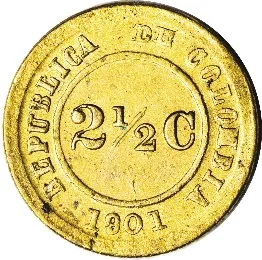
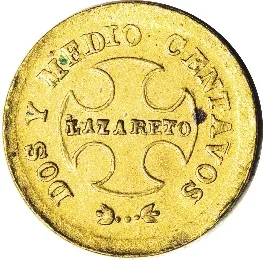
Colombia. 2½ sentavo for leprosori. 1901 ( en.numista.com )
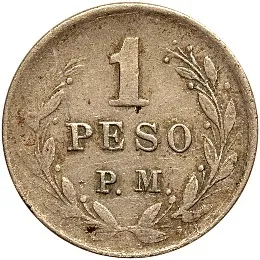
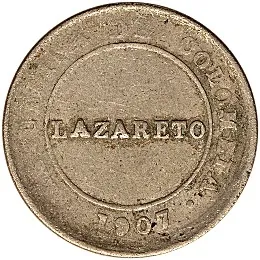
Colombia. 1 peso Papel Moneeda for leprosori. 1907 ( en.numista.com )
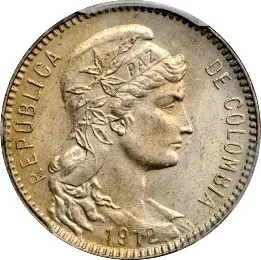
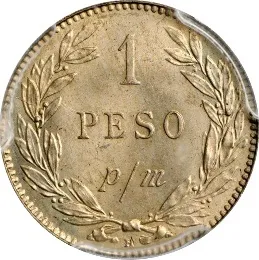
Colombia. 1 peso Papel MoneDa. 1912 ( en.numista.com )
In Japan, the first leprosoria appeared in 1909: the whole country was divided into five zones, in each of which appeared in a leprosoria. Judging by the articles of Wikipedia, the first to mint the leprosorius in Tokyo Tama Zensei-Een in 1919, but the Numista catalog dates back to 1926-1928; The tokens were one -sided, without inscriptions, except for the number of nominal value, but in a variety of forms; It was not possible to find their images on the Internet, and catalogs do not even lead to assessments of their value. Hieroglyph Taisyo (Taishō) in the Leproria Omim Seisyeen (ōshima seishō-en) allows them to be attributed to the years 1912-1926, these tokens were round. In 1927, a nationwide leprosory was organized on the island of Nagasima (Nagashima Aisei-EN), and now the samples of its minting can already be found. Two series were minted, bronze and aluminum, in both cases with varnish coating; The tokens were one -sided, only at the largest denomination 1 yen on the back there was a small stylized symbol of the hospital. Images of several more Japanese tokens are given in the old article [3] about the Philippine tokens (see below), but the quality of the photograph does not allow the distillery, except that the largest of them has the shape of a rectangle with a round opening.
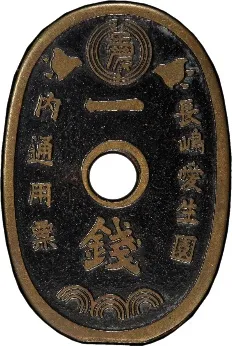
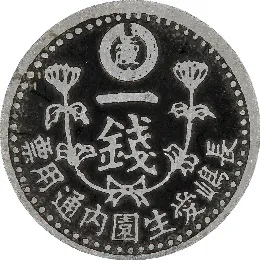
Japan, Nagasima Ayeen. 1 Sep. 1931-1948.
Left - bronze, on the right - aluminum ( en.numista.com )
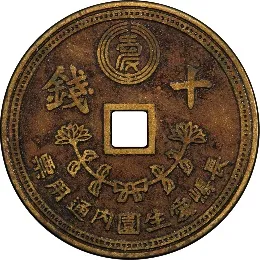
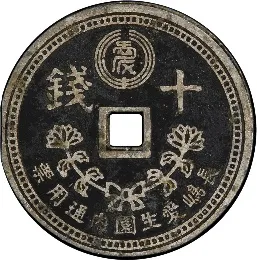
Japan, Nagasima Ayeen. 10 Sep. 1931-1948.
Left - bronze, on the right - aluminum ( en.numista.com )
1 Sep | 5 Sep | 10 Sep | 50 SE | 1 yen | |
Tama Zensyen | Br, o ° | Br, ○ ® | Br, ○ ® | Br, ○ ® | |
Osima Seisyeen* | Br, ○ | Br, ○ | Br, ○ | Br, ○ | |
Nagasima Iceen | Br, o ° Al, ○ | Br, ○ ® Al, ○ ® | Br, ○▫ Al, ○▫ | Br, ○ | Br, o |
Coins of the Japanese Leprozoriy. Br - bronze, al - aluminum, ○ - round coin, o - oval coin, ° - round hole, ▫ - square hole
* Tokens were also produced on Sep and 20 Sep


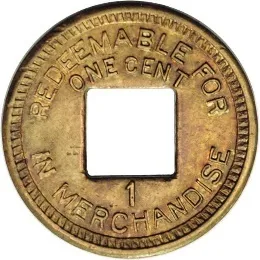
Let's get back to Latin America. The Leprosorius dry branch (Palo Seco) in the Panama Canal zone was founded in 1907. His tokens, released in 1919 and coincided in size with US coins of similar nominal nominal nominal monitors, are outwardly similar to Japanese because of square and round holes, but, apparently, the matter is still not in the general Chinese influence (where for more than two thousand years they used cast round coins with a square hole), and in convenience-the daughter of the cashier, who exchanged tokens for American money, She recalled: " Father told me that the lepers wore cords with a button at one end and a loop on the other, which they tapped in the holes in the coins, so that it was easier to handle them ." Two thousand one -center tokens were released and a thousand other nominal nominal. In 1952, the tokens were taken out of circulation and mainly destroyed on November 28, 1955. The stamps, which were minted, are in private collections: in one - a set of facials, in the other - on the back [ 2 ].
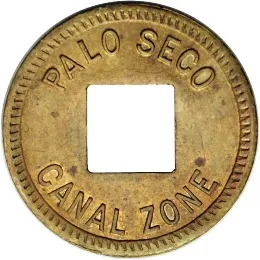
The area of the Panama Canal, the leperzory fell Seko. 1 cent ( en.numista.com )
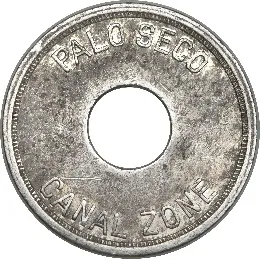
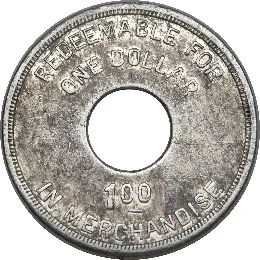
The area of the Panama Canal, the leperzory fell Seko. $ 1 ( en.numista.com )


In Venezuela, the tokens from 5 dumplings to 20 Bolivars were used in the Maracaibo Leprosorii (Maracaibo, 1913 and 1916), the White Coast (Cabo Blanco, 1936) and the Island of Providence (ISLA de La Providencia, 1939). Numista also mentions the Maracaibo toon of 1897 worth 1/4 of Real Madrid, but with the designation of the face value 1/16 (in incomprehensible units - if we count in Bolivars, then it should be 1/8; if in Peso, then 1/40 or 1/64). In the Venezuelan catalog numismatica.info.ve , generally speaking, more complete than Numista, there is no this token; It is not mentioned in a very complete report of the Saskatun Mint [ 4 ]. If it still exists, then seniority intercepts at the Colombian tokens.
At some point, due to frequent fakes, large nominal nominal nominal nominal values were replaced with paper money; The only date that I managed to find is February 1944 on Bon of 5 Bolivars. Bones differed only in the designation of the face value and color: the main drawing was the same. Bon’s front and backward sides were also the same; On the front they printed a series and number and signature of an official.


In Brazil, four leprosori had its own money, but now they are known only for two: the House of Mercy (Santa Casa de Misericordia 1920, from 100 to 5000 flights) and the colony of St. Teresa (Colonia Santa Teresa, 1940, from 100 to 1000 flights).
The colony for the quilted Kulion in the Philippines was founded in 1906, and it contained several series of cash tokens: from the early simple (issues of 1913, 1920, 1922) to real coins (1925 and 1927). At the same time, it turned out that aluminum, from which the first issues were minted, does not withstand the tropical climate in combination with the disinfectants who were treated with tokens, and since 1922 the tokens were minted from nickel or nickel bronze. In 1926, after long bureaucratic clarifications, the tokens were put into circulation in the San Lazaro Hospital in Manila. The financial auditors, which resisted this decision, were right - the aluminum tokens of 1 sentavo were similar to the size of ordinary coins of 5 sentavo and often fell into circulation: the metropolitan patients won four sentavos from each such coin, despite the strict rules (dated July 1, 1925), under the pain of a large fine, deliberating the walking of tokens and ordinary monks [3].
And during the Second World War, in 1942, the US military produced paper money printed on a typewriter for the colony; On the Internet you can find bons in 5 sentavo and 5 pesos.
Paper money was also produced for the settlement of Sunya Bulokh in Malaysia, the second largest leprosoria in the world. It was founded in 1930, and in 1935-1936 the Bones were released with a face value of 5 and 10 cents and $ 1 with inscriptions in four languages.


In Costa Rica and Thailand, ordinary but specially spoiled coins were used in the leprosoria: in Costa Rica in the coins, a large hole was drilled under the designation of the face value, and in Thailand the coin was flattened with shutters with the image of the cross on the one hand and the square on the other [ 5 ]. It is risky to collect such objects: on the one hand, they are rare, on the other hand, it is easy to make the most of the most ordinary coin. Simple tokens knocked out by punchs were used in the Garkid colony in Nigeria: one such with good projunence was sold at auction in 2016 for $ 350.


In China, plastic tokens are used (used?) In the Kinhu district, Tyasyan of the Province of Jiangsu, they were released in 1980 in five denominations: 1 hairdryer (lavender), 5 hairdryer (turquoise), 1 Jiao (dark blue), 5 jao (colorless), 1 yuan (colorless, painted with red).

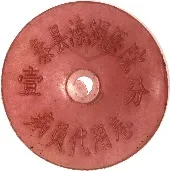
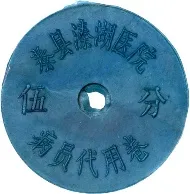
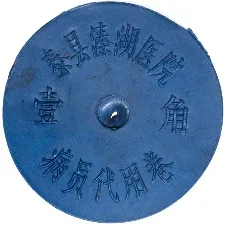
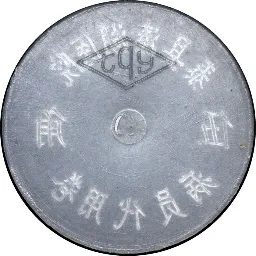
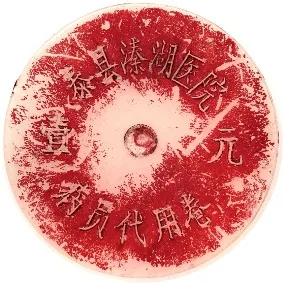
China, Qinhu Hospital. 1 Feng (l. P.), 5 hairdryer (p.), 1 Jiao (p.), 5 Jiao (Fr.), 1 Yuan (p.). 1980 ( Data.shouxi.com )
And finally, a mythical story is already completely. In the Leporia No. 11, on the Farm of the Guest of the Kherson province, at the end of the 19th century, triangular tokens were circulated with a face value of 14, 28 and 42 kopecks (1, 2 and 3 daily content of one patient), they realistically depicted a palm of the leper, respectively, with one, two and three remaining fingers. The text [ 7 ], in which this is described, makes the impression of artistic; whether it is based on real history, unclear; There are no other sources confirming this.
M. G.