
Translated material
Hero of Art Nouveau
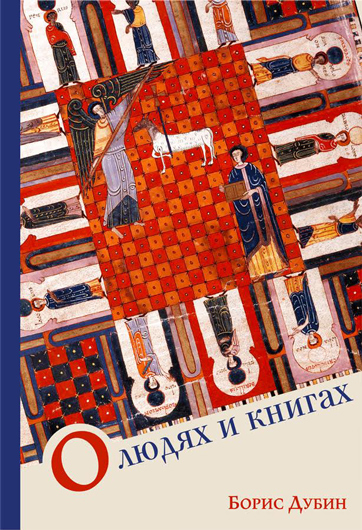
The book of Boris Dubin “On People and Books” contains his articles of different years about literature, as well as autobiographical texts, including published for the first time.
This volume of reasoning by Boris Dubin on a variety of topics unites one thing, and this one can be determined by the Latin proverb “Ex Ungue Leonem” . We recognize the lion by claws. The following essays, articles, performances and obituary are written by a tireless cultural worker who tinted for our good, dear reader. No need to be afraid of the Soviet shade of the phrase "cultural worker"; If we think about the simplest and most direct meaning, it will turn out that does not work “in the field of culture”, but an employee of culture, if by “culture” you understand not a set of books, visual images and sounds, but a community of people trying to reflect, speaking with a high syllable, looking for meanings with the help of words, images, notes. No matter how they try to turn the culture into a place of a pleasant vacation, which is not related to the so -called real life, will not work - at least as long as there are real cultural workers, such as Boris Dubin.
The trace of the Dubinsky hand, his unique intonation, a set of names, metaphors, and - especially - you find out in any of the texts that compiled this book. The real reader, by some chance, unfamiliar with the “main” texts of Boris Dubin, can guess the whole by these fragments, to identify a large creative-and even a day-item-a project for details either rejected or not useful or lost. And the one who already knows the club-cultural scientist, the dubus, the anti-soci-sociologist and, of course, the club-translator will undoubtedly be glad to supplement the overall picture with some important private individuals. Therefore, such a book is needed.
I will not retell the biography of Boris Vladimirovich here - in the first section of this meeting, he speaks about himself much better than anyone else - although I will return to the plot of his life a little later, but already in a sociological, or, or, vein. Dubin is a real sociologist: knowledge of society, his understanding was, if you like, his passion. Boris Dubin often repeated the same things about the Soviet and especially post -Soviet society, but he did it precisely because he was sure: this is exactly what he should say, this is precisely what is a reliable reflected knowledge, without which neither society does not understand, nor society does not understand himself. This is the civic position of Boris Dubin, no matter how the phrase “Civil position” now seemed to be Istered. By the way, this is one of the main Dubinsky topics: if we really consider something true, we should not be afraid of repetitions. Dubin was deeply alien to the capricious aesthetics, dismissing from simple-in Oreullein simple-truths: they say, tired, entertain me with something fresh, sharp, piquant. Boris Dubin did not entertain - but did not teach. He is an employee. He showed how what was arranged that he was interested in - and what, in his opinion, should be interesting to a decent person. Another, by the way,, as it were, the phrase that has lost significance. A decent person. A person whose consciousness is determined by the aesthetic and ethical order deliberately accepted values.
 © Publishing House of Ivan Lumbach
But more on that below. And now - about the first impression arising from reading this book; After all, it is very different from the rest of his books. “About people and books” - the name is very accurate: after all, people without books at the club will not meet and books without people - too. So, we really have a special case: that at first glance it may seem a weak place - compared to other, more “serious” and more “classical”, Dubin collections and research - this publication, in fact, makes it special, strengthening the main emotional impression of the texts of the club. If you use the expression of one Soviet humanitarian from the generation of "Pentecostals", is cultural luxury. The luxury is called something excessive, excessive - such was the thinking and cultural horizon of the club in the context of the dull late USSR and even more dull eighteen Putin years. In a sense, only the 1990s with their feverish, but genuine interest in perestroika opened in the big world could correspond to this cultural luxury. And it is also very important: Dubin did not paint for domestic simpletons, “as it is arranged in their culture,” he tried to plunge his reader into other cultures so that he understood that it was not “with them”, but “we have,” that the circle of topics does not fundamentally differ, there are only details, albeit very important. You can, of course, say on the move: they say, we are others, we are all curious, but no more, and in general, they would have our concerns. Then nothing will come of it. Actually, it did not work out. How were the “melodies and rhythms of a foreign stage” and “masters of foreign literature”, so they - albeit in a transformed form - in the same rank and remained: from Proust to Yanna, from Hammershy to Bargheld's Blixie. This is them, not us. So the cultural luxury, which is the texts of the club, is, as it were, good, even beautiful, but it is not for us by a symbolic pocket; We will admire it from afar, through the glass of the windows, and then we will go about our business, whistling the song of the Leningrad group. Boris Dubin put his life so that it was wrong.
Of course, cultural luxury. Being a little acquainted with modern English essays and criticism, I can say for sure: I haven’t met such an amazing horizons anywhere that would not be conditional erudite-factological character ( Google does everyone have, namely?), Namely, a deep understanding of a wide variety of cultural phenomena, revealed in various languages. And from non -ang -speaking, now living, I recall only Roberto Kalasso; Although, of course, he and Boris Dubin are very different authors, very much. It would be to complain here: they say, Kalasso has the status of a national classic, although in the postberlisconian Italy, more like a party at the beginning of the film “Great Beauty” than to the country of Italo Calvino and Umberto Eco (of course, I understand the convention of such a definition). But you should not complain. Firstly, it was always or almost always, there is nothing new here. Secondly, we must not complain and not indulge in sorrow, but act, work. What Boris Dubin did - although notes of hopeless regret slip in different texts.
Dubin wrote and spoke (and most importantly, he translated them!) About the authors of Polish, French, Mexican, Spanish, Portuguese, Argentinean, Cuban and even American, although he (under) He (under) Consciously circumvented Anglo -Saxon literature and humanitarian knowledge, left aside, with the rarest exceptions, T. S. Elit and, it seems, U. B. B. B. B. B. B. B. B. B. B. B. B. B. B. B. [1] . The gaping that literally opened at the place where Russia is in the landscape of the last two centuries is in the landscape of the last two centuries is surprising.
Not quite, of course, gaping: in fact, Dubin writes a lot about modern poets that are close to him (I think, more likely, somehow metaphysically than aesthetically, but I’m probably mistaken here), and about my senior colleagues (and just colleagues) of translators. The second is simply explained: this is not only a tribute to his colleagues in a difficult and usually nameless service of “mail horses”, but also an attempt to sociological analysis of the reasons for the amazing diversity of the fate of Soviet literary translators and editors. How did it happen that there were more talented people in the Soviet artistic translation than in Russian Soviet literature itself? The explanation - and quite simple - begs, but Dubin also avoids common places. He is interested in each individual case, which he, as it were, includes for the time being an invisible large picture. One of my main regrets is that I will never see Boris Dubin’s books about Soviet translation and translators taken in a sociological way. The lack of such a Duba book will be felt for a long time. We will understand little in Soviet and post -Soviet literature and culture (and in society, if we take its intellectual layer), not receiving a clear idea of how and why the mechanism of translating tens of thousands of books into Russian functioned, among which there are many complex, focused on our own language and reader, and sometimes simply hermetic. As a consolation, the section of this book will remain, entitled “He is about translation”, which includes not only interesting articles about the translations of Alyosha Prokopyev and (especially) Yuri Chaynikov, but also discussions about the craft in a sociocultural context.
So, modern Russian poets (from Victor Sosnora to Alexander Skidan) and translators into Russian. There is almost nothing more and nobody. Why? This is a really interesting question. And I risk offering two answers: one is superficial, but instantly seeming true, and the second is slow, somewhat dubious, requiring more thorough thought.
It is impossible to challenge what becomes obvious when reading this book: Dubin, who did not bear the “Soviet” at the level of aesthetic, emotional and civilian (seeing in the late USSR, the guarantee of the deepest social decline and even degradation) was even more acutely disappointed with the post -Soviet period of the history of Russia. The point is not even in the regime established at the very beginning of the 21st century. Primitivization of public opinion, atomization of society, cynic egoism instead of fruitful individualism and, most importantly, banalization, primitivization of culture. It seems to me that for Boris Dubin it was much more sensitive, more painful than any Brezhnev tropar, with whom everything is clear. Here, a club-sociologist and clubs-a cultural worker diverges. The first one perfectly understands that another result of Russian history after what happened in the 20th century is unlikely to be possible. He understands, so to speak, academically - and just common sense tells. But the club that “works of culture”, “makes culture” cannot relate to this with Olympic calm, and even more so satisfying: “Well, I warned ...” in some of these texts (and here “pure sociology” is not represented), he is simply indignant; However, contempt is more common, or energetic, then tired and tired. For example, here: “The price of such defaults and impealities was opened later, already in the 1990s. If we talk about ideas, the situation of permitted freedoms “from above” in the absence of any serious intellectual backlogs “from below” turned into scandalous and not yet ending to the current failure of the ideas and symbols of the modernization of Russia, even in their utterly simplified, “newspaper” liberal democratic presentation, and then-an increasingly clear increase in mass cynicism, and on the one hand, and on the one hand, and on the one equally more common fundamentalism, xenophobia, on the other (if these are two different sides!). ” Naturally, the interlocutor-essayist and the duin-culturologist are trying not to notice either the Soviet or the post-Soviet (almost do not notice-see above), it is not worth attention. Sometimes, however, he breaks into the invectives of unnamed authors and literary figures, in whom I guess - if I am not mistaken, of course - the most chassis, fashionable, adapted to the cynical taste of the post -Soviet education of the Moscow conceptualists. But this is silent about this.
The second explanation of Russia's absence in the Dubinsky cultural landscape is not so flat and more, if you like, theoretical. A hint of it is in the passage quoted above. We are talking about the failed “modernization”, which was so necessary, because in Russia “modern” did not take place at all, she, so to speak, missed it, and of her own free will. The reader will object: how is it that it was not “modern” in Russia? Can't be! And right, it cannot. First of all, the concepts of “modern”, understood not as a certain artistic style, but as a historical period, the concepts of “modernity” (“modernity”) are a lot-and the idea that as a result of backwardness and the Bolshevik-Stalinsky catastrophe “modernity” in the country did not happen, therefore it is urgent to catch up with those who occurred from whom it occurred, ridiculous. It is impossible to suspect that Boris Dubin did not understand this. For several decades, the Soviet period has been interpreted by some sociologists as one of the varieties of “multiple modernity”, just like the modernity characteristic of the (former) “third world”, from Singapore and India to China. And this is only one of a considerable number of theories. Dubin knew them, but almost specifically put himself under blow, claiming: “... the European“ modern ”of the XIX - the first half of the 20th century, the giant project of the worldview and self -understanding of the emergency classes of intellectuals, no more dependent on either the church or the yard. This one by no one separately, nor a group was concentrated in Europe on the anthropology of a “new” independent person, Homo Novus , an active and responsible individual who creates himself and the conditions of his life along with others, in this like it. Among other things, this project unfolded and realized in the form of aesthetically independent “modern” (Moderne) literature, as well as arts as a whole. Means and the price of such independence became the subject of new ethics again-from Kant and Fichte to existentialists. And one of the first, most deep and perspicacious, heralds of the era of Art Nouveau, the heroes of the new aesthetics and martyrs of the new ethics was Charles Baudler. ” I am not a specialist in the theory of modernity/modernities, because this statement will seem an exaggeration, but still I will say: I have never met such definitions of modernity. Modernity was determined through an industrial revolution, through colonial expansion and exploitation, through the formation of a new society with its possibility of mobilization, through the possibility of coexistence in one society of modernity and untreated, finally, through the same modernism in a culture, understood as late romance, and so on - many options. But Boris Dubin is completely different. Modernity has an undoubtedly positive connotation, because this is a project:
- intellectual;
-In a sense, ethical;
- Individualist and liberal.
At the same time - and this is important to note before some hasten to accuse the club of complacency [2] and pink liberalism - all this, simply put, does not bring happiness. Neither Bodler, nor Benjamin, nor the existentialists enjoy life because they suddenly became “modern”, “modern”, more precisely, because they, according to Dubin, created modernity. It was created, since modern in this system is the phenomenon of culture, they do it and live in it, doing it.
So, Modern, according to Boris Dubin, is not a utopia implemented in the “beautiful West”: this is a complex type of thinking, dramatic, even tragic, but inevitable, without it, culture, society cannot become modern - that is, adults (the latter I added, of course, from myself). Boris Dubin refers to the cheerful plastic cynicism of the post-Soviet 1990s-as an inappropriate in the decisive time for the country and society, the time of infantilism, once cute, but now becoming disgusting and dangerous. Expressing this attitude, he really fulfilled a civic duty - in his own understanding.
But to express a little attitude. A cultural worker should not express a relationship, but to do the job, as the heroes of Russian classics said. And Dubin did. In particular, he tried to show the reader of a non -core country as Modern was not the most suitable place for this. I think it is here - the unraveling of the sample that Boris Dubin made for himself in the cultural geography of the globe.
As I said, he was interested, first of all, the province. I’m not sure that Boris Dubin was familiar with the remarkable classification of cultural non-metropolis, invented by the French essay and philologist Louis Martinez: “Province, outback, ghetto”. I think he would like her. In Soviet times, he and the intellectuals like him (not intellectuals; we note, the Dubin himself in autobiographical texts resolutely rejects his belonging to this social group) were in the unconditional cultural ghetto. The post -Soviet Russia, according to his conviction, became cultural outcome. There is only one way out: to realize oneself as a province of Europe, an important, but another province of high Western culture.
I will warn you right away: in the word "province" in this case there is nothing derogatory. In the view of Boris Dubin-albeit to someone and seeming somewhat naive and too enthusiastic [3] -Modern was a kind of Roman empire with its blooming and different provinces associated with logistics and logic. The Roman Empire, but without Rome. The latter circumstance is very important. All modern is provincial, even French. Paris is a frame for modernists from different parts of the country and Europe (or even peace), it gives them a shelter, communication - sit in a cafe, write, argue, end with you, but there is no Paris as the capital of modernity without its “provincial” contents. Особенно если учесть потерю в XX веке французским языком универсального статуса, роли новой культурной латыни. Сегодня все, что не англоязычно, провинциально. Дубин увидел в этом не оскорбление, а возможность — и предложил русской культуре эту возможность использовать, показывая, как это делали/делают другие.
В мире Бориса Дубина разновидностей «провинции» было две — он посвятил значительную часть жизни тому, чтобы русский читатель прожил их обе. Это Восточная и Центральная Европа — и Латинская Америка. Чеслав Милош — и Хорхе Луис Борхес. Бруно Шульц — и Октавио Пас. Эмиль Чоран — и Лесама Лима [4] . Авторы, превратившие свою провинцию и свою яркую провинциальность, которой они иногда стыдились, иногда ненавидели, в неиссякаемый источник сырья для персональной фабрики по производству мироощущения модерна — и соответствующих этому мироощущению текстов. Делали это, конечно, по-разному, причем география сыграла очень важную роль в этом. Восточная-Центральная Европа — как бы периферия «настоящей» Европы (с высокомерной, скрыто ксенофобской точки зрения британского или французского обывателя). Латинская Америка — как бы экзотическая ухудшенная копия Европы. Это стереотипы, их можно проклясть, с ними можно играть — или даже ими торговать. Так обычно и делают. Но лучшие — истинные модернисты — создают из этой смеси собственную реальность, настолько мощную, что слова «провинция» или «метрополия» к ней уже неприменимы. Оставаясь провинциальными, эти модернисты становятся универсальными культурными героями. Этого Борис Дубин ждал от постсоветской русской литературы; и, как мы знаем, не дождался.
And the last. С социологической точки зрения жизнь Бориса Дубина оказалась историей принципиального не-интеллигента, настоящего рабочего, мастерового, работника культуры, который, находясь в стороне от интеллигентской повестки, в силу исторических обстоятельств стал в какой-то момент любимцем столичной интеллигенции. Why? Потому что она увидела в нем то качество, которым вчуже восхищается, но которого в ее природе нет. Это качество — умение делать культуру, совершенно не интересуясь, что об этом думает (точнее — может подумать) очередной начальник. Качество — быть истинным модернистом, чья интеллектуальная страсть оттиснута на каждой странице книги, которую ты, читатель, держишь перед собой.
[1] О причинах этого вежливого избегания можно сказать многое. Думаю, это как-то связано с особым пристрастием Дубина к «провинции», которую он находил гораздо более плодотворной, нежели культурная метрополия, за одним важным исключением — Франция. Но и здесь его герои — то румынские эмигранты, то поэты, навсегда сбежавшие из Парижа в пусть и французскую, но все же провинцию. А любимый Дубиным Жакоте — и вовсе швейцарец, провинциал в кубе. Опять-таки чуть ниже постараюсь развить эту тему.
[2] А недоброжелатели обвинят и в нелюбви к русской культуре: ведь здесь модерн был — и еще какой, от символизма до Бродского, если только о литературе говорить. Все так, но Борис Дубин видел в этой разновидности модерна слишком сильные немодерные и даже антимодерные черты. Да, наверное, он их абсолютизировал. Why? Выше я попытался ответить на этот вопрос.
[3] Но наивность, дающая энергию заблуждения, все-таки лучше квиетического коррозийного цинизма, не так ли? Без наивности Руссо, Канта и Беньямина мы не были бы теми, кем являемся. Даже Бодлер представлял собой странную смесь наивного энтузиазма с наивным же цинизмом.
[4] Ну и, конечно, странным образом объединивший — чисто географически — эти варианты Гомбрович.