
Translated material
Hollow people
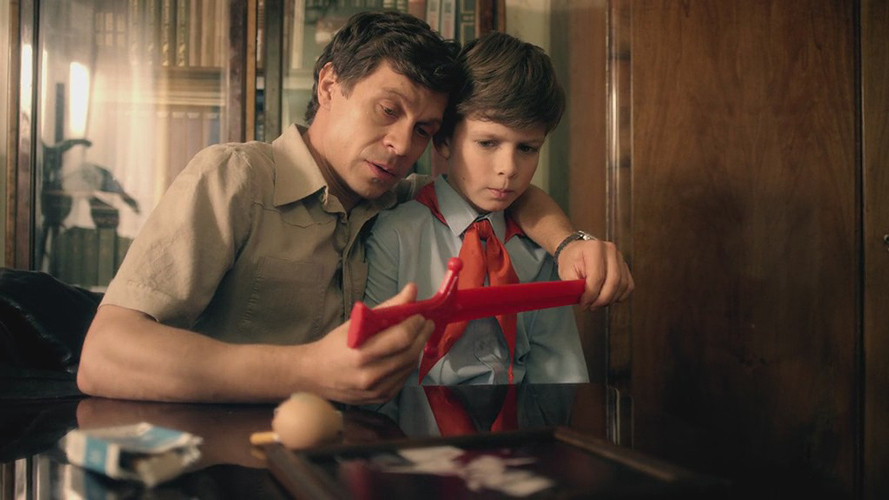
In a recent conversation on Colta.ru, Yuri Saprykina and Ilya Oskolkov-Censer was talking about the “painful, slow process of self-awareness” that is happening in the country now. Of course, it is impossible without clarifying relations with the past, and this issue is included in the new sharp phase now, a year before the 100th anniversary of the October Revolution.
Historical memory is the space of conscious and unconscious deficits, rewritten narratives, the struggle of different forces for this past. Today on colta.ru - two texts that look at these processes from completely different positions, but make similar diagnoses. This is the column of Andrei Arkhangelsky and the text of Alexei Tsvetkov Jr ..
The new film by Nikolai Khomerika “The Icebreaker” is a production drama, the film is based on real events. On March 15, 1985, the icebreaker Mikhail Somov was clamped by ice near the Antarctica coast, the sailors spent a third of the year in an ice captivity.
Recall that the country was just headed by Mikhail Gorbachev, but the crew in the film (a hundred people; there is a radio communications with large land), as if he does not even know that the Secretary General had changed in the country; Or they do not care that this topic has never been discussed during all screen 133 days. According to the authors, they, apparently, are "uninteresting." This might seem like a trifle and nit -picking if this fact had not coincided with a general trend, namely: restructuring for Russian cinema has become an unspoken taboo today.
“Misha Soloviev is returning! By incredible movement in time and space, the hero falls back in our time. But he soon understands that he was mistaken - he is in the USSR, in which there was no perestroika. Now he is forced to work as a simple district police officer. To interfere with him, as usual, will be a maniac Pavlov ” - the annotation of the second season of the series“ The Reverse Side of the Moon ”impatiently expresses the hidden dream of the current ideologists:“ There was no restructuring. ”
Pouring rain and half-drunk, drunk Yeltsin, everyone drinks and dance on the tables-the 90s appear like that. “There was a mess” - that’s all you need to know.
Mass culture is the means of “soft control”, in the expression of Marcuse (besides, the mass culture in Russia is largely controlled by the state), and the cinema and series form consciousness. In our case, what is even more important - they speak about the plans of Russian ideology, which, as we know, is not consistently formulated and not stated, and often we can guess it, only as Heidegger Genesis, in varnishes and reservations. And on the TV screens dozens of series about the 1930s-1970s. But the life of the country seems to break off as soon as it worships until 1985. And everything would be fine, it would be possible to explain anything about the restructuring, why? If not for one small problem: then for some reason the USSR broke up. This is no longer going to hide; what to do?
You can, for example, so. “In the early 1990s, time stopped, there was nothing, there was, there was no, and then the 2000s came.” Or like this: "In 1991, the aliens attacked us and selected the USSR." The 18-year-old viewer is even more understandable: darkness opened, Harry Potter came out at the wrong station.
And this is not a stalk, since about the nineties in today's Russian cinema and on TV you need to tell you so that again it seems that nothing interesting happened. The original solution was found in the series "Wonderworker" (2014) - based on the confrontation of the Chumak and Kashpirovsky. There, these ten to fifteen years are literally compressed into a “indistinguishable one”, waterproof, dirty lump, a dull bazaar, where everyone sells rags. Color is also important, and the 80s and 90s are necessarily in Sepia, in gray or in h/b, to emphasize the overall decay. In the adaptation of "Homeland" , the series "Homeland" (2015), the nineties are again deprived of bindings to all sorts of details; This is literally nothing , empty time, they should not be named by name. “There was a mess” - that’s all you need to know. Spring rain and half-drunk, drunk Yeltsin, everyone drinks and dance on the tables-such 90s appear in the scenes of fluffs in different series, if they are at least somehow present there.
The concepts of perestroika and nineties, their interpretation in mass culture and ideology over the past decade has experienced three stages. First: the recent past, “Yesterday” (1985-1991), was obscured by a huge carcass “The day before yesterday” (1930-1970). The second: the Soviet one was connected with an even more total “tsarist” time and “Russia”, leaving less and less space: 15 years against the background of the millennium are perceived as a second, as a “mistake of history”, a deviation from a thousand -year course. Finally, now the third stage: restructuring and nineties are completely removed from mass consciousness. Does it seem fantastic? Not at all.
Why is this done? In order not to "injure people who have not benefited anything from freedom." For reconciliation. In order not to quarrel once again. Do not disturb. Do not rock it. And because the story (the one in which there is only greatness) has become the moral basis of the current state correctness. And also because the current tasks of the authorities are exactly the opposite of the goals of the goals of perestroika and the nineties.
1985 and 1991 - the same basic myths for Russia as the Frenchman is a great French revolution or an American Declaration of Independence.
The huge propaganda apparatus is abandoned to fight with recent historical memory, but restructuring and nineties anyway, like the immortal maniac Pavlov, pop up from darkness and remind of themselves: the very fact of our existence.
Having broken up, the USSR finally gave us a new system of values (it usually happens). Because today we live according to economic and even political laws laid down precisely in the 1980s, and then in the 1990s.
The first achievements of perestroika are symbolic: freedom. And then the release of brains in six years (in total!), From 1985 to 1991, inexplicable, partly even miraculously led society to fundamentally new economic relations, market; Ethics gave rise to the economy. Even a fierce struggle with the “wrong past” cannot cancel the main acquisitions of the 1980s-1990s, for example, this is a sense of property: “mine”, “my own”, “Meminity”, paraphrasing the philosophical term. The changes that happened to us then more fundamental than the result of all the Putin years together, the most important thing happened there. 1985 and 1991-the same basic myths as the Frenchman is a great French revolution or an American Declaration of Independence.
If you take away your memory of the main thing that happens? First of all, this leads to the rejection of historical subjectivity. Since the hole is now gaping in the place of the heated 1985-1991, it suggests that we did not make history ourselves, but someone for us (and at the same time gives rise to the thought that now everything will decide for us). Although, in fact, perestroika was done by “we”, our parents. A considerable part of those who are now the famous 86%voted at the referenda and went to rallies, and yes, many are not for freedom, but for sausage and jeans. But this is all "we."
Or here the TV inspires that we live in the reincarnation of the USSR. But take a conditional middle class. Having owned several apartments, cars and a cottage, which a person could not dream of in any 1984, receiving a salary of a thousand dollars, using the innumerable number of services and services, such a person wakes up in the morning and says: how good it was, mother, under socialism! Everything was with us, he bitterly laments, and some sickle and hammer hangs in his workplace. But, going out into the street, at every step is convinced of the opposite: the world lives and exists according to the laws of capitalism. Mass exclamation "Unjust!" - Allegedly, the reflection of the world trend - in Russia is caused by completely different reasons: this is a reaction to the bifurcation of consciousness. From morning to evening, they inspire a person that we are getting closer to the USSR, and then he receives accounts for an apartment, light and gas, as it were, from another country. If a person was explained that the “injustice” was laid down in the very essence of the socio-economic model called “capitalism”, but it gives advantages to the one who has learned to live in this model, then, perhaps, there would be fewer unrest. The reason for the disappointment-they say one thing, but they live differently, and not that "the liberal project failed."
The post -Soviet man has simply emptiness inside, and it is the worse and even more frighter, the more it is.
An even more radical result: the same person begins to dream of a war as purification. But this is explained by the replacement of the fundamental in the past. A person feels an inexplicable loss for him. In an effort to cope with her, he wants a radical, extreme action, zeroing, in order to finally come to clarity. Aggression is taken from the crowded out questions: who am I, where I live? For 25-30 years, the post-Soviet man did not connect the cause and investigation in his mind, did not perform an elementary logical operation: everything that he now has is a consequence of what happened to the country in 1985 and 1991.
And this refusal is universal. The next year, the anniversary of the October Revolution, and instead of thinking about the causes of the revolution, everything again comes down to aesthetization, to the dancing around the BES, to discuss what they wore and at that year, a game of Facebook and Twitter of 1917 is arranged. But if you seriously deal with 1917, we will have to talk about adult things, for example, about violence.
Or 1937: And what, in fact, happened then? The state’s violence against man won, and the history of the great -grandfather, which Denis Karagodin excavated, was a reminder of this. But society is unlocked by all means; No, no, let's forget it better, so it will be more true. Forget is the main medicine in Russia, only it treats symptoms, not the disease itself.
Paul Riker wrote about the culture of oblivion, but conscious, after the person remembered and comprehended everything. And this is a huge difference: to forget, understanding, or forget without understanding. You can really forget only what you survived; And the fact that it is not decided internally does not get out of my head . The crowding out of the memory or fake of this memory of 1917 or 1937, 1985 or 1991 does not cause symbolic, but concrete damage to our consciousness. It remains hollow all the time. As stated in a famous joke, "there are just dreams." The post -Soviet man has simply emptiness inside, and it is the worse and even more frighter, the more it is.