
Translated material
Serdyukov gave slack
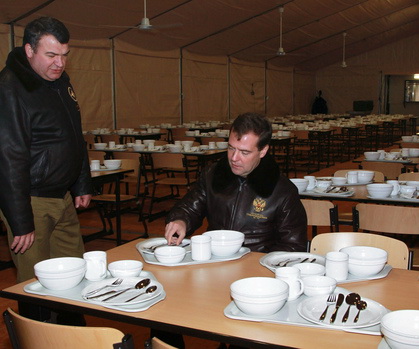
The Minister of Defense Anatoly Serdyukov made a sensation the other day, saying after the president’s meeting about his intention to increase the number of officers of the Armed Forces by 70 thousand people. The explanation of the head of the military department, which boiled down to the fact that such a large-scale increase in the officer corps is caused by the intention to create a system of aerospace defense, does not withstand any criticism. This system will be created on the basis of existing parts and air defense compounds and a missile attack warning system. New formations, of course, can be formed, but only on the basis of new military equipment, which, alas, enters the armed forces in very modest volumes. 70 thousand posts here cannot be created.
Military reform in Russia, it seems, approached the next turning point. It began two years ago with Anatoly Serdyukov’s sensational statement about the intention to reduce the number of officers in the Armed Forces from 355 thousand to 150 thousand. This was due to the desire to eliminate a huge number of parts and uniform formations (the number of joints of the ground forces should have been reduced by 11 times).
Until the very last moment, the military department harshly (and sometimes mercilessly) realized this plan, which had a significant attitude to ensuring the country's defense. Russia abandoned the concept of the mass mobilization army. After all, parts of the incomplete composition should have been accepted by reservists, and the officers, unnecessary in the peacetime army, had to command the mobilized regiments and divisions. It is clear that such large -scale abbreviations could not but cause fierce resistance. But Anatoly Serdyukov, with worthy respect for perseverance, was reduced, ignoring the cries of the destruction of the glorious officer corps of the country (which, I note in brackets, has not existed for a very long time). Fighting an overabundance of officers, the Ministry of Defense went to suspend the reception to military schools. At the same time, several thousand lieutenants either immediately at the end of the school were dismissed, or received appointments to sergeant posts.
And suddenly the head of the military department arrived at the back. Suddenly it turned out that the officers were not at all an excess, but a lack. It was worth painfully reducing the armed forces by 200 thousand officer posts in order to immediately introduce new 70 thousand! One cannot disagree with one prominent military expert who called all this a manifestation of bossy hysteria.
There may be several reasons. The most obvious is the inability of the state to fulfill obligations to the dismissed officers. In the middle of last year, information appeared that at present there are just 70 thousand officers behind the state. These are those who have not found posts in the army of a “new appearance”. But it is also impossible to dismiss them either - the state has no apartments that these officers should receive when resigning. In the fall, another figure was announced - behind the state, they say, only 40 thousand officers. However, it is impossible to check how many officers are actually behind the state: what figure the Ministry of Defense officials will want to name, they will name this. It can be assumed that, having realized his inability to pay with future retirees, the military department decided to simply include them in the States.
Another possible reason is that the staffing positions of officers were reduced, hoping to fill them with trained sergeants and civil servants. However, the salary established by civil workers - lawyers, financiers, doctors - turned out to be not too attractive for qualified specialists. The training programs for sergeants also fail. Training centers simply do not have time to produce as many junior commanders as the armed forces need - they are required at least 100 thousand. Take them from nowhere. So they decided to use officers again to perform sergeants' functions in combat units, rear staff, and service personnel. If so, then this is a serious blow to reform. Because the officer ceases to be the elite of the armed forces, again turns into a younger performer.
Finally, the worst option. The generals convinced the president, and most importantly, the premiere of the fact that combat readiness can be found by returning to the old mobilization model. This is the final end to the reforms. If so, in 2012, after the presidential election, the term of military service will inevitably increase. And everything will return to his circles.
Whatever the reason for the concession made by Serdyukov, she will have the most sad consequences. For the time being, the high -ranking opponents of the minister stopped the fact that Medvedev and Putin unequivocally demonstrated the support of the minister. And now those who hates Serdyukov can decide that he lost this support. They will at least triple their attacks on reforms. In the worst case, this is the first step towards the coagulation of reforms.