
Translated material
Corruption - 3. Detached

I ended the previous article on the fact that we need to agree on determining corruption. The impatient reader will say: “What to discuss there!? And so everything is clear! Corruption - it is corruption. You better tell us: who to shoot at and from what weapons. ” So: I will not only talk about the definition, but I will stretch this “chatter” for a couple of articles.
Here we must understand that there are definitions and definitions. I will not discuss numerous definitions that determine one evil through another. Well, it seems: "Corruption is the abuse of official powers, which ...". There are many such definitions, and they are equally useless. Below, when I need to refer to this stream, I will quote the initial part of the following definitions: “Corruption is evil ...”. I will try to give a definition of a different sense that will be useful because it will make many consequences from it. Some of them will clarify the nature of corruption, others will lead to ideas of possible methods for limiting corruption. It is necessary to come to terms with the fact that such a definition is somewhat more complicated, and therefore I will be forced to talk about it in detail so that it becomes clear and turns into a tool of your own thoughts. From here - two articles. One is about the definition itself, the second is about the consequences of it. Corruption is a very complex social phenomenon, and therefore its understanding cannot be exhausted in one definition. Therefore, the discussion of the nature of corruption will not end there, we will return to this and with further presentation.
To be precise, the definition that I intends to propose now describes not so much corruption “in general” as corruption behavior . This definition arose within the framework of the theoretical model of some social relations, which was developed in the institutional economy and economic sociology, and in practice it was actively used in the analysis of the work of firms. It is called the principal-agent model , often abbreviated-an agent model.
The first character of this model is the principal . If you translate this term from the language of scientific into the language of the household, then this is very simple: the boss (master, boss, etc.). The principal characterizes two key properties. The first is the presence of some resources, the second is the presence of some tasks or goals, which in this case is equivalent. The principal wants to use its resources to solve its problems.
Consider, for example, an ordinary merchant. Its resources are the goods to which it has, retail premises, and the task is to sell this product, if possible, with a more profit for itself. Another example: the head of the department, for example, is the Minister of the Interior. Its resources are, firstly, power, and secondly, budget funds that are released for the functioning of its ministry. And the tasks are facing him. There are tasks set for him by someone else, until we discuss whom: well, for example, security in the country (this task can be considered as external). He may have internal tasks: well, for example, ensuring the effective functioning of the ministry and so on. They can be crushed for subtasks: selection of personnel, road safety, increasing the disclosure of crimes, etc. That is, it can be a fairly wide set of tasks.
But the principal has another, extremely important, property: the principal, as a rule, is not able to independently dispose of all its resources to solve all its problems. For example, it is impossible for us to imagine that the Minister of Internal Affairs alone solve the problems of ensuring security in the country. And the same merchant who has a product who wants to sell it also often does not act alone. He hires clerks to whom he transferred part of his goods. And he sets them the task of selling goods at prices that this merchant considers profitable.
So, the principal in order to solve its problems turns to another character. This character in our model is called " Agent ". Again, we will deal with the translation from the scientific language to the ordinary: if in the ordinary language we called the principal the boss, then the agent is reasonably called subordinates.
What are the relationship between the principal and the agent? Firstly, the principal transfers part of its resources to the agent. Well, for example, the Minister of Internal Affairs may transfer part of his authority to the deputy, who is responsible for safety on the roads. At the same time, he can transfer part of the budget resources to him. The second that the principal does is he sets the agent's task. In the previous example, the Minister of Internal Affairs says to his deputy: “So. Your task is to ensure safety on the roads, other deputies will deal with other problems. ” And, finally, the principal appoints a reward to the agent: the principal spends part of its resources on thanking the agent and stimulating it. There is also feedback in these relations: the agent must inform the principal about how he solves the tasks set before him, the agent, and how he uses the resources that the principal transferred to the agent for this. Schematically, these relations between the principal and the agent are presented in Figure 1.
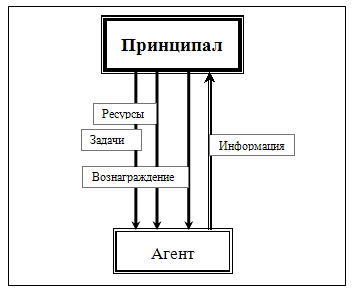
Figure 1. The core of the principal-agent model
We saw the core of the principal-agent model, its main part (we will then expand it a little later). But, already having this core, this minimum part of the model, we can discuss some of its fundamental, extremely important, have serious consequences of properties. The most significant is the imperfection of the principal-agent relations that can be analyzed within the framework of the model.
The first key, most important property of the agent model, and therefore the principal-agent relations as such are the so-called asymmetry of information .
Consider the usual everyday example to us. You live in an apartment, the owner of which, for example, are. All that is located inside the apartment is your resource. We add to this such a resource such as money, salary, income. Among the tasks that are facing you - maintaining this apartment in order. Now imagine that you have a gutted tank in the toilet. You are the task of eliminating this defect. But you are not a specialist in plumbing. Or maybe you are, but you work simultaneously in some large company and, of course, earn frantic money. And you perfectly understand that the hour you spend on the repair of the tank is much more profitable for you to spend on work. It is simply more profitable for you to hire plumbing. So, a plumber comes to you and delves into the bowels of your tank.
What happened? You entered with a plumber in principle-agent relations. Firstly, you transferred part of your powers to him: you temporarily transferred the right to dispose of the tank belonging to you in the toilet. Secondly, you set the task for him: bring the tank to normal. Both sides imply that this will not happen free of charge, but for some reward. Finally, he must inform you what happened to your tank, what he did, how much it costs and what happened as a result of the repair.
Further, the situation develops as follows. You are sitting in your office and working, and the locksmith is in the toilet and repair your tank. Therefore, he knows what happened to the tank, but you do not know. In addition, he as a professional knows how to bring the tank to normal, but you do not know. He, as a professional, knows how much spare parts cost, whether they are in stores, whether he has them in a suitcase, but you do not know. In short, we observe in this example the constant fundamental property of the principal-agent relations: you, as a principal, do not know all the details of the agent’s operation that you set before him. In this case, of course, the plumber knows everything about the tank and what is happening to him, but you do not know.
What often arises in this situation? After some time, let's say, after an hour, having tightened the time to emphasize the severity of the disease of the tank, the plumber comes to you and says: “Master, the situation is very difficult. So, there is such, which means, a fig, eight by twelve, which determines completely the life of the tank. This is a very rare spare part; In the store, it is practically not to find it. But you were lucky, I accidentally left me, I saved it for myself. But for you, so be it, I can sacrifice. "
Everything becomes clear to you: of course, you need to pay. And you, of course, pay him. Of course, you have the opportunity not to believe him, go to the store and check if this fig is sold there; Buy it yourself, bring home and call plumbing again. But you decide that it is cheaper to pay him, and let him fix this tank, and thereby you go to additional costs. And this happens only because there is this very asymmetry of information: you, the principal, do not know everything about the task, but he, the agent - knows.
Such an agent’s behavior, when he, relying on the asymmetry of information, uses the resources provided by the principal not in order to optimally solve the task set before him, but for personal purposes, is called “ opportunistic behavior ”.
But the asymmetry of information is far from the only defect in the principal-agent relations. Let's look at others.
First, the principal may incorrectly choose an agent to solve the problem. For example, you need to repair a tank, and you invited a royal specialist, simply because he is your friend and asked to work out - these are your personal problems. And if for a great reward he agrees to repaire a tank, then the result of this work and costs related to this (he nevers what he will do there) are your problems: you were mistaken in the selection of an agent.
Further, you could inadequately transfer the resource to him. Moreover, it can be different here. Suppose you transfer power from top to bottom, as it happens in power hierarchies - bureaucratic and political. You can give too many powers, and this can lead to negative consequences: an excess of powers gives rise to a temptation to use this. You can transfer too few powers, and then the agent will not be able to solve the problem set before him. You can simply transfer the wrong powers: you can, for example, where money needs, give power, and where power is needed, give money. So, these may be powers that are not adequate to the task. And this will happen through your fault.
Further, you can inadequately appoint a reward. It can be too big, and then you carry unjustified additional costs. But you can pay too little, and this will push the agent to opportunistic behavior.
Further, the principal can inadequately formulate the task of the agent, and this happens very often. For example, the entire Soviet economy, not being market, was constantly in search of the correct task to its agents. In a centralized economy, economic tasks descend, as in a bureaucratic vertical, from top to bottom. And problems arise from this. For example, planned tasks usually distorted the functioning of economics agents and did not stimulate its development.
Finally, the last type of agency costs is an illiterate use by the principal of information that he receives from the agent. The agent can send him adequate information, but the principal may not use it, or may make independent efforts to distort it. Traditional example: Freedom of the media. For normal, not bad power, free media is a feedback channel that can be used in order to understand what is happening with the country. So, if this channel does not know how to use the authorities, then it itself increases the costs of its management. It does not use the opportunity to compensate for the effect of asymmetry of information.
So, the overall conclusion can be formulated like this. In nature, there are no ideal social institutions, ideal social relations, they all suffer from certain defects, just like ideal people, ideal animals or plants, ideal mechanisms do not exist. Relations “Principal is an agent”, or the relationship “boss - subordinate”, is also not always perfect, and there are always costs in the relationship between the principal and the agent, which can be called the costs of management. Costs are additional losses that the principal carries in solving its managerial problems. There are two types of costs (or losses): losses associated with opportunistic behavior stimulated by the asymmetry of information, and the costs associated with the imperfection of the principal, also creating conditions for opportunistic behavior.
And now I am ready to define corruption behavior:
Corruption behavior is a kind of agent’s opportunistic behavior, in which the latter uses the resources transferred to him by the principal not to solve the problems of the principal, but to solve his own problems.
So, the agent changes the tasks of the principal; So, the first side of corruption is betrayal; The agent uses the resources of the principal not to solve its problems, but to solve his own problems, that is, he steals the resources of the principal. So, corruption is always the betrayal of the principal and the theft of its resources.
Enough. We will continue in the next article in which we will try to understand, but what follows from such a definition.
To be continued
Author - President of the Indem Foundation