
Translated material
"12" as Apology of Putin
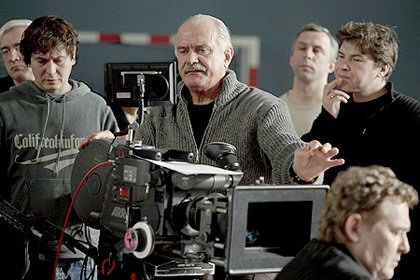
I don’t know why the members of the Russian Academy of the Russian Selective Committee of the Oscar decided that Nikita Mikhalkov’s new film is worthy to represent our country at the most prestigious world film contest. It always seemed to me that the Academy Award was awarded for works of art. And Mikhalkov’s film “12” is the work is not first of all artistic. The main thing in it is the ideological message, the meaning of which is still the same apology Putin and its regime, much more frankly revealed in the called documentary “55” for the President’s birthday. The difference between these two films is that the first film was shot by Mikhalkov-director, who, being a talented person, even in such an ideological picture has not lost professional skills. Which in itself is much worse and worse, for the audience effect from this “product” is much stronger than the effect of the frankly hacking film “55”, mounted in a habitat and turning away with his deceit and lysolence.
“This is a film for everyone and about everyone” - says an advertising slogan calling for a new movie by Nikita Mikhalkov. This is an application for a movie, which, according to the author, was supposed to become a public event. It should have become, but it did not. Why?
At first glance, the idea of the film is simple. 12 jury, representing different layers of Russian society, are going to decide the fate of the Chechen teenager accused of killing his adoptive father - a Russian officer. It seems to be a film about the jury and about the Chechen war, about the attitude of society towards this war. But in fact, the whole entourage is a trick. The film is not about the jury. And not about Chechnya. The film about Putin and about his mode. I'll try to explain.
Chechen scenes, probably reconstructing the First Chechen War of 1994-1996, leave the viewer a vague sensation. Here we see formidable Wahhabis, one of which gives the Chechen guy his knife. He begins to selflessly dance the national dance. He is stopped by a checker who does not support the separatists, for which he receives a condemning remark from one of them, such as "a man is not a man to sit under his wife under his skirt." Then the father-checer, along with the beauty-hay, is killed. The boy is left alone and hides in a bombing house, with difficulty freeing himself a place next to the corpses of the dead Chechens. Here he finds the Savior - a Russian officer who brings the boy to Moscow.
Who killed his parents “Chechen” (as the heroes of the film call him)?
According to Mikhalkov, it turns out that they were killed by the Wahhabis. In general, the feeling is that the whole Chechen war was a civil war, on which the Chechens fought among themselves, and the saviors of the civilian population were Russian soldiers and officers.
And now the war is over. The jury considers the murder case. The young Chechen is accused of that the same knife, once donated to him by the Wahhabis, killed his adoptive father-that same Russian officer. Mikhalkov, his directorial will, changes the Criminal Procedure Code of Russia. In his film, the jury verdict about the guilt or innocence of the defendant should be unanimous. So as this happens in American legal proceedings. In Russia, for the acquittal of the verdict, six votes are enough for the innocence of the defendant. The accusatory verdict is issued if the majority of jury are expressed for the convict’s convict.
But what are such trifles for Mikhalkov? After all, the whole story with the murder of the foster father of the Chechen boy is just an occasion to talk about the “main”.
Therefore, the jury is composed of stilt characters, in which people-functions are easily recognized, designed to remind the viewer of the problems of Russian society. There is a Jew, a Caucasian, anti-Semite and xenophobe, a suffering intellectual, a meaningless democrat, a pontal rich producer, a decuting bandit-director of the cemetery, Ukrainian, as a representative of the former USSR, etc. All of them, by the will of fate, turned out to be jury, are eager to lose this duties as soon as possible, but in the heat of disputes they suddenly begin to confess to each other.
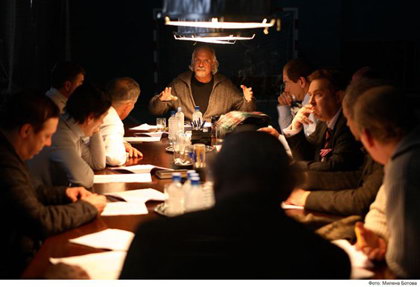
The foreman of the jury Mikhalkov throughout the film silently watches them without interfering in their fierce disputes. And closer to the end, when the jury change his indictment to the acquittal, he, like a sort of judge-arbitration or as a god-father, puts his subjects before a serious life choice. He invites them not only to bear the acquittal, but to follow the fate of the justified Chechen boy, who, after liberation from custody, threatens a mortal danger.
The character of Mikhalkov is sure that the real killers of the officer were bandits who wanted to assign a house where the foster father of the Chechen young man did not want to leave where. And now they will probably want to get rid of the Chechenenka.
Wanting to convince the jury of his innocence, the foreman finally admits that he is not an artist, but an officer of one of the Russian special services. And in the jury is not a beginner. He offers the heroes of the film to unite and fight together against what prevents Russian society - against civil passivity, indifference, corruption. And when all eleven jury cowardly refuse, referring to his personal affairs and duties, the character of Mikhalkov takes all the responsibility for the Chechen boy to himself.
And here it becomes clear that we are not talking about one boy, whom the former officer, who is freely speaking in Chechen, invites to live, is about the whole of Russia, for whom the former Russian officer took the responsibility for seven years ago. And the officers, as we know, are not “former”.
This is not the only allusion of the film. Some characters are strikingly similar to famous people from real life. And Mikhalkov laughs quite evil at them. There is an infantile television producer in the film, who cannot step without his mother (Dmitry Lesnevsky is guessed in it). Sergei Artsibashev plays a democrat, reminiscent of Valery Novodvorskaya. These are the people to whom Nikita Mikhalkov experiences obvious antipathy. Even more than anti -Semite and xenophobu, played by Sergey Garmash.
Many film critics have already asked the question: why in a film, claiming to the depths, to get scores with unloved heroes in life? The directorial pettiness annoys, leaving the auditorium, you feel disappointed and “used”.
You went to the film about the jury, about the very judges of the people who judge by conscience. You thought you would see the psychological drama of people, and, perhaps, the understanding of the Chechen tragedy.
And you were shown a story about Putin's Russia. Russia, where there are anti -Semites and xenophobe, and we must live with it. Russia, where quite noble bandits flourish, who, as the director of the cemetery, are “making” money on deception of customers, but they share their earned, opening schools for the poor. And none of Mikhalkov’s heroes objects against this. Let it be so. But the main thing is that the most worthy and correct people in Russia are officers. These are those who fought - no matter what war. Only people as the hero of Mikhalkov are able to raise Russia from the knees. Next to them are all the rest - intellectuals, simple hard workers, democrats and stellar boys who have learned in Harvard is nothing. And the officers are the salt of the earth. Savior of the Fatherland.
Of course, Mikhalkov’s character does not look like Putin at all. But he looks like him in essence. It is not surprising that following the film “12” appeared a documentary film “55”.
It is terribly insulting to watch how talented people serve the authorities using their gift and using other talented people. After all, Mikhalkov gathered truly star artists in his film. And he forced them to play the “Simeless Truth” about the country in which we all live. And when the film was released, it turned out that the director used them "in the dark." And all their piercing stories, which were built in the film as a beneficial “numbers”, needed the director only to lead the film to the main thought of the film: all of us are insignificants that are not able to help the country that the Russian officer will certainly save. An officer with a capital letter.