
Translated material
Passion for the exam
The chairman of the Investigative Committee of Russia, Doctor of Law, Professor, Honored Lawyer of the Russian Federation, General of Justice, Alexander Bastrykin, expressed his opinion on a single state exam, characterizing it as torture for young people. I can’t argue regarding signs of torture, but I do not think that the Professor general used this term in a strictly legal sense, rather in emotional.
Otherwise, he should demand an immediate ban on this form of the exam on duty, since torture in the Russian Federation is legally prohibited. In general, this sounded in the context of the wishes of a return to the good old Soviet model, which provided the country, in his opinion, world leadership in the field of education, and not only school. As for the “best in the world” education of the time of the USSR, the question itself is discussion, but this is a topic for a separate conversation. Personally, I, having experience of studying and working in a Soviet school, will not undertake this.
It would seem that it is simply impossible to add anything to the already said state exam. The history of the USE has in our country quite solid twenty years, if we consider it the beginning of 2001, when, in the order of the experiment, the exam in this format was carried out in eight subjects in five constituent entities of the Russian Federation. The experiment was recognized as successful that it was introduced into the law on education as the only possible form of school certification, as well as the entrance exam into universities. This also happened not yesterday-in 2009, and in the current FZ-273 “On Education in the Russian Federation”, adopted in 2012, the USE moved in this capacity.
And all these twenty years continues, with more or less tension, a discussion about the appropriateness of a single exam, the meaning of its conduct, as well as the impact on the entire sphere of education, both of the middle and higher. Arguments for and against the exam were expressed many times. Its supporters, as a rule, indicated as the main advantages the possibility of admission to the leading universities of the country of applicants from the province, as well as the solution with the help of the USE problem of university corruption during admission. The opponents also noted the mechanism of this format, its focus on memorizing certain information, as well as the possibility of successfully passing the exam by simple guessing the answers.
The long -term confrontation ended with the victory of the exam, which even had to put up with even the most fierce opponents, but the discussion did not end there. Numerous scandals associated, as a rule, with the leakage of information and the inconsistency of the results of passing the exam by the actual level of knowledge of first-year students, added arguments to its opponents; Every year, the published official statistics of the results strengthened the confidence of the supporters, confirming the correctness of the course on standardization and unification on the country's scale of both the entire school educational process and its final stage - graduation exams at school and entry into universities.
The failure results, for example, in 2014 were explained, in full accordance with the tradition, exclusively by the shortage of teachers. The USE turned into part of the GIA (state final certification), acquiring a “younger brother” - the main state exam (OGE), intended for certification for the course of basic general education. Children who have completed the 9th grade pass a kind of “Lithe”, getting an idea of what awaits them at the end of school. The tasks of all -Russian verification work that appeared five years ago (VPR) are built on the same principle as in the USE; They are also designed to accustom schoolchildren to the format of the exam, which they have to take at the end of the school. In the context of the pandemic, the system acquired another USE clone - state final exams (GVE).
The main complaint that is presented today to the exam: with its introduction of children at school, they stopped teaching. The share of truth in this, I believe, is. The declared goal of the school stage of education - the actual education and upbringing of a harmoniously developed personality - is realized in the form of training, and from an older age, to the result - graduation exam. Moreover, he is also an entrance exam at the university, which means, as testologists are expressed, this is a test of high responsibility.
In other words, the result of the exam determines the entire further life of the graduate. Of course, there is a retaking procedure, however, at the domestic level, the exam is perceived in this way. The basis for the planning of work for the subject teacher in 11th grades was not a methodically thought-out program proven, but the specialization of the exam for the upcoming academic year. Everything that is not mentioned in this document can be missed, since this knowledge will not control, and there is always not enough time to prepare. True, in a year, the specification will change, and the missed topics will probably have to be studied by squeezing them somehow into planning-for example, having removed what was necessary before, but there is no in the new specification. It turns out especially inconvenient in cases when one other material is studied, for example, in the 9th grade, and it will be taken after the 11th. Or there is no time, since in this particular year this topic does not appear in the specification of the exam and the OGE.
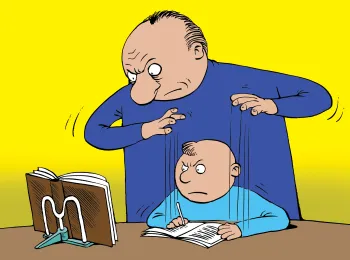
The Unified State Exam completely reformatted the school process, establishing the unconditional priority of the mechanism of control over its content and essence. This took years, since the school as it was and remained a very inertial system. However, these years have passed, and the result manifested itself, becoming accessible to analysis and evaluation. In essence, an elementary substitution of target has occurred. The control tool, the exam, has turned into the purpose of the teacher’s work - not the exam for the school, but a school for preparing for the exam.
At the same time, corruption, contrary to expectations, did not disappear. She just switched to other rails. It was also easier to enter an applicant from a province to leading universities for popular specialties, since internal exams appeared. And the concept of “One” has largely lost its meaning after the audit (speaking) for foreign languages appeared in the examination procedure, as well as the final essay with the “Casement-Testing” assessment in 10 grades with verification, inevitably subjective, the forces of the same teachers. As the deceased Alexander Abramov, a mathematician, corresponding member of RAO, formulated in one time: “E” disappeared, only “he” remained. ” The exam in mathematics, by the way, was the first to cease to be one, divided into two levels: basic and profile.
So the head of SK Bastrykin is right or wrong, offering the cancellation of the “torture” exam and a return to the Soviet education system? I suppose is wrong. Stress for graduates is any exam, no matter what form it is carried out. In the case of the exam, the lion's share of stress does not arise because of the exam itself, the complexity of tasks or forming forms, but even before the graduate that gives him to the audience. A very unfriendly police cordon at the entrance to the PPE (examination point), metal detectors, gadgets, formidable warnings about sanctions for attempts to write off and other regime measures related to the process are often invasive. But not the exam itself is the reason, but the hypertrophied meaning of supervision and control, the same substitution of the target and meaning of the exam form in which it is carried out.
I would say that today's USE "unfriendly interface". Will a smartphone allow a person to find an answer on the Internet? And why in the audience and in the corridors the observers on duty? Yes, and block the Internet in the PPE completely solved task. In case of emergency communication - for ambulance, for example, there are ordinary cable phones in the teacher, at the director of the director, in the offices of the director and his deputies. And to track the attempt to use the classic paper cheat sheet is not a problem for any qualified teacher. It has not yet been proven that the exam in classical, oral or written form causes more or less stress than the exam. Comparative studies of this kind, as far as I know, were not carried out, in any case, I personally did not come across serious publications in this regard, and the frivolous for the most part are limited to unproven statements in favor of one or another form based on a pair of examples.
“Only his immediate abolition can be worse than the exam.” I have repeatedly heard this statement in different formulations from colleagues, whose opinion I consider professionally significant. These are teachers with many years of experience in direct work with children, including their preparation for exams: translated, graduation and introductory. I completely agree with them. It is good or bad, but today's exam is a rod on which the whole modern school rests. You can open the shortcomings for a long time and scourge the harmful consequences of its administration, but the removal of the rod on which it holds will lead to guaranteed destruction of the structure and, as a result, the collapse of the school system, and with it the rest of the formation.
Let us not forget that the “USEISISE” of the school, despite its all-terrible state support, demanded many years not only because of the complexity of the exam itself and the organization of its conduct, but also because of the already mentioned high inertia of the school education system. There is no need to count on a fast and painless return to the form, even if the corresponding political decision would be made.
The well -known triad of qualities “quickly/cheap/good”, from which it can be realized at the same time no more than two components, makes it possible to suggest likely options for the system reform in case of such a decision. Given all the previous experience, the most likely script will be “fast and cheap”, since this is how the school problems are solved in the vast majority of cases.
If we take into account the fundamental impossibility of the rapid reform of the school, as mentioned above, only one, the most likely, the consequence of a return to the educational system of a long -existing country - is “cheap”. Yes, and then under a big question. As for the torture, I believe that nothing terrible will happen if we cancel the “torture” format of the exam.
Leonid Perlov, teacher, honorary employee
General Education of the Russian Federation (Moscow)