
Translated material
Ordinary authoritarianism
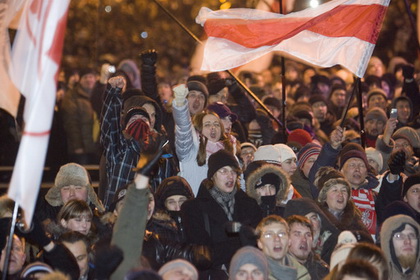
Alexander Lukashenko won the Belarusian presidential election in the first round. I do not think that this wording is not true, despite the protests of the opposition. Another thing is that this victory leaves a heavy, bitter feeling - Belarus resembles a train filled with passengers, which is going to a deaf dead end, and at low speed. So his journey can last a long time, but it will not end in anything good.
It would seem that Lukashenko created a problem from scratch. He could win cleanly or relatively clean if he close his eyes to the president’s informational domination. The West, in principle, was ready to do this-in exchange for the normal supply of voting results, which would give Lukashenko 60-65 percent already in the first round-without extreme measures such as quarter voters who go to early voting. Most of the Belarusian population was ready to vote for the president-patronalist who provides a minimum acceptable standard of living-people are not inclined to think about what ways the authorities achieve this result, what debts they climb and how much depend on the price policy of Gazprom. The opposition could not “stir up” people for many reasons - it did not have a full access to the media and from the very beginning was a split. None of the candidates starred in favor of the other - on the contrary, almost every of them hoped that in the conditions of relatively decent elections, it was he who would receive more than 10% of the vote, becoming a figure of a nationwide scale and creating a backlog for the future.
Such a scheme looked rational if you do not take into account the main factor. In the last election, Lukashenko received 83% of the vote. Any significant decrease in this result (even up to 70%, not to mention a more modest victory) would be perceived by local bureaucracy as the beginning of the end of the ruling regime, evidence of its erosion. Lukashenko, through the large -scale use of an administrative resource, established such a high electoral bar that it was simply impossible to obtain a comparable result by honest means.
In the second half of the 90s, Lukashenko showed that it would be with every “state man” if he violates the unwritten rules of the game. The chairman of one of the most famous collective farms of the country Vasily Starovoitov, partisans and twice Hero of Labor, a man of Masherov time, one of those on whom the republic held. He was accused of economic abuses and sentenced to a real term, not paying attention to either merit or gray hair (74 years old). Starovoitov did not break in prison, after a couple of years he was released, but for other representatives of the elite this sentence became a lesson. As well as the indifferent attitude of society towards the fate of influential people who did not please Lukashenko, they cannot count on broad folk support in a poor country, controlled by a “folk defender”. Therefore, by the way, none of the “state people” of Belarus went against his boss, despite the numerous signals from Moscow broadcast on Russian television. Each of them understood that at any moment from an influential official could become a criminal, and you can’t pierce the wall with the wall.
If the electoral results of Lukashenko would go down, the situation could change, the wall would not look so impressive. Therefore, the Belarusian authorities did everything to avoid a script that would be more risky for them than a spoiled relationship with the disappointed and offended West. Moreover, with Russia, the Belarusian president a few days before the elections was able to agree on oil duties, and he could count if not for public support (such would not be very decent after a multi -month negative campaign and against the backdrop of the next revelations from Assange), then for the neutrality of Moscow. As a result, instead of 83% Lukashenko, “brought” 79.
The opposition’s protests were predictable, but it seems that the impromptu opposition movements of Neklyaev and Sannikov were even less capable than their predecessors, united in the past elections around Milinkevich. In addition, one of the leading presidential candidates, economist Romanchuk, actually crossed the side of Lukashenko, who honored his ten -minute audience. Perhaps he will receive some nominal post in the civil service-for example, as a developer of projects that can be hidden in the lower drawer of the table and removed in case of arrival of representatives of international financial organizations.
Did Lukashenko win? Tactically - yes. Strategically - hardly. People can come to terms with the fact that there is no freedom in the country - in exchange for some material benefits. But the economic initiative is suppressed, the development is inhibited, investments are artificially limited. In the West, even the most active supporters of Realpolitik regarding Belarus are unlikely to bring any convincing arguments in favor of the fact that Lukashenko’s archaic regime can be “civilized”, albeit gradually and neatly. In Russia, there are fewer complaints against the Minsk authorities, but the double game, on which the “dad” was caught repeatedly, are not inclined to forget her authorities.
And not least, it is important that people were brutally beaten in Minsk - both famous politicians and young people who only seeking their place in life. With the help of large -scale use of a propaganda resource, it is possible to pass these people for enemies of the state, but the memory of a police officer in the center of the capital will still remain. As a certificate not of the strength, but the internal weakness of the authoritarian regime, unable to decide to hold more or less free elections even in conditions of fairly high electoral support. Which is still preserved, but cannot be eternal.
Author - First Vice President of the Center for Political Technology