
Translated material
Slogans or dialogue?
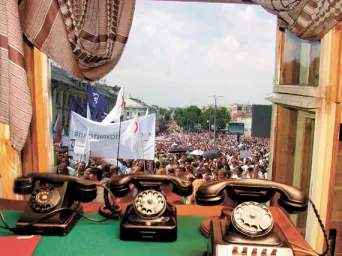
Due to the sharp polarization of public moods, few people now believe in a calm dialogue between society and the authorities. Increasingly, the authorities demonstrate to us that it is simply not interested in such a dialogue, and it is not clear who and how to represent society and speak on its behalf. Indeed, now it is difficult to organize normal negotiations between, relatively speaking, Bolotnaya Square and Putin-co-codes.
Somewhat paradoxically, in this context, the idea sounds that the polarization that we observe today at the same time revealed the diversity of both society and representatives of the authorities. Fortunately, both power and society have many faces, including those where contact is not so antagonistic. Life continues, and the hope of dialogue in the field of science, and possibly education, always remains.
Recently, statements regarding the Russian fund of fundamental research were made “from the bottom up”. The essence of the statements is that the principles of the work of the fund should become more democratic and transparent, and its financing is increased. The form of statements - petitions (there were two of them) with many hundreds of signatures. At first, an unsubscription from the RFFI was received as an answer (after which the second petition was redirected by the government), but later two of the initiators of these petitions, Oleg Melnik and Dmitry Dyakonov, were introduced into the RFFI council. The fund's financing was increased by a third. We do not know how these decisions were made, but they can be regarded as a kind of answer. Such a dialogue is in any case much more constructive than mutual curses or “screwing of nuts”.
The second, recent statement “from below” is addressed to specifically the new Minister of Education and Science Dmitry Livanov. The applicant in this case was the company of scientists. Its essence is the proposal to organize a science council under the Ministry of Education and Science, which will include actively working scientists (there are similar tips in many countries). It is proposed to include representatives of Russian scientific diaspora and large foreign scientists in the Council. Work in the council should not be paid, regular rotation is mandatory. The Council should put priorities in financing large programs, including the creation of Megaustanovs and the country's participation in major international projects, give recommendations for financing academies and research centers, for organizing and conducting federal competitions. The proposal is motivated by the fact that the opinion of scientists who are the main “motor” of science is systematically ignored, as a result of which Russia rolled up from 16th to 27th in 27th place in the citation of scientific articles over the zero years. The minister must directly interact with the scientific community. As far as we know, the initiative as a whole has been met positively and something similar in the Ministry is already planned.
So, the points of contact appear, but you do not have to count on a slight dialogue. There are serious contradictions, primarily in terms of education. Society is quite annoyed by the adoption of new educational standards and primarily the suddenness with which the clearly unfinished project was represented by the outgoing minister. A sharp criticism caused a statement by the new minister about the need to reduce budget places in universities, which is perceived as an attempt on free education. Yes, and a single state examinated in all in his teeth.
In addition, scientific and educational communities are far from homogeneous, and this circumstance prevents the development of intelligible mechanisms for delegation of the right to speak out on behalf of the entire community. Thus, the society mentioned above is just a group of people who can either speak on their own behalf or collect signatures (which was done).
In the latter case, the “recipe” is simple: the reputation of people who make up the group or signed the petition, the intelligibility of the statement and openness during its discussion work. There is hope that in the field of education there will soon be similar groups that will begin to conduct a responsible dialogue.
The “recipe” for the official is even easier: clarify, argue, convince, as well as listen and answer. Let's hope that the new Minister of Science and Education will be ready to do this. Scientists, university teachers, teachers should not only express general discontent, but clearly formulate their claims and ensure the most representative form of their expression. Even a difficult and difficult conversation is always more useful than a bite and primitive slogans.