
Translated material
Wet place
On the stage of the Moscow Art Theater with particular cruelty was killed by Vassa Zheleznov
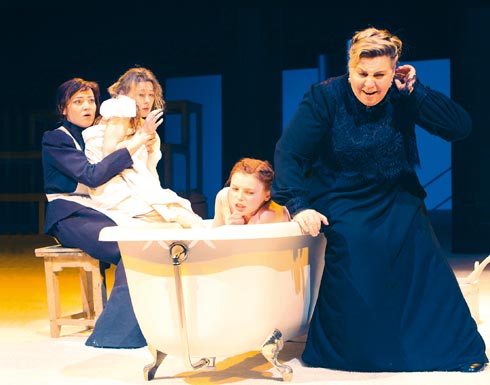
Wet place. On the stage of the Moscow Art Theater named after Chekhov, with particular cruelty, the murder of the Vassa Zheleznova was committed. What remains of Gorky’s drama is not even a metaphor at all
Lev Ehrenburg is well known to theaters: a student of Tovstonogov, he has recently headed his small drama theater (VT) in St. Petersburg and actively puts in provincial Russian theaters, excitement and attracting the public with a non -standard reading of classical plays.
The image of a night pot
"Vassa Zheleznova" - Erenburg's debut on the metropolitan stage. The directorial handwriting is guessed right away - the performance begins with Urino Intermedies. The maid, barely restraining the dummy, rushes through the stage, holding two full night pots in front of him on outstretched hands, one of which overturning Melnikov’s shelter. A minute before, Melnikov carefully washed and sniffed his pants. The expression on his face left no doubt about the origin of the calcium pollution.
The theme of physiological departments “red thread” passes through the whole performance: the artists change their own or erases their now and then that everyone suffers here - both servants and gentlemen), they are sick and turning to what they have to - on the table, on the floor, on partners), they hiccups from the indefatigable cognac, placed in the scammers throughout the scene. The memory will overtake the maid Lisa will overtake right by the ramp, and the first rows of the stalls will be horrified to watch with scarlet blood flowing through her hem. The vassal of Zheleznova and her assistant Anna are constantly struggling with nasal bleeding, and Pyatrkin, shamelessly lowering his pants, will smear his swollen red knees for a long time, and then even voluptuously launches his hand in front of Lyudochka Zheleznova. With Lyudochka, after that, the paddle. She, poor, is not aware that this Pyatrkin is just a metaphor ...
Nobody is afraid of iron Vassa Borisovna here, no matter how much she yelled at her subjects, breaking off with anger. "Do not dare to chew on me!" - She shouts to the same Pyatrkin, and in a minute she will calmly watch how Melnikov and Natalya almost copulate over her head on a staggering chandelier. Why on the chandelier?!
The scene that opens the second act in the bath seems to be brought from the Soviet performance about partisan life: Gorky characters arrange a cheerful orgy somewhere “in the front-line forest”: to the sounds of the accordion and under the muddy moonshine, naked girls and men hang out between the bath and the hole, squeal, squeeze each other in my wet hugs, and lickening playing playfully lickening Semi -boots. And you are waiting for a sudden scream: "Air!" Or "Germans!" The scene ends with an attempt to rape the revolutionary Rashel with a lustful Prokhor Khrabov, who, thank God, will be impotent, which will cause a depraved underground, an attack of satanic laughter - they say, you need a bourgeois outbreak!
The director’s manic desire to undress everyone and wash everyone (which, apparently, symbolizes the breakdown of all kinds of masks) reaches the comic: the hero of Sergei Kolesnikov (the Vassa Zheleznov’s husband accused of pedophilia) appears on the stage only in order to carefully and extremely believable in water filled with water, wash and with the head! Acquainter. Splashing in the same bathtub, they find out their relationships drunk in the trash of the Zheleznov sister. The ability to walk freely on the stage without pants demonstrates all male individuals, despite the social status.
"I'll show you!"
Paphosa interviews preceded the Prime Minister of the Vassa Zheleznova (“Russia is holding on such vasses”) and quiet scandals. Evgenia Dobrovolskaya was initially appointed to the main role, who, after several rehearsals, refused to work. Marina Golub, who received the opportunity to show herself as a tragic actress, seems to have invested in this role all her experience and all her temperament. But Vassa did not succumb to her, and the director did not help, did not offer the necessary support for such a contradictory and so passionate nature. The only scene that could become the key to the image is the scene of death that Marina Golub played silently and majestically, face in the hall, with her eyes open. And this vassa has nothing to do with the one that we observed throughout the performance - hysterical, helpless, not distinguished by either a special mind, or special strength, or a special worldview.
Actors are sorry. Alexei Maksimych knew how to write roles: all his plays are inhabited by powerful bright characters, playing them is a pleasure. Leo Ehrenburg deprived the artists of this opportunity, in other words, they shamelessly stole their roles, adapting them to his simple, easily read concept, the meaning of which comes down to three words: “I will show you!” This “concept” has destroyed more than a dozen talented people bypassed by metropolitan glory, but passionately dreaming of it. Intoxicated by a noisy, often scandalous success in Russian provinces and shining to the coveted capital, they try to shove into the Moscow debut all their "brave" directed by the provincial public ideas. The Moscow spectators stunned by this pressure initially take this Metaphor fountain for the original directorial vision, not noticing neither the directorial narcissism, nor the vulgarity of stage decisions, nor the apparent resistance of acting nature.
The provinciality, which, as we know, the concept is not geographical, manifests itself in the illegibility of the means chosen for self -affirmation, in unceremoniousness, in the rapture of power, in shameless self -love, in demonstrativeness. In the "Vassa Zheleznova", the meaning of which Lev Ehrenburg defined as a "history of spiritual self -destruction", if desired, you can see the carefully hidden history of directorial arrogance.