
Translated material
All about hail: myths and reality

On July on July six, 2021, a large city hit Central Europe. Hundreds of messages were recorded and processed in the European Laboratory of Dangerous Storms (European Severe Storm Laboratory). The largest number of messages about a large hail - in meteorology, are these gradins more than 2 cm in diameter - came from Italy and Germany (Fig. 1).
In some areas of the city, there were so many city that photographs of eyewitnesses resembled a winter landscape; Motorists were especially difficult. In some places, the hail was very large! In Italy, in the area of the town of Almedo (Emilia-Romania region), the size of Gradin reached 8 cm, in Germany-7 cm (Taubenberg, Bavaria). Weighed such gradins up to 100 g (Fig. 2).


 Rice. 2. Grad, which fell on July 26, 2021. Left: Grad in Almedo (photo from the personal page of Maria Cuohi in Facebook), on the right: Grad in Taubenberg (photo from the personal page of Andrzej.baczyzmalski on Facebook)
I will remember that the size of the city is understood the largest distance in any of the axes. Sometimes, for imagery, journalists love to compare a hail with walnut, apricot, apple, golf ball. But still, the hail is very far from the ball form. According to observations of a large number of gradin on Earth, scientists have found that their form is mainly a flattened spheroid. The more hail, the more it is flattened. For gradin about half a centimeter, the ratio of the minimum and maximum diameters is about 0.95, and for gradin in size 5 cm - already about 0.6 [ 1 ].
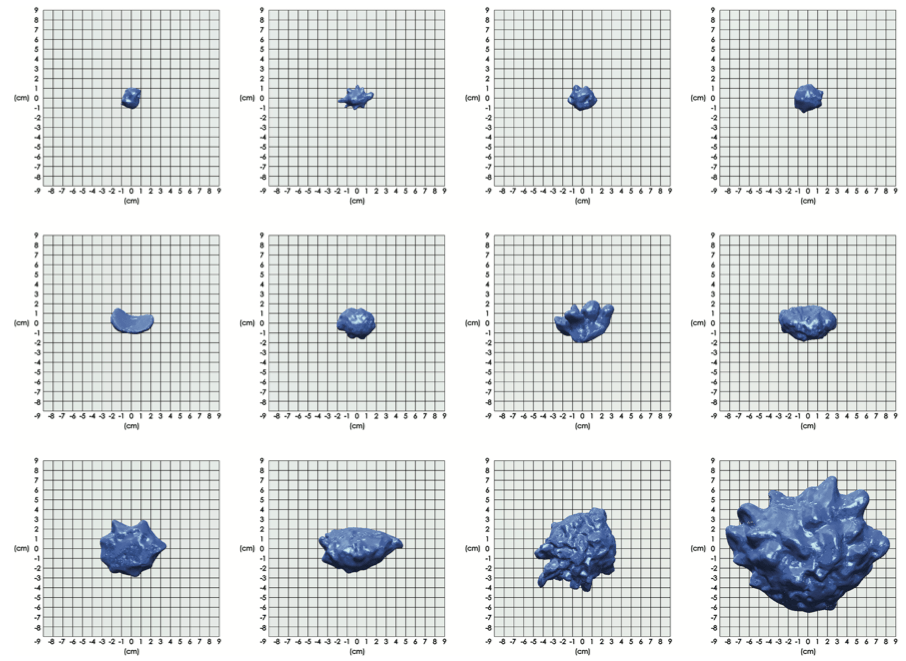
But this is only a simplification. In fact, the forms of gradin are more reminiscent of a spheroid with a large number of "prooferens" directed in different directions. During the fall and collision with the Earth, these "proofs" undermine or break off the mother gradin. Therefore, you can’t restore the exact form of gradin in the cloud on Earth - a three -dimensional laser scanning of city clouds helped, which showed countless form variations [ 2 ] (Fig. 3).
The evolution of the hail embryo
For a hail growth, several conditions are necessary: the presence of an embryo (particles in size less than 1 cm, usually either a frozen drop, or sticky wet snow - a grape), a large zone of hypothermia and a powerful rise in air.
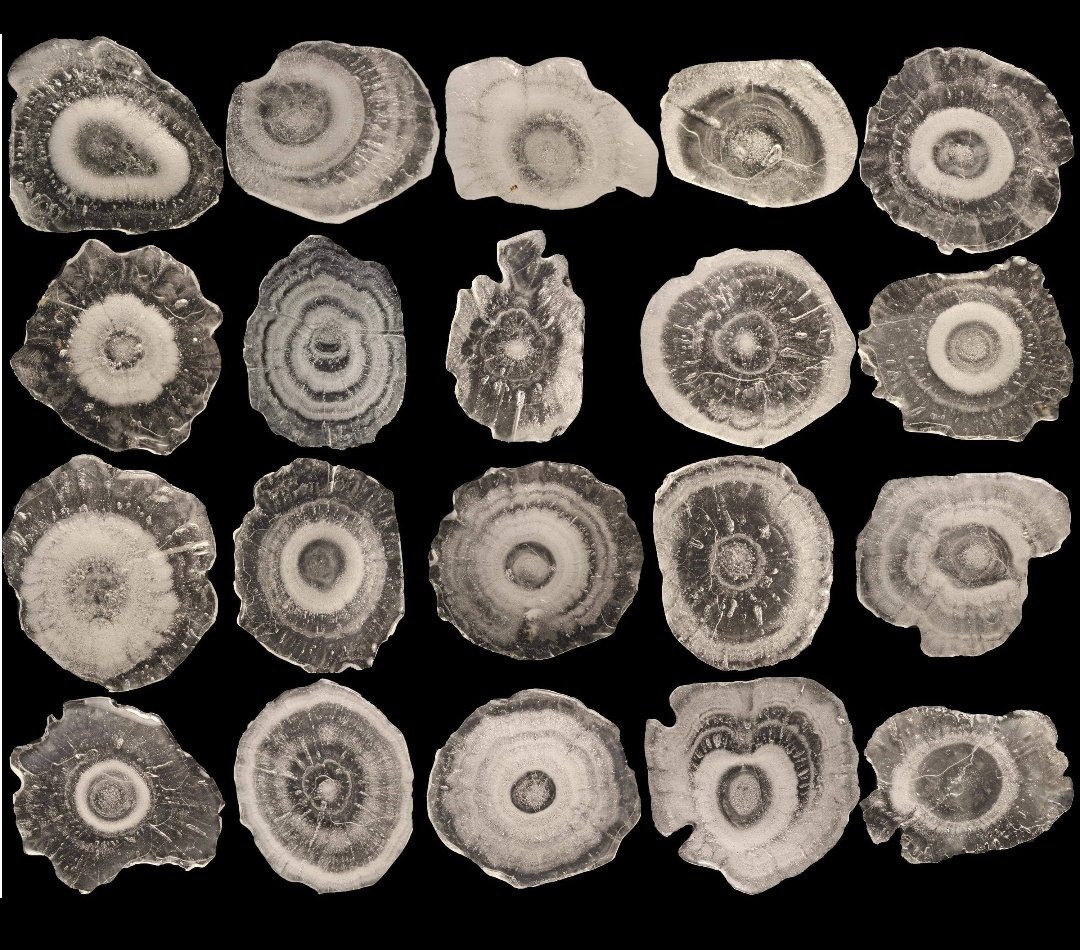
The embryo picked up by the rise, turning into a hail, can be in the cloud for up to 10-15 minutes [ 1 ], gradually growing in size. At the same time, the growth of hail is “dry” or “wet” - depending on the number of hypothermia in the cloud, the size of the hail, the temperature of the surface of the city and the surrounding air. The “dry” growth is observed in conditions when the drops around are slightly, and the surface of the city is very cold - as a result, the water vapor from the surrounding air sublimes on it, a whitish layer of ice is formed. At this stage, hail grows quite slowly. In conditions of a large number of hypothermarized drops and a warmer surface of the city, rapid growth is observed: the surface of the hail shakes, supercooled drops from the cloud actively join it. At this time, a transparent layer of ice is formed. This is the stage of "wet" growth.
Both stages can alternate during the rise or horizontal transfer of gradin in the cloud, which ultimately leads to the ring structure of gradin. But previous ideas that whitish ice corresponds to lift, and transparent - lowering and that the number of transitions from one type of ice to another can indicate the number of rise and lower gradin in the cloud (just as the rings of trees speak of the age of the tree) turned out to be incorrect. According to modern ideas, the hail inside the cloud still does not experience numerous rise.
The ideas are not true about how the "prooferens" are formed. This is by no means the result of a clash and absorption of a large gradin of smaller ones. No, this is either the result of gripping and increasing the icicles on the surface of the city during “wet” growth, or the growth of petals and protrusions during “dry” growth.
Size Gradin: "We beat records"
But let's return to the July degree in Europe and ask ourselves the question: is it a lot, 7-8 cm? An avalanche -like growth of city data (thanks to smartphones, mobile Internet and social networks) allowed scientists from ESSL to study thousands of city samples and establish that 70% of all events are less than 4 cm, 97% - less than 7 cm [ 3 ]. But a hail of 8 cm or more accounts for only 1% of events. At the same time, only events with a hail 2 cm or more were taken into account in the calculation of interest, and everything that was less was not taken into account at all. So we can safely say that the event on July 26 was abnormal!
By the way, it is in Italy-only in the north-east, on the border with Slovenia-the maximum number of days in Europe with a large hail is obtained: every year, a hail of more than 2 cm falls here for four days, and once every two years-more than 5 cm (Fig. 5). In Russia, the most urban place is the North Caucasus, where in the 21st century several cases of a city of more than 10 cm have already been noted.
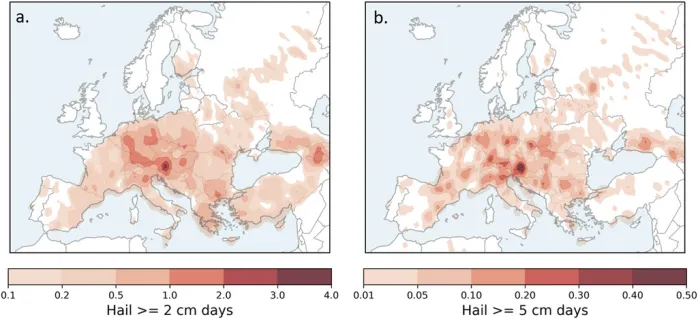
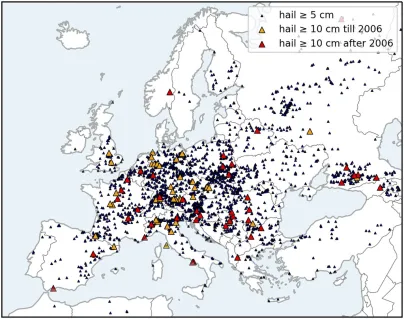 Rice. 5. The number of days a year with a hail is more than 2 cm (at the top left) and more than 5 cm (at the top right), as well as individual events with a very large (> 5 cm) and giant (> 10 cm) hail (below) (Fig. From [ 3 ])
The largest hail falls from the so-called super-icing clouds-the enlargement cucch and removal clouds with its own crushing air-a mesocyclone (more about such clouds-in the material “Tornado in Russia: a real threat?” [ 4 ]).
In Russia, the largest city, apparently, fell on June 9, 1984 during the Ivanovo outbreak of tornadoes, but not from the super-tower that gave rise to the most powerful tornado, which passed through Ivanovo, and from the western, which passed through the Yaroslavl region. The size of the city was 15 cm, and its mass was estimated at 1 kg [ 5 ].
True, this assessment of the mass is most likely overestimated. So, according to the large many years of experiment on the study of several thousand samples of the city in the USA [6], the mass of the city is quite well approximated by the degree function M = Adb, where M is the mass of grades (in grams), D is its maximum size (in centimeters), a = 0.53, b = 2.4. In article [ 7 ], other values for the coefficients were obtained: a = 0.37, b = 2.7. Then, according to these estimates, the mass of a 15-centimeter gradin is 350–550 g.
But a 20-centimeter city can weigh 1 kg! Closed in size gradins in the 21st century were marked in the USA, Argentina and Libya (Fig. 2). In 2020, scientists even established a new gradation: to a large (Large, more than 2 cm), very large (Very Large, more than 5 cm) and giant (Giant, more than 10 cm) now added a tremendous city size (Gargantuan, more than 15 cm) [ 8 ]. Or, if you like, Gargantuyle ...
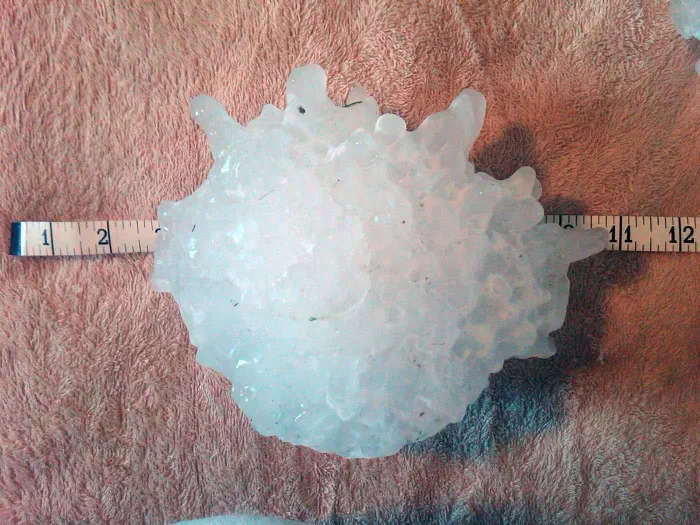 Grad, which fell on July 23, 2010 in the area of Vivian, North Dakota, USA (NWS Aberdeen photo)
 Grad, which fell on February 8, 2018 in the area of Villa-Carlos Pos, the Cordoba Province, Argentina (photo Victoria Druetta/SWNS)
 A city, which fell on October 27, 2020 in the area of Tripoli, Libya (photo Saad Aldeen Hmouda) Fig. 6. The largest city in the XXI century
Such colossal gradins can not only damage cars, greenhouses and roofs of houses, but also kill a person. So, in Romania in 1997, four people were killed due to a large city [ 3 ]. One of the urgent tasks of meteorologists is to predict not only the place and time of the city of city in advance, but also its size, which will enable people to prepare for the element.
Alexander Chernokulsky, cand. physical. sciences,
Art. scientific. sore. Institute of Physics of Atmosphere named after Am Obukhov RAS
1. Agupubs.onlinelibary.wiley.com/doi/abs/10.1029/2019RG000665
2. Journals.ametSoc.org/view/Journals/BAMS/98/7/BAMS-D-15–00314.1.xml
3. Journals.ametsoc.org/view/Journals/mwre/147/11/mwr-d-1 19-0204.1.xml
4. TRV-SCIENCE.ru/smerchi-v-Rossii
5. Sciencedirect.com/science/article/pii/s016980951731158
6. AMS.confex.com/ams/27sls/webprogram/paper255294.html
7. Journals.ametSoc.org/view/Journals/ATSC/75/11/JAS-D-18-0035.1.xml