
Translated material
Live certificates
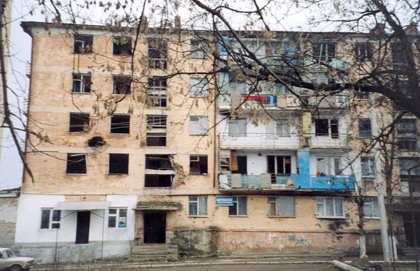
This is a story with a happy ending. Her heroines in the winter of 2000 lived in Grozny, in the Staropromyslovsky district - Natalya Goncharuk in the village of Katayama, and Heda Mahauri on Tashkal. Lived and survived.
Grozny actually has a difficult geography. The city consists of numerous "villages", "towns" and "plots". But the Staropromyslovsky district is simply arranged - it will be pulled to the north -west along the Staropromyslovsky highway: the dog - turbine - Mayakovsky - Katayama - Tashkala. At the beginning of the “second Chechen” federal troops, saddled the ruling heights of the Sunzhensky ridge, this area of the Terrible was seized in the first place. Somewhere else Chechen detachments resisted, and in the old crafts, in Kataya, there were already "feds".
Why, in fact, Natalya and Heda remained in Grozny? And where, tell me, did they go? In fact, according to the official victorious reports of the Russian media, that is, the radiant smile of General Valery Manilov, in the city, like throughout the republic, only “point blows” were delivered, so nothing threatened the civilian civilian. In addition, the “humanitarian corridors” were allegedly provided to go out the civilian civilian population. And on December 6, 1999, the remaining in Grozny turned to a warning - to leave until December 11: "The people remaining in the city will be considered terrorists and bandits. They will be destroyed by artillery and aviation. Everyone who did not leave the city will be destroyed." Why didn't you go out?
Upon closer examination, this is the case. The blows were by no means “point”, but massive and indistinguishable. On the roads, they also beat - the "humanitarian corridors" in fact turned out to be the "corridors of death." And the exit of the refugees outside Chechnya was generally banned on September 25 by order of General Shamanov. Ingushetia disobeyed, hundreds of thousands fled here, but on October 23 this way was closed. They promised to open on October 29, but the attack aircraft "worked out" the refugees "worked out". Finally, the “warning” was sent to the formidations in the form of leaflets, and the wind demolished them into the uninhabited part of the factory district ...
And in general, even knowing about the “ultimatums”, it is very difficult to force yourself to get out of the usual place and move towards the unknown. There is too much sensation of "it simply cannot be worse." People remained in their homes, hoping that this horror would end. Not only Chechens remained in Grozny, but also Ingush, and Russians, and others. The stories of those who survived the blockade of Grozny - from autumn 1999 to February 2000 - are very similar to the memories of the Leningrad blockade. The struggle is not just for survival, but for survival is worthy. People tried to support each other, and this mutual assistance helped them not to fall and not give up. After all, the "ethnic cleaning" of the city was carried out mainly by war. When the next war began-whether it was December 1994, August 1996 or autumn 1999-everyone who could leave the city. And the Chechens returned primarily. According to the stories, the militants did not really annoy the inhabitants of the old crafts. But until they leave, the shelling will continue - and the end of the military seemed to be delivered to many.
In 1999, 38-year-old Natalya Goncharuk could not leave Grozny, was sick. Goncharuk moved to Grozny in 1990 from Kazakhstan, escaping from interethnic clashes. But in 1993 and in Grozny it became uncomfortable-Natalia had to take his daughter out of the city, it became unsafe at school. But she, like many other Slavs, remained to live in Grozny.
On January 19, 2000, the battles in the old crafts resumed, bombing and shelling intensified. Natalya Goncharuku and five more people, who were hiding together in the garage, fled to the cellar located nearby. While the woman ran, she was injured in her leg. When the outside was calmed down, the military appeared. They ordered everyone to go out. They said: everyone who remained in the city is accomplices of the militants. And they will kill everyone. People tried to explain that they were not militants, showed documents. The documents did not look, people did not listen, drove back into the basement, began to throw grenades. Finally they ordered one to go out. The wounded Natasha Goncharuk could not go herself, without support. Two women and the man stepped forward, and were shot by the first burst. The second went to another woman and a man who supported Natasha. The Chechen Kosum covered it from bullets and fragments when the wounded was finished off in bursts and grenades. Everyone was killed-two men-checers, two Russian women, and Ukrainian Goncharuk was just injured.
When it got dark, Natalia got out and crawled to the nearest house. Those said: the neighbors tried to take out a relative wounded into their stomach-at the block-post in the "humanitarian corridor" they shot everyone. Then, at the same post, other neighbors were shot ... But Natalya Goncharuk did not care: she was bleeding, Gangren could begin. She was lucky at the post: they missed, and even transported to the hospital ...
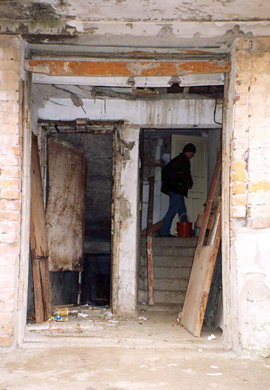 Heda Mahauri in the winter of the 2000 also remained in Grozny-in one of the basements. The basement of the five -story building protects even from a large -caliber shell, and bombs destroy the upper floors. On January 21, 2000, Heda, along with two more neighbors, left the shelter to see what happened to the house. Actually, many remained in Grozny to look after the dwelling, in the hope that the presence of the owners would stop, and that the looters would. In addition, Mahauri wanted to pick up some documents from the house.
Having passed the quarter, the women saw that four-hundred meters from them were four BMPs and three or four dozen soldiers. That is, they do not stand, but methodically load the property of one of the neighbors of the head in armored vehicles.
Understanding that it was unlikely that the women wanted to leave to “stop” or “aside”. But the military had already noticed them, took them to the sight and demanded to approach. Women were called by scouts of militants, but the subsequent actions of the military did not fit into this version. In unfortunately, they demanded to give all things and documents from the head and her goods - they obeyed. Then one of the soldiers asked if they had forgotten anything. Mahauri thought that we were talking about their poor jewelry.
The soldiers returned the women to women and ordered to sit in an armored vehicle - they say, it is necessary to proceed to the commandant’s office to establish a person. Heda and his friends beat off the car, and the soldiers led them on foot.
On the way, they blindfolded with scarves, such an order. A few minutes later they stopped - the soldiers wanted to get them into the courtyard. Having suspected something was amiss, Mahauri pulled a handkerchief from her eyes and saw that they were not at all at the commandant’s office, but at the gates of a private house and they were taken to the sight. She begged the military not to shoot, talked about young children ... In response, there were queues.
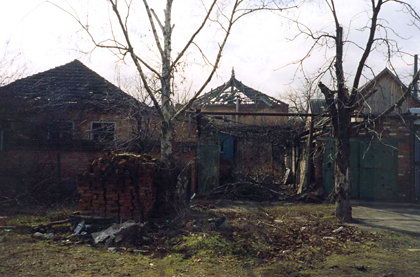
Heda Mahauri miraculously remained alive - from many bullets she covered the body of another woman, Larisa. The wounded, she pretended to be dead while the soldiers took off her chain, earrings and ring from her. The earrings were pulled out of the ears. The ring was not removed - the soldier asked the other a knife, but then it succumbed. Then Heda lost consciousness ... After some time, she came to her senses from the smell of Gary. The soldiers filled the bodies with drenched gasoline mattresses and set fire to. She crawled out. I tried to go. She turned off again ... waking up, crawled, leaving behind her a bloody trail. She crawled to the shelter - there the elderly women bandaged her, replaced her clothes torn and impregnated with blood. It turned out, not in vain: after the trail of blood, the soldiers reached the basement, but did not recognize the heading in the old woman rags.
Three days later, on January 24, 2000, relatives took Kled Mahauri to Ingushetia. She spent two months in the hospital. Her left hand remained paralyzed.
The investigation of these crimes, of course, did not reveal "persons to be held accountable," and was suspended. Yes, and criminal cases themselves opened only after the relatives of the victims turned to Strasbourg. The European Court examined the first cases in the Staropromyslovsky district three years ago, then a decision was made in favor of Magomed Khashiev and Rosa Akaeva, whose relatives were killed in that terrible January. The domestic investigation had three more years. At the disposal of the investigators were the documents of the command of the united group: how, when and what parts took old fishing. According to these documents, the 205th separate motorized rifle brigade acted in those places and at that time. Witnesses are also said about the soldiers of the 205th brigade at the block. And still - the "persons to be attracted" were not established.
The investigation in general went in a strange way. The cases of the two applicants were conducted by two different prosecutors. They sat in the neighborhood, but for four years they did not know that two crimes invested were committed almost simultaneously in neighboring courtyards.
I repeat: two episodes of the same crime have already been considered by the European Court of Human Rights and did not entail any progress in the investigation. But the Russian Federation paid the money awarded to Khashieva and Akayev. Perhaps these amounts are perceived by the state as a “lawlessness tax”: I paid - and sleep calmly.
Now, almost eight years after the crime, Strasbourg has a decision on the affairs of Natalia Goncharuk, Head Mahauri (their cases were represented by the lawyers of the Memorial) and Petimat Goygova - the military was shot by her mother, Maryam, and brother, Magomed Goygova (this case was conducted by the Legal Initiative in Russia).
It seems to be congratulated by Natalia and Khedi - they not only survived, but also achieved justice. (At least partly - after all, Strasbourg decisions do not replace and do not cancel the need here, here, to find and punish criminals.) Only in the course of the case they had to go abroad - they threatened ... pressure on those who apply to the European court, generally common. Just like a deaf silence about the decisions made. Christ on October 2 in Strasbourg, Christ Purgurides, was a discussion, a corresponding resolution was adopted. Only domestic media preferred to talk and write about this, but about the speech of Alexy II ...
... Then, eight years ago, almost all of Russia supported its army, liberating the territories occupied by "bandits and terrorists." No doubt, you need to fight terrorists, but how? Or "the war will write off everything?"
Throw grenades and shoot indiscriminately those who are hiding in the basement? This "methodology for the fight against terror" raises questions to me, to put it mildly.
And to tear off the dead chains-sergi-ring? There are already doubts for purposes ...
Of course, this is not about the fact that all participants of the "Second Chechen" were such as those who shot women in old crafts. And in the 205th brigade there were also different people. These crimes were committed by specific people who should be liable. But until justice has established these specific people, it turns out that everyone remains under suspicion. And certainly on everyone - not on the military, but on all of us, “dear Russians” - lies moral responsibility for these crimes and for the fact that they are covered by a system of organized impunity.
When will we understand this? When a "man with a gun" knocks on our door-or after all before?
Author - Member of the Board of the Society " Memorial"