
Translated material
Court of TV Show
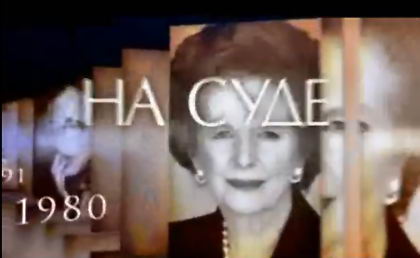
I’ll make a reservation right away: Nikolai Svanidze, in my opinion, does a great educational business, withdrawing his “historical chronicles”, his unchanged fundamental on two issues - national and attitude to Stalinism - worthy of all praise. And the accusations of excessive loyalty to power, conformism, the ability to maneuver, I consider more like a person’s ability to be moderate, unwillingness to become a member of the corporation, even liberal, commitment to objectivity, dignity and professionalism. In addition, who proved that non -conformism is better? ..
In short, I treat Nikolai Karlovich with respect. Including, therefore, I consider it possible for myself to speak out about his new project, a television show on the fifth channel “Court of Time”. You can even consider this text with a television with a certain stretch.
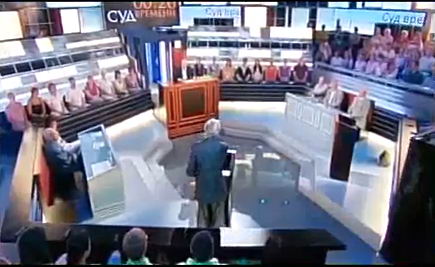
I looked at three programs: about the collapse of the USSR, about Caesar and about Gaidar. All of them are made in the same way. Actors: the presenter, he is the chairman of the court, however, who cannot stand the verdict, he is taken out by the jury - the audience at the TV and in the hall, as well as the prosecutor and the defender, who invite their witnesses to the studio.
To be honest, the program, although it looks interesting, is not very original, the constant presence of the same characters changing roles-Leonid Mlechin and Sergey Kurginyan, is a game form reminiscent of theatrical history lessons, which were practiced in the late 80s and early 90s, it greatly resembles a school debate. But the main thing: the lack of a live broadcast, the strict regulation of time performances and the procedural task deprive the transmission of the living nerve.
Nevertheless, it is obvious that the release of the “Court of Time” was an attempt to return to the air the discussion format on acute relevant, political and historical issues that our television has lost over the past decade. Let in a soft, controlled form, as, again, a compromise, but from the point of view of educational logic, it is better than nothing.
But is it so? 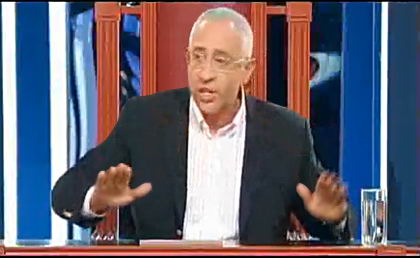
I dare to make an assumption that for Nikolai Svanidze this is another educational author’s project. He probably puts his super-task to reduce the number of stereotypically thinking people in our country, to help them think a little more about difficult historical and political processes.
And what happens as a result?
With a crushing superiority, the television audience votes for the saving dictatorship of Caesar, against the collapse of the USSR and against the reforms of Gaidar. Moreover, the numbers that appear in the first seconds after the voting meter is turned on, by the end remain almost the same - the discussion does not change the relationship of people to the problem, what is called, what they came with, and left.
It seems to me that the creators of the program make at least two mistakes: firstly, they are inaccurately formulate issues, and secondly, doubts causes the choice of one of the regular participants-I am talking about Sergey Kurginyans.
"The collapse of the Union is a disaster or a smaller of evils?" Yes, of course, in the minds of the vast majority of people, the collapse of the country in which they were born grew - a personal disaster. How else? They do not care if it was the "Empire of Evil", "Prison of Peoples." This is an emotional, even existential experience . Another thing is to think: could it be different, but it would not be worse if Yeltsin, Kravchuk and Shushkevich did not sign Blovezhsky agreements? Emotion is faced with reasonable arguments, and in such a situation, the a priori wins the emotion.
Now about Kurginyans. He is a strong rhetorician, but, despite his constant assurances, he is not going to look for the truth: “all his sonorous power” of the actor, director, tribune, and the ranger he gives the polemic struggle. For him, this is not a court, but a ristalism, not a discussion, but a gladiatorial battle. And the transmission genre leaves him considerable scope for this. The secular Mlechin, who plays exclusively according to the rules, has no chance of equal contraction.
Kurginyan could be invited to one of the programs, but to make it a permanent host, in my opinion, a mistake. If the program actually sets educational tasks. He incites passions, and does not enlighten his brains.
... The famous book of Mark Blok “Apology of History” begins with the question of the son “Dad, explain to me why you need a story?”. And it ends with the words “Reasons in history, as in any other area, cannot be postulated. They must be sought ... "
In the same well -known work, one more question is raised, addressed to historians, but quite appropriate for all descendants: to judge or understand? For the historian Blok, the question was rhetorical - to understand. It was in the understanding of time, era, man, circumstances, and, ultimately, the bloc of history saw himself. He tried to set people in other eras, societies and civilizations of our Questions, in anticipation of getting their answers, because only in this case a dialogue is possible.
Moreover, opposing peremptory historical assessments, against imposing a living history of “scrolling” schemes, the block advocated the search for questions, not mandatory answers. It was more important for him to see complex trends, and not superficial results, he advocated for understanding, not memorization, for historical and personal reflection, developing self -awareness.
The fact that historians should not judge has become a common place. Whether the story is judging - as if a discussion question. (Although for me, of course, he judges, and very cruel.) But the fact that there is no trial - I'm absolutely sure.
Yes, of course, there is a court, but there is a judgment. But the whole transfer is built precisely as a court. And in the dock - Yeltsin and Gaidar. And they are judged by Rutskoy and Baburin. Is this not a mockery? ..
And it turns out a paradox: the democratic seemingly, according to the idea and according to the procedure, the transmission involuntarily turns everything upside down, changes the accusation and protection, fixes conservative dogma, historical myths and philistine stereotypes in the minds of people.
And to get rid of an ordinary bitter remark “Well, what can you do if we have such a” will not be fair. In addition, in order to make sure what our people think for the most part, it was unlikely that this expensive sociological survey was worth starting.