
Translated material
Fear of justifying expectations
Well - for the third time
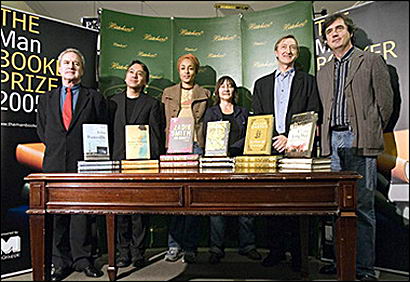
BukerovskayaThe prize sailed from Julian Barnes literally from under the nose. The author, who was visited by all critics, journalists and bookmakers (the British booker is not only the prestigious literary award, but also a gambling game for millions of English) - there is no need to talk about readers - he remains with nothing again. Actually, the fact that it was the Irishman John Banville (known to the Russian reader by the novels of Athena and the Eidues ”) was not so important: the Buker intrigue this time was not exactly exactly who would receive the prize, but whether Barnes would receive it. Not received.
The stubborn unwillingness to award Julian Barnes, for many in the English -speaking world of The Writer for a long time - or, using the not quite accurate Russian analogue, a writer with a capital letter, has quite obvious reasons. And the point is not that Barnes is a hundred percent Englishman who has lived in London all his life (for reasons of the political correctness of Boker, they prefer to give writers a kind from the countries of the Commonwealth or, worst, from a deaf English province), this would be half -bank. A much greater irritation among the Buker jury is exceptional popularity and the commercial ooper of Barnes - so, according to British intellectuals, and not far from the pop. Well, in fact, how is it so - to give a serious literary prize to the writer, whom even Durochka Bridget Jones knows, the heroine of Roman Helen Fielding (Julian Barnes flashes on the pages of Bridget Jones as one of the episodic characters)? For the same reasons, John Ronald Ruel Tolkien could never claim the Buker laurels, and today they are not shining with either Yan Banks - he loves him “wide reader”, nor Stephen Fray - he is too bright and published. Judge for yourself, to reward someone from the above-mentioned “upstarts” is about the same as giving a Russian booker, well, I don’t even know who ... Pelevin, or something. In short, Fi. Not comme il faut.
By the way, about Pelevin. No matter how ridiculous, the situation with the British Boker repeats the story with the Russian Boker, whose short list was declared last week. Having proclaimed the main line of this year the struggle with the dominance of commerce in the literature, the judges of the domestic booker, first at the stage of forming the long-list, systematically cut off all the masses of any massive things, and then did not allow a short book that has a chance to be read outside the narrow professional community. (However, I note in brackets, and in it the novels of the finalists did not cause much enthusiasm.)
However, for the obvious bias of the British Buker jury there is a kind of explanation-albeit not sufficiently justified. A booker in the English -speaking world is a local analogue of Nobel, and it is simply not customary to give it for good books. Awarding the prize, the jury members take into account dozens of factors that have nothing to do with the literature - including the material status of the applicant (and here, of course, 50 thousand pounds with melancholy and, what sin to hide, boring Banville is much more needed than a good capital Barns who has embedded in his books). Moreover, the British booker is traditionally awarded to a writer who does not claim to be massive popular: whether we like it or not, but over the past thirty -five years there have been practically no exceptions. The ideology of the prize is such that it suggests, rather, help talented, but for one reason or another, insufficiently promoted authors than the fixation of the current status quo.
The Russian booker does not have such an excuse: throughout the thirteen years of the prize, its prize is from one extreme to another: from the abstruse Mark Kharitonov to the “people's” Lyudmila Ulitskaya, from the living classic of Vasily Aksenov to the unknown Mikhail Butov, from the timeless Bulat of Okudzhava to the firmly forgotten Alexander Morozov. Each year, it brings new trends, to follow which - the head will spin. This time, we were fighting commerce, and therefore Mikhail Shishkin’s Venus’s Hair Venus, Dmitry Bykov, and “They” by Alexei Slapovsky, and the “The Holy Book of the werewolf” Viktor Pelevin, and indeed all the interesting texts of the past year, remained overboard.
And one more significant “but” - whatever one may say, Banville writer is worthy, simply not a couple of a brilliant Barnes. What can you not say, for example, about the novel by Solntsev - the author of two (!) Romanov at once, who included in the short list of a Russian boker.
However, there are in the decisions of both the Russian and British jury something painting to pain. It seems that both ours and their prizes are more afraid to seem predictable in the world, to justify reader expectations and thereby drop their authority of original thinking experts. The result is a dubious laureate in England and a completely odious short list with us. It is clear that it is far from always worth to following public opinion, but to keep it in mind, of course, or notless. At least just in order not to sit in a puddle, as it happened this year with the British Buker and with their Russian colleagues.