
Translated material
Uncommunicable care
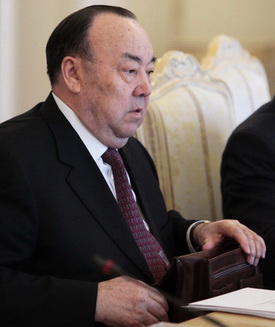 Murtaza Rakhimov leaves his post. In principle, the question of the fact that he would not remain for the next term was resolved last year, when his son of the Urals left not only the post of president of Bashneft, but also the country. In the past, the father and son of the Rakhimovs had disagreements, but in recent years they were political allies. However, in 2009, the oil assets of Bashkiria, which previously controlled the Urals, became the property of the AFK System, after which the basis of the power of the Bashkir leader was undermined.
However, Rakhimov clearly did not want to leave voluntarily. This, apparently, was connected not so much with the desire to hold out for another year (the official powers of the Bashkir president end in 2011), but with the desire to ensure the continuity of their power. More recently, he sharply criticized the Kremlin’s policy, which, most likely, overwhelmed the patient’s patience. This happened during the World Kurulti Bashkirs - a structure patronized by the republican authorities. If Rakhimov had not been so harsh, he probably would have managed to stay at the presidential post for long, but it is unlikely that the new leader of the republic should get comfortable in his post to the Duma elections, which will take place in December 2011.
At first glance, the behavior of the Bashkir president looks irrational. Indeed, Rakhimov could leave differently, without scandals, without provoking a conflict with the Kremlin-as his colleague and a longtime political partner Mintimer Shaimiev did. However, upon closer examination, the fundamental difference between Tatarstan and Bashkiria becomes clear. Shaimiev managed to agree with the federal center on the successor and his own status of the state counsel. This was due to the dominant positions of Shaimiev in Tatarstan, where he did not have any real alternatives. In Bashkiria, the situation is different: Rakhimov was significantly less effective in solving the problem of elite consolidation.
In the last presidential election in 2003, Rakhimov won only in the second round (in the first he received 44%) and with the active support of the Kremlin, who actually withdrew from the game the opponent of the president, Sergei Veremeenko. Rakhimov, unlike Shaimiev, was not able to renew the contract with the federal center. The loss of control over the Bashkir "oil industry" is another sign of weakness. In addition, the “security forces” unfriendly to Rakhimov, a protege of the Center, were appointed to the republic not so long ago, which significantly limited the influence of the president. A similar mechanism was used in the Oryol region, from which another governor, Yegor Stroyev, was successfully replaced at the federal level.
Another interesting example. In 2008, Rakhimov had a large -scale conflict with his own head of the administration Radius Khabirov, who ruined relations with the Urals. A criminal case was instituted against Khabirov, he was removed from his post, excluded from United Russia. And what? Khabirova took under the defense of the federal leadership of the party (of course, the decision on its exclusion did not enter into force), soon he was appointed to the leading post in the administration of the President of Russia for domestic politics, whose activities are supervised by Vladislav Surkov. Rakhimov was forced to retreat. It is simply impossible to imagine such an Afront in the case of Shaimiev or Luzhkov.
In these conditions, the Kremlin did not have to make concessions to Rakhimov. It is significant that the mentioned above Kurultai directly said that the future president of Bashkiria could be a “Varangian”. According to the chairman of the executive committee of Kurultay Azamat Galina, such a purpose "can lead to a serious conflict and the loss of legitimacy of power." Similar shares at the end of last year were tried to hold supporters of the Dagestan President Mukh Aliyev, who feared the coming to power in this republic, Varyaga, Magomed Abdulaev. As a result, Aliyev lost his post anyway, and Abdulaev became not the president, but the prime minister. The head of Dagestan became Magomedsalam Magomedov, a politician who is as unacceptable to the Aliyevsky environment as Abdulaev - thus, the “public protest” technology in the framework of the clan system for the federal center does not work effectively. Especially when a fundamental decision has already been made to shift the current leader of the region and it is only about the time and format of his departure. Perhaps there is a chance to agree only on guarantees to the most departing leader-the Kremlin is not interested in creating a precedent of persecution against ex-presidents, even regional ones.
Author - First Vice President of the Center for Political Technology