
Translated material
Show them alive!
The “wizard” Churov, speaking the other day in Warsaw at the session of the Bureau for Democratization and Human Rights (BDIPC) OSCE, said two news. Of course, one good and one bad. He recognized the methods for observing the elections accepted in the OSCE, but reproached the organization of double standards in relation. To the east, they say, to the post -Soviet states, the OSCE sends hundreds of observers to the polls, but, say, in the USA or Germany, only a few people.
The chairman of the Russian CEC, whose resignation for almost two years has loudly demand all the “swamp” rallies, without understanding it, accidentally stepped on the “sick corn” of the OSCE and the West, in general. Because it's not about the elections. More precisely, not only in them.
... A few days ago, Nadezhda Tolokonnikova was in third place in the number of references in the Russian media, after Putin and Medvedev. I think, in foreign media writing about Russia, the picture looked the same. And this is true-the disappearance of the head in the Mordovian colony of Tolokonnikova from the field of view of lawyers and her relatives for three days alerted the public and gave rise to suspicions: the authorities hide something terrible about the state of her health.
Now imagine that there is a country next to Russia where for more than 10 years (!) Nobody knows anything about the fate of several dozen prisoners convicted of life or perennial terms. No one - neither relatives, nor lawyers (however, what kind of lawyers are there!), Neither doctors, nor international observers - have never seen these people since the end of 2002 and does not even know whether they are alive or not. And this does not bother anyone - neither the press, nor politicians, but human rights activists who are trying to remind the world of this monstrous situation, can be counted on the fingers of one hand.
The country in which this Middle Ages reigns is called Turkmenistan, and the people who disappeared without a trace in prison are accused of the case of the so -called attempt on November 25, 2002 at the country's president Saparmurat Niyazov, which was better known under the name of Turkmenbashi the Great, now deceased.
In 2003, when it became known about the lightning -fast lawsuits in the Nevabrists case, who did not leave witnesses, on the initiative of 10 OSCE members, it was decided to launch the Moscow mechanism in relation to Turkmenistan. This is the name of the procedure, the conditions of which were agreed at one time at a meeting in Moscow in 1991. It applies to individual countries - OSCE members on their own initiative or on the initiative of other countries, if it is necessary to study the situation in the field of human rights. The Moscow mechanism provides for the creation of a group of experts or speakers on specific issues that are sent to the relevant country.
The Turkmen authorities did not allow the group to the country (they also made the authorities of Belarus in 2011, and the Moscow mechanism was also launched in its regard). As a result, a special speaker of the OSCE, Professor of the Sorbonne Emmanuel deco, was appointed, who studied the situation in Turkmenistan without a trip there. The result of his extensive report was the recommendations of the official Ashgabat to correct the situation in the field of human rights, which were ignored by the Turkmen dictator.
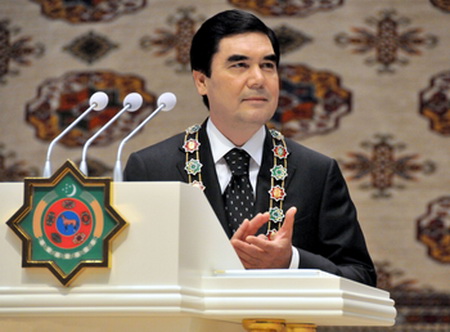
As part of the OSCE OSCE BDPC in Warsaw, on October 2, a presentation of the initiative called “Show them alive!” Took place. The addressee is the official Ashgabat and, first of all, the president of the Turkmenistan Gurbanguly Berdymuhamedov. After all, it was once asked if Boris Shikhmuradov (former Deputy Prime Minister and Minister of Foreign Affairs), Batyr Berdyev (former ambassador of Turkmenistan to the OSCE, ex-head of the Ministry of Foreign Affairs) and other “November” who disappeared almost 11 years ago were alive.
It was at the beginning of 2007, a couple of months after the sudden death of the Turkmenbashi and the coming to power of his successor Berdimuhamedov, who was asked this question during a speech at Columbia University in New York. Berdimuhamedov replied that he was still young and therefore does not know everything so far, but he thinks that those people they ask about are alive.
Almost 7 years have passed. And as they said, speaking in Warsaw, one of the authors of the initiative, President of the Russian Institute of Human Rights, Yuri Jibladze, this is a sufficient time to reveal the truth about people who disappeared into Turkmen dungeons. Moreover, Turkmenistan has joined international legal acts recognizing the right of persons sentenced to a long term of imprisonment, for correspondence and dating with relatives.
Jibladze emphasized that Ashgabata is not presented with any political requirements related to democratic reforms, only one of the Turkmen authorities require only one thing-to prove their commitment to humanism and stop torture by the unknown, which has been subjected to relatives of convicts in 2002-2003 for many years. The horror of their provisions is also that not a single family of the Turkmen “November”, living in Turkmenistan, dares to officially request the authorities of a loved one. Only the family of Boris Shikhmuradov, the most famous of the convicts, who has,, by the way, of Russian citizenship, has been trying to find out the truth about his husband, father and grandfather living out of Turkmenistan.
The authors of the Warsaw initiative, including the head of the Washington Ecological Group, Kate Watters and Civil Solidarity Platform coalition members, uniting 54 human rights organizations from around the world, will also insist on admission to Turkmenistan of the working group of experts to study the situation with the country's disappearance, because this is not only appropriate Noybrists, but also a number of convicts in other cases.
In general, this will mean the need to return to the launch of the Moscow mechanism-2 in relation to Turkmenistan.
The authorities in Ashgabat are likely to learn about the nomination of a new initiative from the media - a table with a sign of Turkmenistan at a session of the OSCE OSCE in Warsaw Pustoval. The most amazing thing is that even the representative of the OSCE mission in Ashgabat did not arrive in the capital of Poland, in other words, European diplomats working in Turkmenistan are not much different from Turkmen colleagues ...
Of course, you can give this different explanations, for example, of the “gas” properties: they say, Turkmenistan for the West is of interest in only one quality - a source of hydrocarbon resources. And the “human dimension”, the promotion of which in the OSCE countries, in fact, is devoted to the activity of the BDIPCH, before this recedes.
But then, probably, our “wizard” Churov, who threw a reproach for “double standards” in Warsaw, who threw in Warsaw. Indeed, to Belarus, where there is neither oil nor gas, and a human rights situation is even a little better than in Turkmenistan, the OSCE is incomparably tougher ...
The unwillingness to find out the fate of the former high-ranking member of her team, the ex-dowry of Turkmenistan in the OSCE Batyr Berdyev, convicted in the case of November 25, 2002, also looks shame for the OSCE. Maybe the desire to wash away this shame explains the readiness to support the “Turkmen” initiative of human rights defenders in Warsaw, which was showed by many delegations of the OSCE members.
Ashgabat should be ready for this.
****************************************M
Under the curtain of the testing of the BDIPCH, it became known that the US government supported the demand “show them alive to the Turkmen authorities!”. The head of the American delegation, the ambassador Robert Bradtka, who spoke in Warsaw, emphasized that "10 years after the Moscow mechanism was launched in 2003, we continue to maintain concern about the human rights in Turkmenistan." The American diplomat responded positively to the Presidential decision Berdimuhamedov to agree to the issuance of new Turkmen passports to the owners of double Turkmen-Russian citizenship and the creation of a second political party, which will take part in the parliamentary elections.
Despite this, the US Ambassador emphasized, the country is still far from the real political dialogue, and human rights continue to be violated. “We are worried about the lack of access to the persons held in Turkmen prisons, including political prisoners ...
We still have no information about the state of health and place of maintenance of the former Minister of Foreign Affairs Boris Shikhmuradov And our former OSCE colleague Batyr Berdyev. We join the request voiced in Warsaw, '' show them alive! '', ”Said Robert Braudtka.