
Translated material
Enigisures for Shoigu
In uniform
 Enigisures for Shoigu
November 12, 2012 Alexander Golts
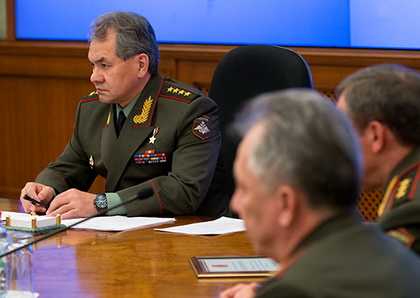
As expected, the first days after the dismissal of Anatoly Serdyukov and the appointment of Sergei Shoigu, the Minister of Defense was provided to analysts and journalists a wonderful opportunity for forecasts. And they literally under a microscope study the first steps of Sergei Kuzhugetovich. Valery Gerasimov was appointed head of the General Staff. If we keep in mind that he conflict with his predecessor, should this not be considered a signal of the termination of reforms? Shoigu commanded the Suvorovites to participate in the parades again - this is a sure sign that the reform of military education will be canceled. The Ministry of Defense is simply shrouded in "rumors in the form of versions." Anonymous sources retell the story to each other that the lists of generals have already been compiled, of which Shoigu will certainly return to the service ...
Of course, in the current Putin Russia, which is shaking from the real political crisis, nothing can surprise. But most of these versions contradict elementary common sense. Take at least the relationship of Makarov and Gerasimov. If the former chief of the General Staff would not have seriously loved his deputy, he would never have put him to the post of commander of the military district - just the one that opens the opportunity to become a NGSH or deputy minister.
Meanwhile, there is a completely real fact that allows you to make a forecast (alas, very pessimistic) regarding the future army reform. This is the decision of Vladimir Putin to return the title of Army General to the new minister. Which returns the situation by 2007, the moment of the appointment of Serdyukov. After all, his predecessor, Sergey Ivanov, also proudly wore general stars.
Explaining this Putin’s decision, the Zadremlin commentators claim that in this way he is trying, they say, to provide a freshly recognized Shoiga among the military. The authority, which, in the slightest degree, was not possessed by everyone, the now -wrecking "Marshal Taburetkin." The thing is that Serdyukov managed to do what his predecessors, “chase carriers” could not commit. He did what Putin himself was afraid to do in 2001, when he said that he did not want to play the role of Gaidar for the Armed Forces. Finally, he did exactly what Putin wanted from him. Namely, he broke an ineffective military machine.
I am sure that if the epaulets were on Serdyukov, he would not have succeeded. Russian generals are great masters of lyso -observation and subtle psychologists. They deftly create a feeling of involvement in the army clan in the next boss. To this, as practice has shown, especially the Non-Army Generals, who, somewhere deep down, realize that they are not too deservedly. Meanwhile, multi -star epaulettes initially suggest military education and relevant experience. Therefore, unlike Serdyukov, ministers in uniform are afraid to ask the military simple questions, since they do not want to look incompetent. The same Sergey Ivanov clearly favored the generals who managed to maintain the illusion of competence in him. “The trouble is that he professionally felt when you began to simplify any difficult questions when explaining,” one very high-ranking military told me. “And then he began to get angry.”
All this is a consequence of a false position in which the head of the military department inevitably finds out if he considers himself part of the military corporation. The civil status of the Minister of Defense is the very first step to the implementation of albeit not civil, but at least political control over the military sphere. This is evidence of the strict separation of the functions of military and political leaders. In Russia alone, unfortunately, the strange term “military-political leadership” has the right to life, which looks like an oxymoron for any normal democratic state. For effective management of the armed forces, it is necessary to decisively share the functions, and, therefore, the responsibility of the highest military and political leaders. One British state husband in the century before last the formula described this system of relations between the army and politicians in the formula: "The soldier’s business is to kill the queen’s enemies, the policy of politics is to indicate the soldier of these enemies." In principle, the situation should be excluded when the generals decide on what threatens the state at a particular moment. The military should only advise the highest political leadership, and after the decision is made, strictly execute it.
Of course, to exercise civil control of one civilian minister is not enough. The defense ministries of Western countries for the most part consist of civilian officials - they formulate decisions that, after they receive the approval of the highest political leadership, must be carried out by the military. An attempt to create such a ministry and made Serdyukov and Makarov, dividing the defense department into two “trunks”: a civilian who dealt with financial, economic and material support, and a military man itself. It so happened that the main posts in the civilian segment were occupied by the colleagues of Serdyukov in the tax service (where to go from the tradition - sometimes it seems that the Dresden residency of the KGB was numerical to the division). It was the presence of Serdyukovsky “battalion in skirts” that irritated ministerial officials in uniform.
It was under Serdyukov that the Minister of Defense from the “Chief General” turned into politics. And the Ministry of Defense itself gradually turned into a department that develops a defense policy, coordinating the defense needs of the state with its capabilities. The return of Shoigu Poson again makes the Ministry of Defense a purely military department, and the minister himself will do not make political, but purely technical decisions and bear responsibility for them. He inevitably becomes a hostage to the military who prepare these decisions.
Now in Russia the Ministry of Defense will be dressed in a military uniform, as it was before. No one will try to raise hundreds of civilian officials competent in military affairs. And the new breed of generals who, without prejudice, will be ready to comply with the orders of any civil minister, and not only the owner of the general rank ...
Photo from the official website of the Ministry of Defense of the Russian Federation