
Translated material
Middle -aged crisis
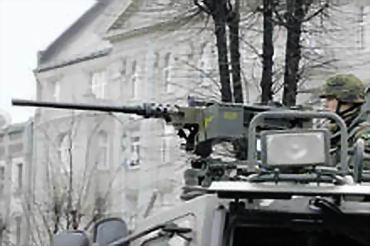
The NATO summit in Riga caused an extremely emotional reaction of domestic media, especially television. In their interpretation, the meeting of the leaders of the North Atlantic Alliance was almost entirely dedicated to Russia. Even in the fact that the summit was first held on the territory of the former USSR, they saw a special challenge. The passions really raged when it became known about the performance of the American Senator Richard Lugar at the conference at the same time with the summit. In his speech, the politician announced the threat of “energy pressure” from Russia, which might allegedly arise against several NATO states. And since the senator insisted that in this case the fifth article of the NATO Charter, which speaks of a collective defense, should be applied in Moscow, they immediately started a question of aggressive aspirations of the block.
In the days of the summit, I was Riga, participated in the conference at which Lugar spoke. And I must say that at the NATO meeting, and in official statements and in the documents, there was nothing anti -Russian. On the contrary, a course on close cooperation with Russia and dialogue in various fields was confirmed. Another thing is that in the speech of the US president, who also spoke at the conference, Russia was already mentioned not as a partner in the broad sense of the word, but as a partner in solving specific problems. This is not toughening, but some cooling: they want to cooperate with us on Iraq, Korea, issues of combating terrorism, non -proliferation of nuclear weapons - but do not consider us as partners.
Meanwhile, the Russian media, more likely to laziness than by an evil intent, exaggerate invented problems, not wanting to notice the real ones. For some reason, no one reads the documents accepted at the summit. If journalists gave themselves the work of studying these documents, they would have found out that the alliance is trying in every possible way to overcome, let’s say, a middle -aged crisis, to find a new purpose. After all, NATO constantly has to find the reasons justifying its existence, because the main task for which the block was created - to restrain communism inside and external aggression from the outside - turned out to be fulfilled. This explains the desire to expand by taking all new countries, and attempts to expand the alliance responsibility zone beyond the European continent.
Now NATO's further fate has been largely set to Kon, because a course has been taken to exit the former responsibility, to solve the problems of global world security. It is no coincidence that one of the main issues of the summit was the question of strengthening the military contingent in Afghanistan. NATO here is rather losing than winning. The Taliban recovered from the blows inflicted on it five years ago, and is already counterattack. First of all, because the Western European allies of the United States do not want to send their soldiers to war. And if they are still sent, then with the condition of the non -participation of troops in military operations, limiting their deployment exclusively safe areas of Afghanistan. Europeans do not want to send troops to Afghanistan, although they are needed there, and in general, as you know, they cannot put more than 30-40 thousand soldiers in the field. Constantly reduce military expenses. This, in my opinion, shows the unionality of the Union to fight with anyone. And certainly no one in NATO is going to fight with Russia.
Which, however, does not mean the lack of alert or even bias in relation to our country. Evidence of which was the speech of Senator Lugar. I must say, the “official” NATO, if they spoke on the sidelines of the summit on energy security, then only in the angle of the need to protect oil pipelines, tankers passing through the straits from a terrorist threat, and not from Russia at all. According to Lugar, however, security is to force oil and gas suppliers to follow certain rules that consumers offer. At the same time, it is not clear what legitimacy such rules have, except for someone’s unwillingness to purchase goods at market prices. Involuntarily, the idea suggests that these rules are supposed to be imposed under the threat of some NATO actions. However, Luar denied the possibility of some power actions against Russia in every possible way.
I was even more perplexed by the requirement to ensure that NATO would ensure the admission of investors to countries - oil manufacturers. This is something completely prohibitive. From the point of view of any right: commercial, economic, everyone.
How to explain all these passages of a usually very reasonable and moderate senator? There may be several explanations. I would like to immediately exclude the possibility that the respectable American politician fulfilled the order from companies that want to break through with NATO into the market. I think that, firstly, we are talking first of all about an attempt to steal the theme of energy security in the European Union. Between the two unions there is an acute competition for influence in Europe, in the world - very acute. NATO is constantly torpedoing the initiatives of the European Union on Foreign Policy and Security Policy. At least recall the rejection of the idea of creating forces that can act independently from NATO.
Secondly, this is a kind of promotion of the "new NATO" from among the countries of Central and Eastern Europe, prone to anti-Russian sentiments. Third: I do not exclude that the Lugar thus seeks to find another sphere of application of forces for NATO, which would justify the existence of the organization. How authoritative and whether NATO is ready, in fact, will move on in the field of energy security will be seen by those actions that will follow or not follow in the coming years. But so far NATO is extremely neat in everything that regard this topic, and the “old Europeans” do not want to raise it at all.
Nevertheless, it is possible that the Americans, playing the separation of Europe, can support the idea of "energy NATO". Just like the Eastern Europeans. And, for example, the Germans do not want any "energy NATO". Finally, it can be assumed that this is a kind of reflection of the views of the current US administration, and here it really contains the hidden threat of Russia. But then everything looks very clumsy. All argumentation is built on the story with a temporary cessation of gas supplies to Ukraine. Meanwhile, now it is already known that the termination was completely legitimate and followed after the nine -month refusal of Ukraine to conduct any negotiations on increasing gas prices. The only fault of Russia is that it very badly in the sense of PR has held this action.
Finally, the speech of Lugar can be considered a reflection of general distrust of the domestic and foreign policy of Russia. In the West, it is believed that Russia, in full, goes to the departure from democratic norms and has passed into a tough counterattack on all fronts, which is partly true. And this criticism should be taken into account when forming Russian politics.
Now about the prospects for admission to NATO Ukraine and Georgia. At the Riga summit, no statement about the invitation of new members was planned. It was planned to declare the transition to more intense contacts with Georgia and Ukraine. This happened due to the general fatigue of the Union from constant expansion, on the one hand, as well as due to the fact that the realization that Georgia is unstable has territorial problems and that the desire to accept it in NATO is unrealistic. Ukraine is also a politically not very stable country in which, in addition, the majority of the population does not want to join NATO. Meanwhile, the North Atlantic Alliance is a “union for good weather”, it does not accept problematic states. But, nevertheless, it is worth expecting increased pressure on Russia, so that it forced the unrecognized republics that do not want to return to any Georgia, to return - so that Georgia is ready to enter NATO. It is very doubtful that Russia began to force, anyone else. Moreover, it is very difficult, if not at all impossible.
The main result is that the North Atlantic Union, on the one hand, did not overcome its crisis, and on the other hand, it successfully tries to adapt to a new reality. The most acute period of the crisis has already passed, and, despite a huge number of problems, NATO remains a dynamically developing organization with which it is necessary to conduct a dialogue and interact. Only this must be done from real positions. Moscow has not demonstrated such behavior recently. The recently voiced idea of creating two security systems - one based on the organization of a collective security agreement (our NATO), is puzzled, the other from NATO - and the division of responsibility zones. NATO never recognizes the zone of responsibility for the CSTO, and we can create a system of structured confrontation, as in a Cold War. Moreover, in NATO in the last two years, anti-Russian sentiments are still intensifying, and such ideas can lead to very dangerous consequences.