
Translated material
Correction of names
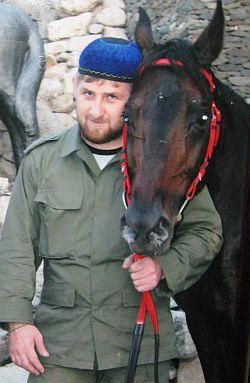 The other day, Ramzan Kadyrov announced: until the end of March, the “counter -terrorist operation” regime in Chechnya will be canceled.
A series of comments from Moscow politicians, comments of conflicting and mostly disapproving followed.
The reader may be surprised, but I agree with Ramzan Kadyrov.
Yes, indeed, there is no reason to maintain a legal regime in the Chechen Republic, different from the North Caucasus in force in the neighboring regions.
Yes, indeed, the “counter -terrorist operation” mode in Chechnya must be canceled.
You can refer to the official assessments of the number of armed underground. On January 23, 2009, Deputy Minister of Internal Affairs Arkady Zhoshelev informed Interfax that the forces of militants in Chechnya are up to 500 people. The deputy minister was silent about Dagestan, but with respect to Ingushetia it was extremely hiccuping - up to 120 militants and 1237 accomplices. Where the figures are incomprehensible: it is unlikely that the “security forces” conducted the “accomplices” census, and the dugouts and caches were bypassed. With arithmetic is generally difficult. A year ago, in March 2008, the total number of militants in the North Caucasus was estimated at four to five hundred people. The Caucasian Knot site summed up the official reports of the “security forces”, at least 546 “Bayonets” were killed and surrendered over the year. The Chechen Ministry of the Interior, that is, the “security forces”, controlled by Ramzan Kadyrov, reported on the elimination of five armed groups over the past year, the detention of 324 militants, the destruction of 61 militants and the “obvious” of the 93rd. In total, 478 turns out. In Dagestan, for the year, 77 militants reported on the physical destruction of 77, 61 militants in Ingushetia. It turns out that the entire personnel of the underground was eliminated in a year, and more than once. It is difficult to explain this. The reasons can be different. Either the usual departmental statistical confusion. Either postscript. Either the significant numerical growth of the underground and the “accomplishment base”.
But in any case, according to the number of killed militants, Chechnya does not stand out against the background of neighboring republics.
You can trace the activity of the underground. The past winter came news of clashes with entire detachments of militants.
There was one such message from Chechnya. On February 9, in the Vedensky district in a battle with a detachment of up to 30 militants, three police officers were injured (that is, again, fighters of one of the structures controlled by Ramzan Kadyrov), one died in the hospital. The Chechen Ministry of Internal Affairs reported that the losses were on the other hand, that later the corpse of a militant, traces of blood and dressings were found. One way or another, the battles with the participation of artillery and helicopters lasted another two days.
But such messages came from other republics.
On February 11, in Kabardino-Balkaria in a forest near the village of herpegezh, the “security forces” faced a detachment of militants, in a clash of seven militants were killed, one policeman was wounded.
On December 24-25, 2008, 12 militants were killed in the area of the Alkun village, among them-Amir Valid (or Abu Valid), in the world-Vakha Jenaraliev, whose "Mansur special forces" acted on the border of Ingushetia and Chechnya.
On February 5, 2009, Amir Muaz was killed in Makhachkala, in the world - Umar Sheikhulaev, leader of Jamaat Sharia, “appointed” to this “position” only on December 5 last year, and four more militants. Such messages came from Dagestan most often. So two weeks after the death of the Amir Muaz in Makhachkala, five “special operations” were killed in Makhachkala and four militants who “appeared armed resistance” were detained.
There is another possible criterion-information about the losses of Russian “security forces”, after all, they are taken into account more precisely than militants and “accomplices”. The War of the War, which collects such information on all open sources, reports that in Chechnya in the winter of 2008-2009, 8 were killed and 18 “security forces” were injured, 7 and 27 in Dagestan, 21 and 55 in Ingushetia. In the remaining republics of the North Caucasus, three killed and three wounded “security forces”. In total - 37 killed and 113 wounded. Less than the three autumn months of 2008 (83 killed and 143 wounded) - "not the season." It is comparable to last winter (42 killed and 85 wounded) and more than in the winter of 2006-2007 (25 killed and 70 wounded are taken into account).
And in Chechnya, 18 “security forces” were killed over last winter and 40 were injured - twice as much as this winter.
Is there any reason to keep the whole Chechnya in the “counter -terrorist operation” mode if the neighboring Dagestan and Ingushetia do without this luxury?
So why not cancel?
Moreover, it was not worth it to declare a “counter -terrorist operation” then, almost ten years ago.
Let me remind you that this phrase was introduced into circulation to large -scale terrorist attacks of the fall of 1999, to the explosions of residential buildings in the cities of Russia. Then, back in August 1999, after the invasion of the detachments of Basayev and Hattaba in Dagestan, the Russian executive power was in a difficult situation. According to the law, the armed forces could be used only by announcing the regime of emergency or martial law. However, this would require the approval of the State Duma or the Council of the Federation, and the parliament was by no means “manual”. That is why the army was used "not for its intended purpose", but in the framework of the "counter -terrorist operation."
The corresponding legal regime was determined by the law “On the Combat of Terrorism” adopted in 1998. The venue for such an operation was supposed to be “building”, “building”, “ship” and the like. Within the meaning of the law, such an operation, limited in space and time, should be carried out quickly - when there is no way to get a sanction from the parliament to introduce an emergency regime. Approximately, as in Budyonnovsk, Kizlyar and so on ...
And in 1999, the whole Chechnya was brought under this regime-thousands of square kilometers. And this miracle lasted for many years.
Imagine that the Boeing’s aircraft manufacturing plants declared aircraft mug. Formally - you will not be held. Make models of aircraft on one scale one to one. And the claims from the regulatory authorities will be smaller - it is unlikely that the control of the pioneers in the house is more cruel than the Gosgortekhnadzor and other inspections laid down at the "adult" factories. At first, presumably, it will be easier to work “modelists”. But when the products of the “circle” will receive consumers ... I would not want to become a passenger of such a “product”.
And with the Chechen "counter -terror" we have been living soon for ten years. The uncertainty of the legal situation, an artificially created legal vacuum became an ideal environment for the "death squadrons." “Unknowns” in camouflage and masks came to armored personnel carriers and stole people. Sometimes the bodies of the stolen were found - with traces of torture, mutilated, blown up. Most often, fired people disappeared without a trace. From three to five thousand people disappeared like this in all these years. There were relatives who did not even have the opportunity to bury a loved one. Unshemed and non -plugged, they were invisibly present, reminding the relatives of injustice and the impunity of evil. So the mobilization base for the armed underground was created. And then a real terror came to Russia ...
And the military prosecutor's hands shook her hands: "No, we have the means and the ability to control the cleaning ..."
Meanwhile, a state of emergency would not only limit the rights of citizens. It, according to the law, would itself be limited - and in essence (the list of restrictions on rights is not disappointing), and in time (you need to renew, each time receiving the sanction of the parliament). Terrible, agree, restrictions! Where it is better to live without any control. More effective. Probably someone thought that was effective. In fact - spectacular.
And the human rights activists-both the Memorials and the State Duma deputies-even in the spring of 1999 called on the head of the Security Council of Russia to introduce an emergency in the Chechen Borderlands. The secretary - his surname was Putin - answered: no, and so everything is under control. In August, it became clear how “under control” it was. The war began. But the emergency was still not introduced - they announced a "counter -terrorist operation."
The results were deplorable.
The “legend” of the conflict, begun since about 2003, changed the situation. Outwardly, it was in the transfer of the authorities of the local administration. In fact, in the transfer of powers to exercise illegal violence armed formations consisting of ethnic Chechens, headed by Kadyrov, Yamadayev, Kakiev, Baysarov. Now there is only one of these highlanders.
The federal "security forces" and the journalists expressing their opinion are not very good for him.
Yes, in Chechnya, abduction, torture, disappearance, killing people are now ongoing.
But the statistics of the neighboring Ingushetia, much smaller in area and population, are by no means easier.
And there, “counter -terrorism operations” are announced locally and short -term, as was written in the law ...
Photos from the site www.rg.ru