
Translated material
Arrests, courts, detention ...
In society
 Arrests, courts, detention ...
June 2, 2019 Elena Sannikova
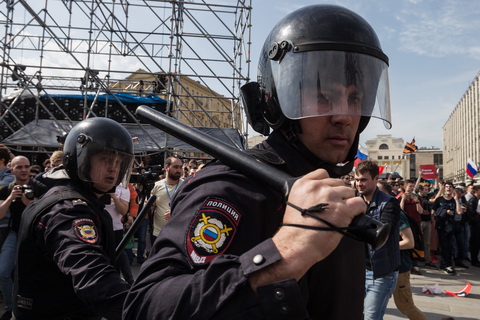
Our current Russian reality is largely similar to the years of Brezhnev’s “stagnation”, when the definition of “sluggish schizophrenia”, invented by psychiatrists to help power to persecute dissenters, was amazingly suitable for characterizing the state of political climate in the country.
Alexander Galich at the very end of the 1960s responded to the monotonous course of those years:
Oh, this old picket fence -
The twentieth opus,
Where every day is a protocol,
And night, like a search ...
Half a century has passed since then, and everything seemed to return to its circles. Only the opus is already twenty -first. Almost every day we hear reports about searches, arrests, court hearings, calls for interrogations ... Somewhere we extended the preventive measure to the arrested for political reasons, somewhere we placed the political prisoner in a punishment cell ... We much less often hear about liberation, excuses, although this happens.
Take only one day on May 27: historian Koltyrin was sentenced to nine years in Karelia, known for the habits of famous structures to factory dirty affairs against historians, researchers of our recent past; The defendants in the case of the “New Greatness” of the Lublin court of Moscow extended the terms of preventive measure for six months; The Moscow City Court upheld the measures of restraint of “in custody”, extended by the Lefortovo court until the end of July ... The latter occurred just against the backdrop of the requirements of the UN International Tribunal on the right to immediately release sailors.
Not everything falls into the news feeds. Not every search, not every court session. Against the backdrop of other shocking events, such incidents as detention on the picket, drawing up administrative protocols that were not taking place, but according to the issued template for copy, administrative arrests of civil activists and other everyday routine - all this does not seem so significant. Courts for political matters are administratively held quickly.
However, there are exceptions here.
On May 27, a meeting on the administrative case of Maria Ryabikova began in the Meshchansky Court of Moscow, who on May 13, without any reason, was detained by police officers and kept the head of the permissible three hours in the department, so she barely had time for the metro. They tried, as it was done, not those who illegally detained her, but her herself, Allegedly "for violation of the established procedure for holding a rally, demonstration, procession and picket."
On May 13, as you know, on Lubyanka there was a folk gathering “in defense of a new generation”. Carried people came who cannot silently put up with the system of cruel torture, which have now entered the practice of FSB investigators. Unfortunately, we have few caring people. The topic of protection of political prisoners or protest against torture does not collect crowds of people. This is not a swamp area.
Recall, by the way, Bolotnaya. And hundreds of thousands of people who took part in the march on May 6, 2012. But how many people later came to the processes of prisoners on May 6? How many joined the process of struggle for the freedom of these young guys who fell under the clubs, and then arrested in Bolotnaya? How many wrote letters to them, came to pickets? I will not say that there are very few, but in comparison with those hundreds of thousandths on Bolotnaya-still a few.
In Kyiv in the fall of 2013, riot police brutally dispelled young people who went to the square in support of the “Europeanization” with batons. Many have received serious injuries. In protest against such a treatment of youth, a people came out to the Maidan, who no longer gave the riot police to disperse themselves. This led to a multi -day confrontation between the people with the authorities and, ultimately, to a decisive change of power in the country.
We are still far from such indifference. Let us recall how, more recently, on May 1, the police in a brutal way beat youth, who came to the musical festival in Luzhniki. The law enforcement officers beat everyone in a row, who turned up by the arm. Well -equipped, in uniform, in body armor armed with batons and electric shockers, who went through a course of special training - they grabbed very young guys, including teenagers who were not protected, in light t -shirts, as if specially choosing those who were not distinguished by muscular physique. They grabbed, surrounded, beat with a group. Bugs on a scale - on the buds, on the head ... How many adults stood up for these boys and girls? Did their parents go to the square? Did they demand judicial persecution of sadists in uniform? Even news feeds were not very interested in this. Only in youth social networks did the shocking frames of the battle dispersed.
We do not know how many young people in our country are sitting without guilt in prisons in self -cargoes, knocked out torture. We would not have learned anything about the case of the “network” if the parents who came to human rights defenders had not shown activity.
I recall a weekly picket on Pushkinskaya Square against the war in Chechnya. Then the city authorities still did not interfere with the holding of pickets and rallies in the city center. A maximum of a few hundred people came to anti -war rallies, while pickets are rarely more than 30 people. The news about the mass death of our fellow citizens, civilians of Chechnya, the weekly lists of the dead in Chechnya did not attract the attention of indifferent passers -by. The rallies in the defense of political prisoners were just as small, the number of which evenly increased during the "zero" years. And only excessively arrogant fraud in the next elections to the State Duma brought countless citizens on the Moscow Square at the end of 2011, having awakened the regions soon. Although, it would seem, is the role of fraud in a country where the media has completely seized power is great? Is it really worse than the mass death of people or the growing wave of new political repressions?
In August last year, the march of maternal compassion passed through Moscow Boulevards and the streets under the heavy rain. The view of the girl behind bars, very young, still a child, awakened people. And Anna Pavlikova weakened the preventive measure, releasing from the investigative prison under house arrest.
It was a rare case. Mass civil lawsuits of compassion. They did not dare to disperse her.
On May 13, the popular gathering on Lubyanskaya Square was also in defense of Anna Pavlikova and her “accomplices”, in defense of young people who were brutally tortured, the factory of the “network”. In defense of the young generation, which the current government does not spare. Not thousands, but several hundred people still gathered. When the gathering had already ended and people began to disperse, the group of people was already detained already from Lubyanskaya Square.
Maria Ryabikova saw how the civil activist Viktor Kapitonova was detained, and resisted asked the police, for which he was detained. As a result, she was detained by herself.
On May 27, the judge of the Meshchansky court of Moscow Victoria Dyachkova began the trial in the case of Maria Ryabikova with refusals to conduct a trial protocol, on the call of the prosecutor, to make information from street video surveillance cameras and the police department on the call of police officers who detained who compiled a report on the detention ... in almost all petitions ... in almost all petitions Refused. Then she announced the “Protocol on an administrative offense” of May 13. “A group of citizens moved ... shouted the slogans of thematic content ...“ Putin - a thief ”... Employees explained ... that participation in a public event without agreement with the authorities ... is forbidden ... They did not respond to the requirements of employees, continued to attract the attention of citizens and the public ...” and so on.
Maria Ryabikova, to the question of the judge, replied that she was at the popular gathering on the instructions of the Sota Vision network edition. After the end of the folk gathering, she with a group of people went to walk along the streets. She also needed to finish the report, perhaps take another interview from someone. This was not a procession, and no “Putin - thief” was screaming, this is a stamp that is contrary to all such protocols. People moved separate groups, she walked in a group with her friends. When we approached the intersection, she saw autozaki. People began to be detained without explanation. Before that, there were no warnings or requirements from the police. When Maria asked the police why and for what they detain people, she was pushed into a car zak without explan the reasons, without introducing her, without introducing her. The judge asked the popular gathering. Maria Ryabikova explained that people went to Lubyanskaya Square without slogans and posters (the popular gathering does not require approval). She had an editorial task to illuminate this event. The gathering resembled a person conference, journalists interviewed human rights activists.
Defender Maria Ryabikova Irina Yatsenko asked to attach to the case file a copy of the editorial assignment of Sota Vision, a press card and a copy of the article written by Maria Ryabikova according to the results of events . Suddenly, the court hearing changed the indictment. The judge asked her to present her properly executed editorial task with the signature and instructions of the chief editor, the Sota Vision registration certificate and transferred the meeting on May 29.
As a result, we have an extremely rare document in our times - an acquittal of the court of May 29 in an administrative case of a political nature. It speaks of both the unproven accusation, and the presumption of innocence ... Golden words!
“The fact that Maria Ryabikova in a group of citizens participated in the procession, shouted the slogans of thematic content, from the evidence collected in the case with undeniable obviousness, it does not follow /.../ It is not seen from the materials of the case that Ryabikova M. joined the public event with the aim of free expression and the formation of opinions on various issues of political, economic, social and cultural life countries and foreign policy issues ... "
Stop, but you can’t join a public event with a similar purpose?!
At the meeting, he witnessed the defense of Stanislav Belyavsky, he was also among the detainees. He showed that the police did not warn anyone, they did not say a word to anyone throughout the walk, they did not seem to be explained and did not explain the reason for the detentions. He himself saw autozaki and went up to ask what was the matter. As a result, he was detained.
Alas, the same judge Dyakova on May 14 awarded 150 thousand rubles of a fine to Viktor Kapitonov, to the very one, for whom Maria Ryabikova tried to stand up at the time of the detention. He was left that day at night at the police department, despite the provided medical documents. Viktor Kapitonov, a young civil activist, has a 2nd disability group. However, more than half of the pensions selects the state from him to pay fines that stamp the administrative courts for participating in the same excise taxes that did not violate any laws, as this one was not violated even: there was no rally or procession, but there was a walk of people returning from gathering against torture.
The Viktor Kapitonov drew up a protocol under Part 8 of Art. 20.2 of the Administrative Code - “repeated violation” of the procedure for holding rallies (Federal Law No. 54). This article provides for from 150 to 300 thousand rubles, or mandatory work for a period of 40 to 200 hours, or administrative arrest for up to 30 days. The same accusation was brought against Konstantin Kotov, Kirill Kotov, Alina Ivanova, Daria Polyudova and Oktyabrins Zvyagina, each of them departed as a result of 5 days of administrative arrest.
Maria Ryabikova and others were released late in the evening from the department, because they were drawn up on them under Part 5 of Art. 20.2 Administrative Code, just “violation”, not repeated. Why is this article dangerous? And the fact that the next such detention will be already under Part 8 of Art. 20.2. And what is the danger of the 8th part? The fact that it may be followed by criminal prosecution under an article that received the name of Dadinskaya. Despite the fact that Ildara Dadina ultimately acquitted the Supreme Court, criminal cases on this legally absurd article are still being fanned. Today I know the names of two civilian activists against which the investigation is being conducted under this article. Both ecologists.
Of course, it is good that the court Maria Ryabikova justified. And Stanislav Belansky, who was a witness to the defense at her trial, has yet to have a court on the same charges.