
Translated material
The knight of eternity
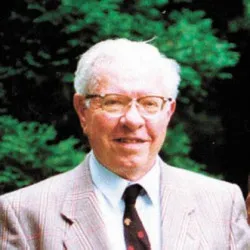
In science, not only the correct theories and concepts left a fairly bright mark, but also some beautiful errors. The author of one of these is the English astrophysicist Fred Hoyle. This essay was lined up during the excavations of the background of the theory of cosmological inflation - a theory that in the most natural and consistent way explains the appearance of our universe, along with many other similar and completely ineffect. It turns out that the theory of Hoyle called “stationary model”, being wrong, lies very close to the channel, from which the modern cosmological concept leaked.
Fred Hoyle went down in history in four hyposts: as one of the pioneers of the theory of nucleosynthesis in the stars, as the author of scientific and fantastic novels, as a champion of the theory of the Pancepermia and as a stubborn unsuccessful fighter with the concept of a large explosion (by the way, the term “Big Bang”, who was voluntarily translated into Russian as a “big explosion”, was invented by him).
In the theory of Nucleosynthesis, Hoyle struck a dead end, which seemed deaf - as elements are heavier than helium in the stars. It turns out that a triple helium reaction serves as a bridge from helium to heavier elements - three gel nuclei merge, forming the carbon nucleus. The probability of the reaction is quite high only because carbon has a nuclear resonance with “correct” energy; It was Hoyle in the late 40s that predicted the existence of this resonance, then this fact was experimentally confirmed. Later, with Margaret Berbidge, Jeferi Berbiju and William Fowler published a fundamental article on star nucleosynthesis, which became the famous.
Interestingly, he also quite took place as a science fiction writer. The most famous is the novel "Black Cloud", which can be safely recommended: http://lib.ru/inofant/hojl/cloud.txt
As for the stationary model of the universe, the context is important here, so we will devote a few words of the history of cosmology.
In the XVII-XIX centuries, up to the 20s of the twentieth century, the Universe was considered infinite, eternal and had the status of the container of all things. This paradigm had problems such as the photometric paradox of Olbers (a speech of view in any direction will eventually come to the surface of the star, so the whole sky should shine like the surface of the Sun), the inevitability of the thermal death of the Universe and its gravitational instability. Nevertheless, most scientists believed that with the development of science these problems would resolve, someone tried to find loopholes saving the paradigm. Even Einstein himself, seeing that in his general theory of relativity the Universe is unsteady, proposed to introduce a special stabilizing member into the equations, which he later abandoned.
In the 20s, Friedman found solutions to Einstein’s equations, where the Universe necessarily had a beginning in time and expands from a state with endless density, and Hubble opened the law of red shift in galaxies. Gradually, the theory of the expanding universe began to establish itself, but it very much seemed philosophically uncomfortable. Naturally, there are many those who defended the old eternal universe, inventing the evidence and loopholes. For example, it was assumed that the red displacement was caused not by the scattering of the galaxies, but by the “aging of photons”-there is some kind of mechanism, as a result of which the photon loses energy along the road.
Hoyle defended the eternity of the universe for the longest. His theory, which went down in history as a “stationary model”, was first proposed by him in 1948 together with Thomas Gold and Herman Bond.
Hoyle admitted that the Universe is expanding, the galaxies are also scattered and red displacement - the real effect of the doppler, and not the mythical "aging of photons". But! Let one proton and one electron be born in each cubic kilometer of space on average once a year. This is enough to compensate for the scattering of galaxies and maintain the average density of the universe at the same level. And so it could always be - no big explosions.
Where will this proton with electron come from? - Yes, at least from nothing! Indeed, in the cosmology of a large explosion, a whole universe arose from nothing (in those days about the "drive mechanism" of the Big Bang no one had no idea). According to Hoyle, the big explosion is anti -scientific and is more likely to the sphere of theology than physics.
Further, the new substance is slowly thickening into new galaxies (in fact, there may be big problems with this), the old ones make room for new ones, and the Universe is self -produced, remaining forever young. This is a very optimistic theory. With the Olbers paradox, everything is in order-distant stars do not shine due to red displacement. Thermal death is also canceled: giving birth to matter has low entropy: it will thicken in the stars and become a new fuel. Entropy of the accompanying volume in the expanding universe grows, but the entropy of a fixed volume remains constant.
In such an evergreen universe, the old idea of the Pancepermia acquires meaning. Life did not arise on Earth - it is much ancient, or maybe eternal. It is transferred in space in the form of a spore of primitive life, for example, with dust or frozen in blocks of ice, thrown from the surface of the planets by blows of meteorites. Disputes sow new planets, life on them propagates and evolves to higher forms, and it will always be so! Isn't it wonderful?!
And if the universe was born as a result of a large explosion? Then, in the idea of the Panzpermia, there is no much sense. Indeed, life on Earth appeared 4 billion years ago, and another 6-7 billion years earlier for her in the universe there were no conditions. What difference does it make - life on Earth originated or a little earlier on another planet and with huge difficulties jumped to the ground. The status of the Panzpermia is no longer the same: instead of an unlimited time to emerge and spread life, it is only 2 more time than it exists on Earth.
Hoyle theory has one more plus: it partly has a physical basis that has been strengthened over time. This type of expansion of the universe, as required in this theory, is actually happening right now. This is a de-test: accelerated exponential expansion, when the distance between a pair of distant galaxies increases by 2 times, for example, every 10 billion years. In 1963-1966, Hoyle co-authored with Jayant Narlikar developed the idea that the Universe was filled with a certain field, which he called the “C-Field) with negative pressure and energy density, which causes the exponential expansion of the universe and gives rise to new particles.
Here, an informed reader can exclaim: “Yes, this is one in one inflation, invented 15 years later!” Almost so, with the exception of the sign of the density of the field energy. But in general, the idea turned out to be close to the truth. In fact, Hoyle and Narlikar were really the first to offer a artisan version of the mechanism called
"Cosmological inflation", occupying a central place in modern cosmology. Alas, the idea was attached to the wrong scenario and had incorrect provisions: for example, now it is clear that the field with negative energy would be unstable. Now we know a lot of things - that such a field exists (only its energy density is positive, not negative) and that it really causes the accelerated expansion of the universe. However, this field cannot give birth to protons with electrons according to modern ideas. In the broad masses, it is known under the name "dark energy". Fred Hoyle lived to the opening of the accelerated expansion of the universe (this happened in the late 90s) and probably was pleased.
What a pity that this life -affirming theory turned out to be incorrect!
The strongest blow to it was inflicted on the discovery of microwave relict radiation, which remained since the whole universe was filled with hot plasma. Hoyle did not give up, he suggested that this radiation is the light of distant stars, processed by galactic dust. Hoyle was indicated that the Universe is clearly changing over time: the Quasars have almost disappeared over the past few billion years, the types of galaxies have changed. But he continued to get out, looking for loopholes. In particular, he suggested that the creation of a substance does not go evenly, but modulated by a sinusoid. I didn’t give up! He ruined his reputation, perhaps for this reason he did not receive the Nobel Prize, which was awarded to his co -author William Fowler for the theory of nucleosynthesis in the stars, but did not give up. He died at the age of 86, with the rank of knight (dedicated in 1972), in the new millennium (2001), when the main events in this field of science have already occurred. The drive mechanism of a large explosion has already become known - that same cosmological inflation. The mechanism of eternal inflation has also become popular - just the process of eternal creation with an exponential expansion of space, only in this process not protons with electrons, but universes are born.
Probably, the drama of Hoyle lies in the fact that the philosopher and poet in his soul turned out to be stronger than a professional-physicist. Still, it is worth paying his due not only for outstanding correct works, but also for beautiful errors, without which the history of science would be boring.
Boris Stern