
Translated material
The collapse of the master bank can speed up the financial crisis
The collapse of the master bank can accelerate the financial crisis on November 21, 2013, Maxim Blanc
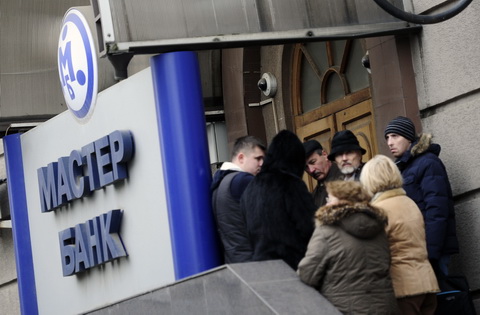
The Bank of Russia took a long-naughty and, nevertheless, unexpected decision to deprive the license of a large and very promoted master bank. Claims for both the regulator and law enforcement agencies have been accumulated to the bank since 2007, and there is no reason to doubt the validity of the decision. Nevertheless, the Central Bank closed not just the “laundry” used to launder, cash or withdraw money abroad, but a bank that served hundreds of corporate clients and stored deposits of thousands of private depositors, one of the leaders in the market for plastic cards, an active participant in the interbank lending market and the Russian stock market.
The Central Bank calls several reasons for the recall of the license: falsification of reporting, failure to fulfill the requirements of the legislation “in the field of countering the legalization (laundering) of income received by criminal means and financing of terrorism regarding proper identification of customers”, as well as in large -scale dubious operations. This scale was called the representative of the Central Bank - 200 billion rubles. In addition, the bank management is suspected of withdrawing assets by providing loans to structures related to the owners of the bank. The scale of such loans amounted to about 20 billion rubles.
Accusations against the bank did not appear yesterday. Back in 2007, the Ministry of Internal Affairs announced the bank's involvement in large -scale operations to cash out funds and their withdrawal abroad. Last year, the bank was already on the verge of a license’s review, and the Bank Vice President Yevgeny Rogachev was detained as part of the case of illegal cashing of 2 billion rubles.
However, the management of the bank was absolutely confident in its own inviolability. The “Bolshebnoy Talisman” of the credit institution was the cousin of Vladimir Putin Igor Putin, who met in the Council of Directors of the Bank, and at some point at all worked there as a vice president of strategy. In addition, the bank is associated with the name of Vladislav Surkov. Bank master, according to some reports, participated in the financing of “Nashists” and other youth pro-Kremlin groups.
Now the need for such services in the Kremlin, apparently, temporarily disappeared, and if it arises again, other structures “built” for other people will already provide them. Surkov is no longer in favor, the projects associated with it (for example, the Skolkovo Foundation) are “cleaned”.
The problem is that the master bank is not just “laundry”, which provided delicate services to one of the Zamremlin clans, but also large, legal, and some analysts believe that the system-forming bank.
In terms of deposits, he with his attracted 47 billion rubles took 41st place in the Russian banking system. Now the deposit insurance agency will have to pay the depositors a record 30 billion, and more than 15 billion risks burning, turning into ashes the confidence of citizens in the Russian banking system.
In addition, the master bank was one of the leaders in the market for the release and maintenance of bank cards, and two and a half hundred partner banks used the services of its processing center and an extensive network of ATMs. Many customers of these banks already have problems with plastic cards. The processing of the master bank proposed to take on Sberbank, and the Central Bank approves this intention. But for confidence in the “plastic” a serious blow was inflicted, and the campaign of the fight against cash, hired by the Sberbank, will now be much less convincing.
The collapse of the master bank can provoke a large-scale outflow of depositors from small and medium-sized Russian banks, and this is not their only problem. The deprivation of the license of one of the serious players in the market of interbank lending will lead to a reduction in limits and problems with liquidity in a huge number of banks. And since the Russian banking system has long been waiting for a crisis, which should provoke an explosion of a bubble in the consumer lending market, the collapse of the master bank can become the beginning of a chain reaction. Whether the crisis will break, it will depend on how quickly the Central Bank will act, which is quite capable of localizing problems.
In the past couple of years, almost all my friends on occasion are interested in whether the crisis is soon and asked to warn when it will be possible to start worried. So, taking this opportunity, I warn you: you can already start worrying.
Photo by ITAR-TASS/ Sergey Bobylev
| Print version |
-
 Maxim Blanc
 -
Maxim Blanus: There are many factors that work on the fact that in the long run, oil prices, at least, will not rise, but rather will fall ...
