
Translated material
Schnderovich corner: Part 7
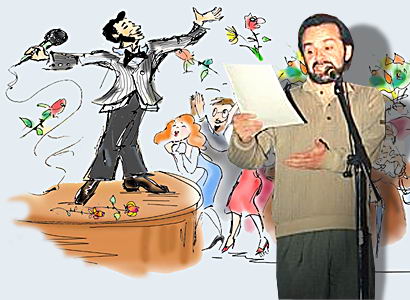
The stage is waiting
The eighty -fourth year, one of my first performances, happened in the eighty -fourth: on the outskirts of Moscow, in the Dzerzhinsky Park.
Dzerzhinsky was just missing there. Arriving behind the curtains, I found a drunk in Zyuzu Confransier - the Moskonzersky baby in a pink shirt. The baby was clearly needed by execution.
“The old man,” he said when I explained to him that, among others, I was invited to act. - How to declare you?
Seeing the state of a comrade on the stage, I wrote in print letters in the notebook my name and surname, torn the sheet and gave it into drunk hands. The entertainer read and said:
- This is not enough.
“No, no,” I remarked hastily. - Not a little at all. Nothing else is needed!
- Old man! - answered the baby and, gaining me, doused me with the smell characteristic of this area, especially in the morning on weekends. “Don't worry, I'll declare you.” This is my job - to submit an artist to the public ...
And he gave me.
- Speaks! - the baby shouted solemnly, as if at least a kobzon was waiting for the curtains behind the curtains. - Laureate of the Prize of the magazine Crocodile, laureate of Club 12 chairs, Literary Newspaper, laureate ...
Minutes for one and a half he, he did all the titles that he had to get in the next decade - and finished:
- Vitaly Shendryakevich!
Without ordering
In the eighty -sixth, damn me to submit documents to the graduate school GITIS.
Having passed the specialty to the five and something else, I hung up to the exam in the history of the party. (Another story, like another party, we did not have.)
Having taken the ticket, I relaxed because I immediately realized that I would give up five. The first question was the discussion on the National Care at some early congress (now, thank God, I don’t remember which one), and the second-Andropov’s report to the 60th anniversary of the USSR formation.
I, as luck would have it, knew and, quickly sketching the abstract of the answer, began to listen to how the abbot, which was being interrogated by the serving from the fraternal republics.
At the examination table, the girl Lena was tormented. Employees of the selection committee vainly served her about the simplest things. Zoya Kosmodemyanskaya told the Germans more than Lena that evening - examiners. The problem of the examiners was that they could not hang Lena: it was a valuable republican frame, which had to be accepted into graduate school.
“Well, good, Lena,” they told her finally, “you just don’t worry.” What are the communists, heroes of the Civil War!
“Chapaev,” said Lena, fulfilling exactly half the condition.
“So,” the commission sighed heavily. - And more?
“Furmanov,” said Lena, fulfilling the second half of the condition. It was completely useless to demand more from her. The commission heads looked at each other, as a saddened snake Gorynych.
“Lena,” said one head. - Where did you come from? From which city?
“Frunze,” said Lena.
The snake Gorynych smacked lightly and nodded with all his heads, letting the girl understand that in the search for a communist -hero she was on the right track.
- Frunze! - not believing her happiness, said Lena.
“Well, you see,” the commission said. - You all know, only worry ...
Having received the “four”, the messenger of Soviet Kyrgyzstan released a place at the table, and I followed my five with a plus. I was eager to thank the examiners for their patience with their erudition.
First of all, I set out in detail the Leninist position on the national issue. He mentioned the Stalin. Separately, he stopped at the discussion in the position of the Rykov -Pyatakov group. The examiners listened to all this, gloomy from a minute to a minute. By the end of the answer, I had an alarming feeling that I told them something superfluous.
- All? - the lady asked dryly, whose surname I, to her happiness, did not remember. I nodded. - Go to the second question.
I nodded again and began to quote the report of Yuri Vladimirovich Andropov, stuck in my unfortunate large -scale memory in large pieces. Pulling all this out, I considered the question closed. And completely in vain.
- When was the report made? - asked the lady.
I added to twenty -two sixty and answered:
- In the eighty -second year. In December.
- What date? - clarified the lady.
- Is the union formed? Twenty -second.
- I asked about the report.
“I don’t know,” I could assume that the report also happened on December twenty -second, but did not want to guess. It seemed to me that this was not important.
“In December,” I said.
“You don’t know the number,” the lady recorded and looked mournfully with the other heads. And suddenly, in a split second, I realized that I would not go to graduate school. And, running ahead, I will say that I guessed. Over the next twenty minutes, I could not answer the simplest questions. The simplest of them was a request to name the exact date of signing the Paris Treaty on the termination of the war in Vietnam. However, if I remembered the date, I would be asked to list the dead Vietnamese by name.
There was no chance. As the Studios once told us, Kostya Raikin: “What is an artist’s terrible dream? This is when you do not need, but you are. ”
I realized that I didn’t need to, took my two points and went away.