
Translated material
From the principle
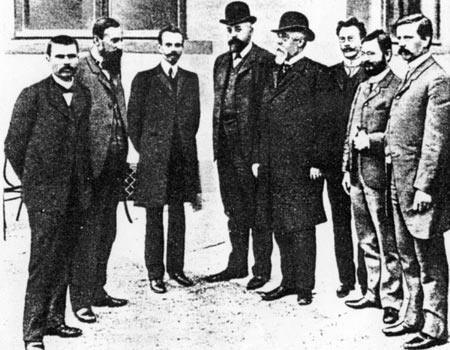
On October 12, 1905, the Constituent Congress of the Constitutional Democratic Party was nevertheless opened in Moscow. The founders had to overcome many obstacles. Including - purely "technical". At the last moment, the congress was almost torn off a village of railway workers. The passenger message was paralyzed, and a barely third of the delegates reached Moscow. But the revolutionary crisis in the country unfolded so rapidly that the audience decided not to hesitate with the creation of the party, because otherwise, as the editor of the Liberation magazine, Peter Struve, “elements that make up its natural, necessary personnel will be pushed into the background and the political fate of Russia will be resolved by the competition of reactionary and extreme parties.”
The main difficulty was, however, by no means technical. And she concerned just "personnel". The capable party certainly had to be soldered ideologically and organizationally. Meanwhile, the liberal camp was extremely heterogeneous. Moderate landowners, adjacent to the “Conversation” mug, did not want the Constitution for Russia at all. Members of the "Union of Zemstvo Constitutionalists", although they were not averse to acquiring a constitution, but were counted only on the merciful mercy. In the Union of Liberation there were many radicals demanding "end the timid half of the legal opposition" and "not be shy of the framework of the current law." And in the “professional political unions” created by his repair (lawyers, engineers, etc.), they generally set the tone. The party could only form, on the one hand, on the one hand, from the Levaki-Polusocialists, on the other, from the "idealists of the autocracy" and "incorrigible Slavophiles." The result of the concingence was quite unexpected and paradoxically effective.
The party came out purely intelligent, and its program was built on the protection of non -estate “interests”, but traditionally cherished by the intelligentsia of “principles”. The essence of the case was best formulated by the professor of Moscow University, the historian Alexander Kizvetter, the professor of Moscow University, formulated: “It is impossible to impose freedom through arbitrariness ... The entire political program of the Party of People’s Freedom follows from this situation (this second unofficial name was born just at the October Congress - N.S.), which boils down to the requirement of the establishment of such political institutions that would ensure the existence of a legitimate democracy. "
And indeed , the program developed by the congress was more likely to be a constitutional act, where the rights and freedoms of citizens and the arrangement of a capable “national representation” were described in detail. The program (with rare exceptions) did not offer recipes for resolving specific social problems and political conflicts. The future state of society was not predetermined in advance, but it was provided to the creative construction of these new institutions. So, to solve the “National Question” “, a legitimate path should be opened in the manner of national legislation” “After the establishment of the rights of civil freedom and the correct representation with constitutional rights for the entire Russian state”.
The same was essentially supposed to be in relation to the “working issue”. The program demanded the freedom of working unions and the creation of “conciliatory cameras”, and the “solution” itself should have arisen as a result of an agreement of entrepreneurs and employees as equal actors.
In the field of “agrarian legislation”, the program provided for an absolutely necessary equation of peasants in civil rights with other subjects of the empire and “an increase in the area of land use of the population treating the land by personal labor”, due to a special fund formed from state, as well as alienated “in the required size of private land land”. But here, “the beginning on which the lands of this fund are subject to transfer to the population who needed them” was supposed to establish future free legislative chambers “in accordance with the peculiarities of land ownership and land use in various regions of Russia”.
 Not much exaggerating, it can be argued that this intelligent focus on the “principles” with a relative inattention to “interests” provided the party with a very significant success. On the cadet principles, people of different classes and provisions came together-from the princes-Ryurikovich to recent immigrants from the "line of Jewish settled", from barely leading ends to the ends of zemstvo servants to completely successful landowners and merchants. In this sense, the ideologists of the party, such as the philosopher Nikolai Losky, were fully argued that "the party of folk freedom has an extra -class character, not bourgeois and not proletarian, but popular."
The intellectual inheritance, however, also affected the fact that the Russian Liberal Party turned out to be very “left” of European relatives. The ideology of the new party was weighed down by the idea of "the return of duty to the people." In the name of the common good, the Party of People’s Freedom, as Kizvetter formulated, demanded "in strong public classes of large and serious sacrifices in favor of destitute masses."
The success of the cadets was impressive. Less than a year later, the party totaled up to 100 thousand members and one and a half hundred provincial and city committees. In April 1906, the cadets triumphantly won the first parliamentary elections in Russian history and formed the largest faction in the State Duma. This circumstance must be emphasized, since the “Wittevsky” election law that was then the “Wittevsky” was so arranged that most electors made up the peasants. The Russian man was not only susceptible to the principles proclaimed by the cadets, but also significantly expressed sympathy for them.
The liberal trade and industrial circles, on the contrary, reacted to the intellectual party with suspicion, and did not spill golden rain into the party cash desk. However, successful party construction “from the principle” did not require large cash expenses. The budget of the Central Committee amounted to about 2,000 rubles a year and easily formed from the donations of numerous poor goodly. In the cadet “apparatus” there was only one employee on a high salary - the secretary of the Central Committee (by no means the chairman, there were no chairmen at all, but as Office Manager would say today), which was supposed to be 100 rubles a month (qualified, for example, typographic, the worker received four times less).
The party was intelligent in composition under the then, not undermined by seventy -year -old Soviet lies, the trust of social lower classes to “education” of great power.
The far -sighted Sergey Witte, shortly before the October Cadito Congress, who returned from the American Portsmouth, where the Japanese delegation and concluded the long -awaited world, was the first to try to capitalize this intellectual power, was the first to try to capitalize this intellectual power. On October 17, when the Cadets argued about the program points in Moscow, Witte forced Nicholas II a constitutional manifesto and was appointed chairman of the Council of Ministers.
Upon learning of the creation of the party, Witte asked to send a delegation from Moscow for a “mutual exchange of thoughts”, as he writes evasively in his evasive memoirs. In fact, the prime minister probed the possibility of the entry of cadet leaders into the government, which first received the character of the “cabinet”, which was obliged to jointly conduct a coordinated political course (before this reform, each minister was separately appointed by the sovereign, only he was responsible and acted, completely unsubscribing with the plans of colleagues). The deal did not take place. The prime minister claimed later that the Cadets refused to fulfill the “indispensable condition” he set by him - “cut off the revolutionary tail”. Intelligent liberals really then valued the "allies on the left." But another circumstance was crucial. The cadets in accordance with their program expected that the new state order would be created by promised legislative chambers. And the main task of Witte’s cabinet was in a hurry to develop the basic laws before the convening of the Duma, and the cadets did not want to participate in this fraud.
In the next twelve years, the Party of People’s Freedom experienced and upsets and falls, but in general it acted quite successfully. This statement can now cause the reader a sarcastic smirk. But political successes should not be measured on the absolute, but on a relative scale. The second largest Russian liberal party, the “October 17 Union”, created by practical business people in order to protect the interests of the Russian industry and, due to programmatic slurium, received the malicious nickname of the “Union of missing diploma”, never used the influence as cadets. And having concluded in 1907 a personal union with Prime Minister Peter Stolypin, the Octobrists became a “government” party in a specific domestic sense of the word: the government did not fulfill the will of the party, but the party fulfilled the will of the government, for which it received the nickname “Party of the Last Government Order”. And completely lost the trust of any wide voter.
But they did not allow the cadets to register the party. From year to year, brilliant cadet lawyers sent constituent documents to the Ministry of Justice, and officials invariably found more and more flaws in them. So the cadets lived all their lives without registration, at a semi -legal position.