
Translated material
What to do 11/12
“What to do” is an eternal Russian question that for utilities that suddenly find snow outside the window in winter, for an opposition, also suddenly detecting the election.
In less than six months before the notorious elections, the formulation of the question “what to do” is a clever departure from the reasonable “what had to be done”. The coalition stories of disagreed and loyalist attempts by ATP and Yabloko obviously failed in the last electoral cycle, along with ideas such as Boycot, Make the Bulletin and “Vote for anyone”. But so far in the country there are no institutions of accumulation and processing of experience, it does not even need its owners.
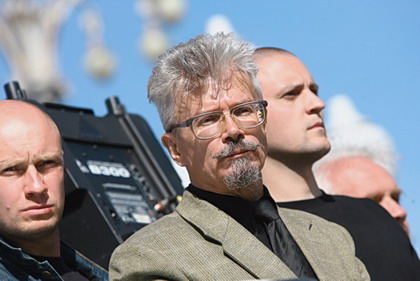
Limonov and Udaltsov decided to make the parties “Other Russia” and “Rot Front”, “Russia without corruption”, which became a party of folk freedom, was born out of the coolness of the Moscow Region. What a lot about these projects and what is the difference from the previous ones, few could clearly explain. To register a party in order to show activists and supporters the inability to register a party is like putting fingers into a socket in a edification of children. Even in private conversations, the depth of the plan was not found. One Udaltsov issued, moreover, in a completely passing interview, a sound political thought: we want to check the rhetoric of Medvedev.
Alas, even similar proactive attempts were 99% in the logic of the existing system. What did the country give the country of Kasyanov's party? Nothing. What does the registration of apple and the patriots of Russia give? Nothing too. As a result, the only tactic is a reaction to the “election without choice”. The reaction is a thing practically meaningless, but people need it, there is always a request for it. Hence there are many offers to arrange observation, take out or spoil the ballots, vote for anyone except a batch of crooks and thieves. The initiatives are very cute, but completely meaningless - without influential opposition and mass participation of citizens in public life, they are unrealized and remain ways to express several thousand radicals throughout the country. Even to create a media effect, these methods are useless due to the usualness and lack of a minimum intellectual background - it will fly into one ear, fly out.
The worst version of the reaction is “observation of the elections”. Correctly call this priesthood “observation of the results of falsification of elections” or, for political correctness, “observation of the voting day”. Elections - a long story that begins with the opportunity for parties and candidates to conduct legal political activities, advance, promote, have access to the media, etc. Such is the political science axiom, which for some reason it is customary to forget in anticipation of voting. For Western and domestic professional observers, the substitution of meaning - observation of voting, and not the election itself - is very convenient. A brief report for many years is about the same: “We have recorded individual violations. In some situations, violations were very serious and will be appealed. In general, the elections can be recognized ... ".
Perhaps I repeat once again: elections in a free country imply the right to nominate, conduct a campaign, have equal opportunities with competitors. The voting day is only a collective, festive event translating the situation from de facto in de jure. The current electoral cycle passing without the participation of 9/10 political forces, by all scientific rules there is falsification. Having made the elections a bureaucratic nonsense, the authorities focused the entire content on the carnival part, the necessary system for the legitimacy of external and internal. In short, the “observation” during the day of voting by independent organizations, opposition or human rights, there is legitimization of falsified elections. Some have a desire to watch it is related to financial interest, for others-with the desire to at least somehow self-explode.
In the topic of legitimacy, the systems are looking for answers to the question "What to do during the election?" Oppositionists-intellectuals Belkovsky, Corb, Illarions, etc. So far, they have not yet come up with effective ways to undermine the legitimacy, you can squeeze into the mechanics of the system. To ensure a credit of trust in the next years, the authorities are forced to mobilize citizens, to warm up excitement before the elections. So that the people come off from minor trouble and somehow fulfill the civil duty, albeit reluctantly and without passion.
In democratic countries, civilian technicians are able to catch the moment of agitation and embed their own wishes through the petitions, orders, etc. Let the deputies and parties on the civilian agend do not depend on Russia, but now there is a unique chance of mediating any topic related to the elections. For example, the issue of direct elections of governors, the expansion of regional parliaments or the introduction of the column “against all”. If politicians and social activists require the return of the elections of the heads of regions, then the initiative will be simultaneously a fresh thought, activity outside the logic of the system and the answer to the eternal question.
Photo by RIA Novosti