
Translated material
Is it to us NATO?
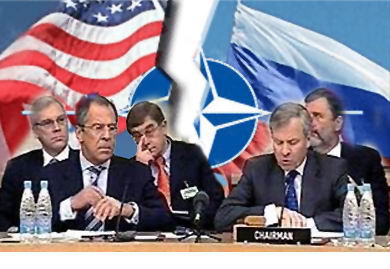
Just today, on Monday, according to the talkative Dmitry Rogozin, a representative of Russia in NATO, in the Kremlin they will decide how to build relations between Moscow and the North Atlantic Alliance. Moscow has already given its adequate response to the decision of the North Atlantic Alliance not to hold meetings of the Russia-NATO Council. It was stated that our country was generally suspended military cooperation with NATO. The most, as they say, is time. After all, it turned out that the plan of Sarkozi-Medvedev to resolve the Georgian-Russian conflict is very difficult to use. Because too general and short. What gives participants in the conflict the opportunity to interpret its points in a completely different way.
Defense Minister Anatoly Serdyukov announced last Friday that the Russian army had completed a departure from Georgian territory. Representatives of Georgia immediately announced that the troops had not left at all from the entire territory. For some reason, the presidents of the United States and France believed Tbilisi, and not to Moscow, and decisively demanded that the previously adopted fulfillment.
Another “misunderstanding” arose due to the fact that the parties interpret in different ways what the “security zone” between South Ossetia, Abkhazia and the Georgia actually controlled by the Saakashvili government should be. In the West, it was believed that this same “zone” would not be wider than ten kilometers. The Russian General Staff drew this “security zone” in such a way that it goes to Georgian territory to a depth of 18 kilometers. As far as you can understand, the logic of the Russian military is such. The security zone is restored, which was established by the Dagoma agreements of 1992. The same agreements were assumed that peacekeeping forces would be mixed, with the participation of Georgian military. However, now Moscow excluded the participation of Georgia in these peacekeeping forces: they say, we will not have any more deeds with the traitors who shot in their Russian comrades. On this basis, the Russian military is going to be where Georgian peacekeepers were located. Moreover, our General Staff insists on the right of peacekeepers to leave this zone. For example, in the area of Port Poti. The words of General Nogovitsin (who clearly overstrain after two weeks of communication with the press) that “our peacekeepers will not sit and watch how Georgians roll out on“ Hammers ”in Poti, should obviously understand that Russian troops will not allow Georgian to prepare another military operation.
There are serious doubts that the West will agree with the Russian interpretation of the Sarkozy plan. But the UN Security Council, as in the Cold War, is reliably blocked and cannot make any decision. As a result, only Russian troops will be in the security zone, and only in Moscow they will be called peacekeeping. At the same time, Russia will be constantly accused of disruption of agreements. If it lasts long enough, the Moscow, the more it will slide down to the position of the world outcast.
I suspect that the situation in the most serious could change the entry into the zone of the peacekeepers conflict from other states. It is no coincidence that the French president is inclining Dmitry Medvedev to ensure that the OSCE representatives control the “security zone” outside the territory of South Ossetia. I note that, strictly speaking, only the operation of international forces, that is, the forces formed by several countries in the UN mandate or regional organization, can be called peacekeeping. Prior to the conflict, it was Tbilisi who insisted that peacekeepers from other countries were introduced into the confrontation zone. And the authorities of South Ossetia and Abkhazia, being, of course, completely independent, decisively rejected such an opportunity. Moscow, too, was not tuned to change the mandate of the operation. Meanwhile, if the French or Germans were in the conflict zone, Saakashvili would hardly have risked attacking Tskhinvali.
If Moscow has no plans to annex Georgian territory (and I believe that this is exactly the case), then the introduction of peacekeepers from other states could legitimize the current status quo. And this would be in the interests of Russia (again, if we proceed from the fact that it does not want a new Cold War).
Only now the question arises, what countries could send their units to this area. It is clear that as soon as Russian troops enjoy the full confidence of South Ossetia and Abkhazia, Georgia will insist that other peacekeepers are from among the NATO states. And if such a decision were made, then the question of joint or united command would inevitably arise.
I must say that something similar already took place in 1999, when the North Atlantic Alliance began a military operation against Yugoslavia. General Leonid Ivashov, prone to dramatic effects, who then headed the Office of International Cooperation of the Ministry of Defense, defiantly tore a plan of cooperation between Russia and NATO to the German Colonel Manfred Dilya, who then headed the Bureau of the North Atlantic Bloc in Moscow.
However, only a few dramatic months have passed, and Russia, along with NATO, participated in a joint peacekeeping operation in the region. I must say that the path to this was not easy. It is enough to recall the "heroic" raid of an enhanced airborne company on Slatin. In my opinion, the world community still has not appreciated the feat of British General Michael Jackson, who, in response to the order of the Russians from the airport, said that he was not going to start the third world war because of Kosovo. As a result, in Kosovo, quite effective cooperation between the Armed Forces of Russia and NATO was established.
Just now, when professional Kremlin propagandists proudly say that, they say, we do not need any cooperation with the North Atlantic Alliance, when we refused this cooperation the second time in ten years, it's time to think about its meaning.
Indeed, the interaction of Russia and NATO is quite specific. The fact is that both Moscow and Brussels can quite calmly do without each other in the field of security. Perhaps the only exception here is the transport support of the NATO operation in Afghanistan. You can’t say against geography - here Russia is vital for NATO, since transit through its territory the most convenient. Looking at all other cooperation programs, one cannot help but see that they are specially invented to demonstrate that the interaction between our country and the North Atlantic Alliance exists.
In fact, this is not so little. For half a century, the alliance troops were preparing to withstand the threat from the East. In the same way, several generations of our military were preparing to fight with an "aggressive imperialist block." It so happened that when the period of confrontation ended, Moscow and Brussels did not have common threats that would make general efforts to eliminate them. But at the same time it was extremely important to demonstrate that we are not opponents. Just for this, the two watchdrops of the Black Sea Fleet participated in patrolling in the Mediterranean Sea, and the military personnel of our army regularly lead the American Bradley and Abrams as part of the Torgau doctrine.
However, even this form of “peaceful coexistence” does not protect against regular crises and mutual claims. And the reason for this is the so -called Values Gap, that is, a gap in values. Moscow has stated dozens of times that she did not intend to build life in Western tracing paper. That is, to live in accordance with all sorts of stupid things like the rule of law, respect for civil freedoms and human rights. Because the former Soviet people did not ripen in order to be free. As Vladimir Putin said at one time, our country needs twenty “manual management” years.
This is where the main contradiction between Russia and NATO is located. The desire of Georgia and Ukraine to join the North Atlantic Alliance is considered by Moscow as a call. And the call, as it seems to me, is not a military nature. All conversations about the possibility of the emergence of some “NATO” military bases in Georgia and Ukraine, from which rockets can launch in Russia. Because missiles that could pose a danger to Russia were destroyed twenty years ago in accordance with the Soviet-American Treaty on the destruction of medium and smaller missiles.
Another thing is that Kyiv and Tbilisi suddenly stated that the Ukrainian and Georgian peoples comply with the Western standards of democracy, that they do not need the decades of “manual control” at all. And this was already a challenge to the Kremlin, and much more serious than the hypothetical appearance of military bases around the perimeter of Russian borders.
If you call a spade a spade, just the desire to prevent Georgia in NATO and has become decisive for Russia's policy in the region. It forced Moscow to lead a complex game with separatist enclaves. The game that ended in war. And it is possible, by the accelerated technique of Georgia and Ukraine in NATO. It's time to think, is it to us NATO?