
Translated material
Story
In society
 Story
Story
November 7, 2019 Alexey Makarkin
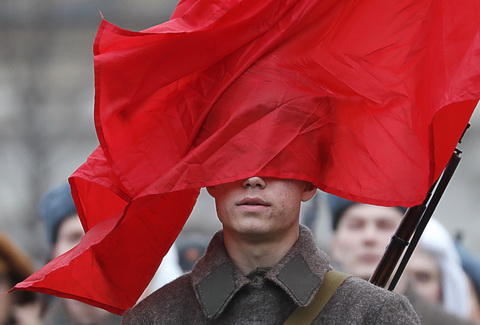
The holiday of November 7 was easy to cancel. Even before its official cancellation, he became the corporate holiday of the Communist Party, the influence of which has sharply decreased compared to the 1990s. Ordinary Russians used this weekend in order to relax with the family of the house or complete the country season, preparing a phase for winter. This can be done with equal success on the 7th and November 4.
The abolition of the holiday is justified on November 7. This day has become a symbol of the tragic split of Russian society. Much and rightly written about mass terror, which became the result of the revolution. Now, often the scale of this terror is undermined, considering it the victims of only executed and at the same time rehabilitated. And even the rehabilitation procedure itself is called into question, although there were no automatic revision of sentences - investigators re -interrogated witnesses and studied falsified cases. Often the red and white terror is equalized, although the latter was directed against specific opponents of the White movement, and the first - against entire social groups, which were considered to be disloyal.
Moreover, people who would be sincerely outraged about the usefulness of repressions if they were pulled out of a cozy apartment for at least one day and sent for no reason to spend the night at the police department. But these same people do not consider the victim of the repressions of the peasant, from whom they selected all the property and hugged in exile (and only during collectivization 4 million people suffered). Or a priest who is deprived of all rights and means to exist and who died from hunger. Or an officer who was “lucky” to survive after the Operation “Spring”, to survive the conclusion and be released by the deadly sick. The revolution is broken human destinies, which cannot be corrected by any rehabilitation.
But do not forget about something else. The simplest thing is to blame a bunch of conspirators who were hired by the German General Staff (this is as absurd as the idea that another General Staff, Austro-Hungarian, came up with Ukraine). Yes, the circle of Lenin's associates was small, but do not forget that the Bolsheviks supported a considerable part of society. Not the majority - they lost the elections to the Constituent Assembly, and the fact that universal suffrage was returned only in 1936 shows that the Bolsheviks had no illusions about the approval of their policy. Nevertheless, there are many Russians baptized in the church and studied the Law of God on the side of those who aggressively rejected religion and persecuted the clergy. Or indifferently, they relate to the closure of temples and the death of pastors. The execution of the royal family was perceived in society calmly, although it was a recent autocrat, whose portraits hung in all present places and for whom they prayed in the church at every liturgy. Behind the external veneration of the sovereign and the Church, a variety of gamma of feelings was hidden - from hatred to indifference.
You can remember another important topic. Now, in many respects, with the presentation of Nikita Mikhalkov, there is veneration of Alexander III, which looks like a powerful symbol of the autocracy. And a number of authors - from the Great Solzhenitsyn to unknown epigones - stigmatized the liberals and the elite, who betrayed his son and involuntarily contributing to the coming of the Bolsheviks to power. Other voices sound much deaf. The voices of those who pay attention to the fact that the “freezing” of Russia, the dramatic gap between the economic modernization and the political stagnation became one of the main causes of the crisis of the monarchy. And the archaicization during the reign of Nicholas II, sincerely passionately enthusiastic about the traditions of the 17th century, could not contribute to the solution of the numerous problems facing the country - but supported the illusion of the people's love for the sovereign. And none of the opposition did more to discredit the monarchy than Rasputin - no matter how now they made the holy old man in films and publications.
The Bolsheviks, in turn, offered people the possibility of vertical mobility, launched social elevators. The accelerated elimination of illiteracy was ideologized (children and adults from the very beginning were taught communist dogmas), but became a response to a real challenge, which the previous government could not cope. The plan of universal training began to be developed under the king only after the Russo-Japanese War, which showed the mismatch of the conscripts to the tasks of the modern army. Prior to this, education sought to limit the parish schools, and they tried to regulate the social composition of the gymnasium students (however, not always successfully-life took its own) the sad circulator about the “cook children”, adopted under the same Alexander III.
The same applies to the famous electrification plan, which was developed by professionals who worked on similar projects back in tsarist times. But then they were not among the priorities - the plan of state support for economic growth was approved only a few months before the start of the First World War with the efforts of the ministers of Krivoshein and the Bark. Too late - and the story does not forgive late.
And the last. The Bolshevik terror was convicted of numerous Russian officials. But the paradox is that those who acted with weapons in their hands against this terror continue to officially be considered violators of the law (although the Bolsheviks themselves abolished all the legislation, and during the civil war they replaced laws to arbitrariness called “revolutionary legality”). Lenin, Trotsky and Stalin are not recognized by criminals, while Kolchak officially remains so. Veterans of the Armed Forces brought up in Soviet traditions demand to remove the memorial plaque to Kappel opened in Ulyanovsk - and they are going to meet them so as not to offend retirees.
You can cancel the holiday on November 7, but the Soviet tradition associated with the justification of arbitrariness, committed in the name of the “bright future”, is much more tenacious, although it gradually goes into history.
Author-First Vice President of the Center for Political Technology
Photo: Mikhail Japaridze/TASS