
Translated material
Noah's ark
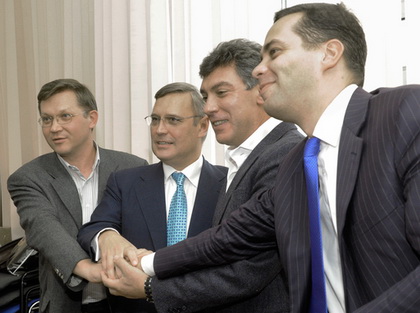
The creation of the opposition coalition “For Russia without arbitrariness and corruption” is an attempt to agree on joint actions before the presidential election. Parliamentary, although declared as one of the goals, is more inertia. Only parties can participate in the Duma election campaign, and registered at least a year before the date of the election. And they will take place in December (or October, if the initiative, just voiced by Boris Gryzlov) of 2011 passes. There are currently no chances for a serious change in the electoral system - for example, for the restoration of majority districts or admission to the elections of movements and blocks.
So, presidential elections. Recall that in 2007, another Russia tried to nominate a single presidential candidate. The only opposition politician capable of collecting two million signatures of voters laid down by law was then Mikhail Kasyanov, but his reputation for the former Putin prime minister did not allow him to become a consensus figure. As a result, Kasyanov went to the elections on his own, but he did not count the signatures (while the explicit “safety” candidate of Bogdanov’s authorities was allowed without problems). It is unlikely that Kasyanov would have been allowed to participate in the race if he had become a single candidate, but in this case the effect of refusal to register would be higher.
Now the second attempt is being made - and it is difficult to say how successful it will be. The existing Russian party system (or rather, the mass of formal and informal barriers for registration) creates almost insurmountable obstacles for the emergence of new parties - it is not to be considered such unification projects implemented under the patronage of the Kremlin. Therefore, a kind of noev arose arises. In modern Russia, the liberal has to unite with the conservative, which, by European standards, looks strange. So among the leaders of the new coalition there are two liberals (Boris Nemtsov and Vladimir Ryzhkov), conservative Vladimir Milov, and it is more difficult to describe the political views of Mikhail Kasyanov. Officially, he acts as a liberal economist, but in his mentality it is more likely to be a political pragmatist, the will of fate (and Vladimir Putin) pushed out of power into opposition policy.
In the ideological diversity of the coalition participants, there is a plus: in the end, it is itself that such different and ambitious people were able not only to sit at the same table, but also to formulate the “road map” of the creation of the movement: from the formation of the organizing committee to holding the congress with the sight to the party institution. But in it - and not just in the struggle of pride - lies a considerable risk. It is known that Milov had just left the “solidarity”, in which left -wing liberals prevailed, considering the movement not so much as a “protoparty”, but as a human rights structure. The answers of human rights defenders to many problems that excite society (for example, attitude to minorities, migration) are usually opposite to the priorities of conservatives - this is clearly manifested during the scandal with the deportation of gypsies from France.
The relationship between the majority of “solidarity” and the new coalition, in which Milov plays a significant role, is one of the intrigues that will determine the future of the next unifying project. It seems that soon it will be possible to get an answer to another question: how much the priorities of Nemtsov correspond to the interests of this majority. Especially due to the fact that “solidarity” recently expressed a desire to transform into the party itself - how is it combined with plans to transform the newly created coalition into a batch (while we leave the issue of registration after brackets)? And whether human rights activists and their opponents are capable of ideological compromises, not in theory (where you can build various beautiful constructions), but in life, which often puts politicians before an uncomfortable choice. For example, how to relate to the refusal of the Polish court to give Russia Zakayev - for the conservative this is by no means a reason for joy (he is generally negative about all the successes of the separatists), while the human rights activist clearly sympathizes with the emigrant who once again avoided meeting the Russian pre -trial detention center. And there will be a lot of such challenges of the unity of the coalition. At the same time, the new coalition does not have a strict ideological incompatibility for most basic issues (market economy, competitive democracy, foreign policy priorities, etc.) - unlike “other Russia”, where the liberals were adjacent to the National Bolsheviks.
However, observers are more likely to pay attention to other problems. On the already mentioned “personal”, which can be considered chronic for Russian politics (it is enough to recall the many years of confrontation between Chubais and Yavlinsky). Now in the coalition there is no obvious leader around whom the unification could happen, as happened in Ukraine in 2004 (even Tymoshenko was forced to temporarily support Yushchenko) - and this increases the risk of a split. Kasyanov’s position, who could become such a leader in 2007, is now seriously weakened - he is not perceived as a “recent prime minister”, but as a figure from the past, almost like Rybkin. They pay attention to the shortage of resources - information, financial and organizational. The low level of population requests to the supreme authority, which helps to preserve a rather high rating of participants in the ruling diarchia, despite a lot of claims to specific officials traditional for Russia, “bad boyars”.
All these problems exist, and each of them is really serious for the new coalition. But, probably, the experience of political dialogue and the achievement of mutual understanding, which can be in demand not only in 2012 (hardly anyone seriously doubts the outcome of the presidential election) as in the future. After all, the upcoming elections will not be the last in Russian history. Another thing is whether this coalition will “last” for a long time (even, perhaps, in a modified format) - taking into account the fact that there are no quick successes.
Author - First Vice President of the Center for Political Technology