Here the Chekists tormented the Lithuanians, and the Lithuanians killed Jews
At first it was a fortress that defended Lithuanian Kaunas from the north-west. Then a prison for ordinary criminals. Then - for political prisoners, whose path lay on Kolyma. Then the place of execution of the Jews. Then again a prison for sending to Siberia. Since 1958 - a museum. The museum from the fort of death - its second name - did not work, it turned out to be continuous pain and shame. From repulsed memory - in some and the inability to admit their guilt - in others. And exactly this does not allow to reconcile the past with the present and 70 years later
"Why do you need it?" -The woman-ciosker, who sold tickets to the museum, was completely surprised. There are two museums in the ninth fort, respectively, two tickets. One, new, built already in the 1990s, is dedicated to the history of the Molotov-Ribbentrop Pact-the prologue of the first Soviet occupation of Lithuania, the deportation of thousands of Lithuanians to the Gulag, the repression of the second occupation, which began when the Red Army liberated Lithuania from the Germans. Only during one operation “Vesna” and only in May 1948 36 932 Lithuanians, including women and children, were sent to Eastern Siberia, at least 21 thousand people were killed. Another museum is called in the reference books as “old” - it is about the atrocities of the Nazis, about the tragedy of the Kovnovsky ghetto (the former name of Kaunas), about the death of a whole culture: 168 thousand Jews lived in the pre -war Lithuania, after the war there were only 6% left - 143 thousand in the camps, in gas chambers, in the ghetto. In Paneriaye, a place of 8 kilometers from Vilnius, they shot 70 thousand, here, in the ninth fort - 30 thousand, of which 9,200 were taken from different places from the ghetto: except Lithuania, from France, Austria, Germany. They were shot, including, if not first of all, by the hands of the neighboring liths. "Why do you need it?" - Realized this, old museum.
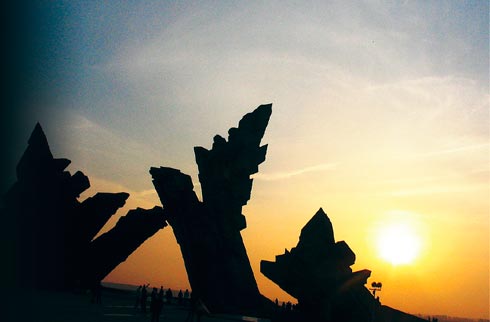
In memory of the dead Jews on the hill of the ninth fort in 1984, a monument was erected 32 meters of the sculptor A. Ambraziunas. The project on the stele was supposed to have a gilded star of David - they abandoned it, as they refused the mention of the word “Jews” - the inscription was restored in the original form in 1991, already in independent Lithuania
One true ...
“Born in the USSR,” as it is sung in a well -known fucker, it is difficult to walk along the new museum. Even if I read and heard what ours was doing in the Baltic states, it is still uneasy and certainly do not want to speak Russian here. The feeling of guilt from involuntary complicity - at least on the basis of citizenship - presses on the floor and squeezes the throat. Here the farmer and his family are expelled from the farm, here the column reaches for calf wagons, here is a letter about how hundreds of people were thrown into a 40-degree frost on the Siberian half-land, where neither the Cola nor the yard and where the children turned into corpses, here are evidence from Norilskla, where the arrested in the middle of June 41st, even before the start of the war, even before the start of the war, even before the start of the war, even before the start of the war Lithuanian officers. Here-a certificate of Kraslag (Krasnoyarsk ITL): in the summer of the 41st, the thousands of Lithuanians were driven there. “To arrange”, that is, they didn’t have time to give sentences: most of them died the next winter, and condemned them already posthumously. Others received for 5-10 years, and those who were awarded the "tower" were shot in a Kansk prison. Further - certificates of already post -war era: special settlement in Kazakhstan, in Komi, in other places of the immense USSR. Further - the history of resistance, the Lithuanian Union of Freedom fighters, Samizdat, Tamizdat, Politzon, a punishment cell: you can take a breath - this is already our, common, one fate ...
... and the other is also true
If in the new museum people meet, excursions go, then in the old, memory of the Holocaust, there is a booming emptiness. This story here is a stranger. And not only here, a few kilometers from the rebellious and fallen Kovnovsky ghetto (he was immortalized in his novel “The draw lasts a moment” Itskhokas Meras: the book on the oversight came out in Russian in the early 1970s, and it was immediately removed from all libraries), throughout Lithuania. “The Jews have never lived here,” women and years old, about seventy, who passed along the sidewalk told me in Kaunas - exactly 20 meters from a small black obelisk, on which there were a gate to the Kaunas ghetto. ” And others repeated exactly the same-“No, no, there were never here”-in Zagar, once, before the war, a Jewish place on the border of Lithuania and Latvia. But the ghetto was also in Zagar: now it was on the square where he was shot that the obelisk “fell for the independence of Lithuania” is a monument, including those who fought for this independence in the SS Wehrmacht and Divisions. “20 local guys participated in the Hetto's execution,” Isaac Mendelssonon told us the only surviving Jew in Zagar. ** Today in Zagar there is no him: Mendelsson under 90, he is in the nursing home in Vilnius. Not far from the town, in the forest, a hundred meters from the road there is an obelisk, in which in three languages - Yiddish, Hebrew and Lithuanian - carved: "Here on October 2, 1942, the Germans and their local assistants shot 3,000 Jews." There were no people here for a long time: the path to the obelisk had to be laid - the grass was high ... In the ninth fort, there is also an obelisk - large, prominent from all sides, and the inscription is also in three languages, only the numbers are different: "This is a place where the Nazis and their assistants killed more than 30 thousand Jews from Lithuania and other European countries." The inscription in this form was engraved already in 1991, when the country gained independence: in the information brochure it is specifically indicated that during the USSR, the words “Jews” were not on the monument - “everyone was called by a common name - Soviet people”. And then the truth is that the Holocaust fit poorly into Soviet historiography, and the first museum of the disaster in Moscow appeared only in the early 1990s.
Here tears and blood are forgotten ** From the song of Alexander Galich in memory of Janusz Korchak - a writer and a teacher, a Pole by a nationality who went to the gas camera along with Jewish children of the orphanage he headed.
In Lithuania, you clearly feel: the Hitler’s “final solution to the Jewish question” here was realized one hundred percent - and not only how many were killed (94%), but also how carefully it was out of memory - “did not live”. Therefore, today's marches under the sign And possible. But the trouble is in another - that the two Soviet occupations of Lithuania in the country, which is the heiress and successor of the invaders, are not recognized and not convicted in Russia. The author occupied the author for a long time: why with the Germans - with the eastern before, with the Western now - we, who have lost more than 27 million people through their fault, managed to find a common language, and the German chancellors are present at our Victory Parades and for that in Germany they are not condemned, on the contrary, they accept as compulsory and due? And I have one answer: Nuremberg. Whether the trial court was the right - the subject of the discussion, but fair - of course. And justice is primarily in the fact that the guilty were named - with specific names and surnames. This did not remove the fault from those Germans who led Hitler to power, but allowed their children and grandchildren not to be accomplices: in the end, each crime always has specific performers. Neither Russia nor Lithuania did their Nurembergs, and therefore shame and wine - for the murder of civilians by Soviet executioners and defenseless Jews by Lithuanian, as well as shame and curse - were smeared at everyone. And everyone became accomplices. Children, grandchildren, great -grandchildren of executioners and victims - including.
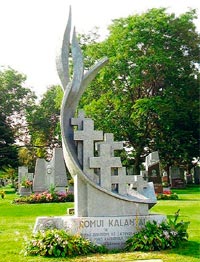
Monument to Student Romas Kalant in Kaunas: on May 14, 1972, he set fire to himself on the main street of the city - Alley Laisves. The underground “Chronicle of current events” wrote about him in his 27th issue: “Calanta made self-immolation in the city garden near the Kaunas Musical Theater, opposite the building of the city executive committee at about 13 o’clock/ .../ He doused himself with gasoline, his remnants splashed around the ground and set fire to himself. The young man who rushed to him asked them to kill him. Soon he fell without leaving the fire circle. It is only known that Kalanta protested about the orders existing in Lithuania and claimed that it was better to die than to live as before. The burns received were so vast that in the hospital where he was delivered, had to be injured in the soles of the legs. According to rumors, Kalanta often repeated in delirium: "I will not say anything." According to rumors, the KGB officers were constantly on duty at his bed. He died a few hours later. " Since then, in Soviet dissident circles, Kaunas began to be called Calantograd, and in Lithuania itself he became a symbol of the struggle for freedom and independence. There is a stele in memory of the calate in the ninth fort - she meets you at the entrance to the new museum.