
Translated material
Online in the past
As modern Russian media would publish the USSR news.
The constitutions of the Soviet Union proclaimed freedom of speech and press, but in fact the Soviet media were completely controlled by the authorities and censorship. After the revolution, the printing house was nationalized. The release of private publications could occur in the form of Samizdat, but this threatened with persecution.
The agenda of the Soviet press depended on the level of publication and the era. After the war, she lived on the principle of "about the USSR either good or nothing." Crime, if it fell on its pages, a small line telling about the square of Soviet justice. In a meticulous manner, it was announced in the field: anti -Soviet phenomena were criticized among individual people and small groups of citizens.
They wrote worse about foreign countries - before the war they were waiting for the world revolution from the proletariat. After - they praised the achievements of socialist countries and were worried about the fate of workers in capitalist ones. On the first lanes - slogans and instructions of the party and government, on the latter - the program of transmission of radio and television.
We wrapped the headlines of the Soviet media into the look of modern Russian news sites: the texts of the headings themselves are not adapted to the style of modern publications, but were taken from the original newspapers of those years. Ten days of history and ten screens about them.
The beginning of red terror
M24.ru dated September 3, 1918
The beginning of September 1918, Moscow met in tracking the health of Vladimir Lenin. Every day the press printed the ballot about the well -being of the head of the Soviet government - on August 30, an attempt was made on Lenin. The shooting Socialist -Revolutionary Fanny Kaplan was shot and burned on September 3 in the Kremlin.
On the day of the attempt on Lenin in Petrograd, the chairman of the city Cheka Moses Uritsky was killed. Including these two events became the reason for the declaration of red terror - the current number of executions was recognized as ineffective to combat enemies and white terror, it was necessary more. All the Right Socialist Revolutionaries were to be arrested and part of the bourgeoisie and officers were taken hostage. On September 5, about 80 people were indicatively shot in Petrovsky Park, including former ministers and chairman of the State Council.
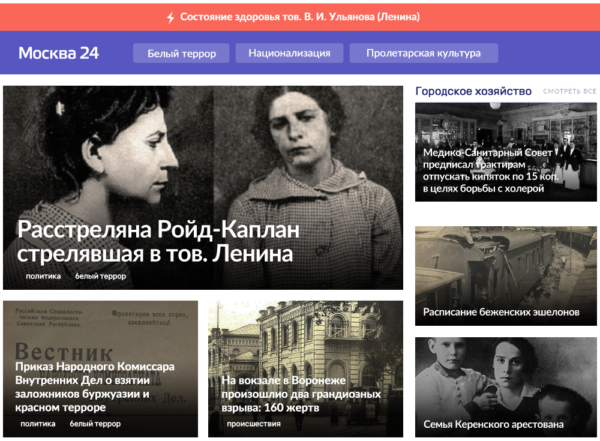
On the same days, Ust-Sysolsk (Syktyvkar) arrested the family of the former chairman of the Provisional Government and Socialist-Revolutionary Alexander Kerensky: in fact, at that time his ex-wife Olga, two sons, mother-in-law and niece of his wife. In the press, the arrest was filed as an answer to the actions of the intervention in Arkhangelsk, but Olga Kerenskaya was not shot, but sent to the city of Kotlas. Later, with the help of a fake passport, she emigrated from Russia to the UK. The sons of Kerensky became engineers there. Olga’s brother, former Major General of the army Vladimir Baranovsky, in September 1918 began to serve in the Red Army. In 1931, he was repressed and died in the camp.
The beginning of dispossession
RBC dated February 15, 1928
In early 1928, an active campaign resumed against fists - wealthy peasants. The Bolsheviks accused them of specifying with prices and concealing stocks, which led to a decrease in bakery and increasing prices.
The call followed to combine the efforts of state and cooperative procurers against fists and speculators, but without excesses. Inside the CPSU (b), then there was a discussion how to deal with the kulaks: economic or repressive methods. As a result, supporters of rigid power measures won - dispossessing through arrests, violently leaving farms and relocation. Not only prosperous, but also the middle peasantry suffered. The dispossession policy led to mass hunger and product deficiency.
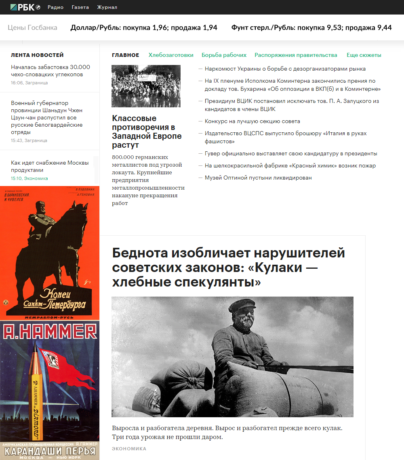
The intra -party struggle will cost the lives of its participants - the opposition to Stalin will be repressed. In early 1928, Lev Trotsky, a representative of the left opposition, was sent from Moscow to Alma-Ata. In the same year, one of the supporters of the left opposition Pyotr Zalutsky rejects from it and is restored in the party. This will not save him: in nine years he will be shot by decision of the second Moscow process.
The ban on abortion
Wonderzine on May 28, 1936
Under Stalin’s rule, family policy was tightened: unification of schools, the introduction of benefits for large families, criminalization of sodist, canceling free marriage, complicating the divorce procedure and banning abortion.
Abortion was banned in 1936, with the exception of permits for medical reasons. Before taking the ban, the collection of opinions on the bill, which were printed in the press, was deployed. Most were for the ban, but part of those who were against it were printed.
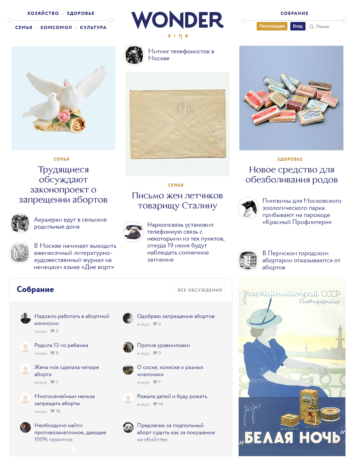
The consequences of the ban was an increase in the number of illegal abortions, maternal mortality and detublines. The growth of the birth rate was short -term. Against this background of this, the real demographic picture on the censuses of the late 1930s turned out to be worse than planned. The ban on abortion was canceled after the death of Stalin, in 1955.
The second Moscow process
"Mediazone" dated January 30, 1937
Three Moscow trials of 1936-1938-connecting in the "large terror" of the pre-war years. They were judged by the famous Bolsheviks, who allegedly intended to commit a coup on the direction of Leo Trotsky, arranged terrorist acts and spied on enemy states.
The second Moscow process took place in January 1937 and was widely covered in the press. The case of the "parallel anti -Soviet Trotskyist center" ended with thirteen mortal sentences. Four more accused were sentenced to imprisonment, but subsequently killed. By the end of the 1980s, the Supreme Court of the USSR rehabilitated all the sentenced ones.
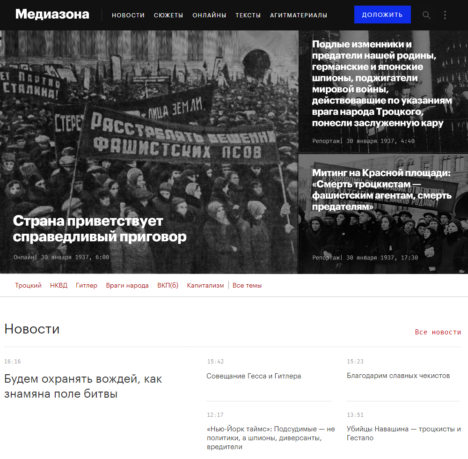
The process and its decision in the press were approved by workers. Festive rallies began at night immediately after the announcement of the sentence. According to the press, 200 thousand people gathered to express their agreement with the verdict on Red Square of Moscow. 1937 became the peak of mass political repression in the USSR.
The anniversary of the Baltic states to the USSR
Meduza on July 20, 1950
July 1950 became a festive for the Baltic Soviet republics - Latvia, Lithuania and Estonia. They officially noted the tenth anniversary of the annexation to the USSR - "the elimination of the anti -people bourgeois regime and the release of foreign imperialists from the bondage."
In Riga, the celebration was reflected in the city landscape. The main street was renamed in honor of Lenin. Previously, she was Big Aleksandrovskaya, Brivibas (Freedom) and Hitlerastrasse. In the same July 1950, a bronze sculpture of Lenin was installed on it. After the declaration of independence of Latvia in 1991, the street was renamed Brivibas, and the monument was demolished.
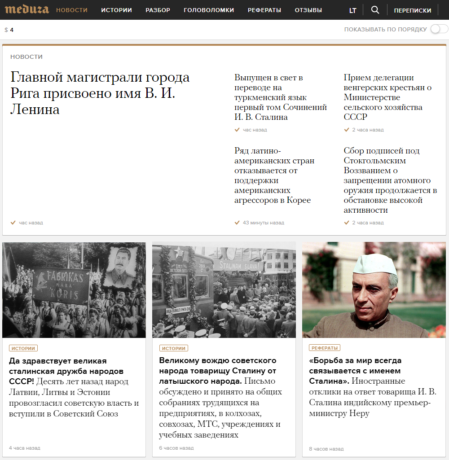
Throughout 1950, the USSR was collecting signatures under the Stockholm appeal. This is a document with a call to ban atomic weapons adopted by the World Congress of supporters of the world, which was funded from the USSR. In total, 115 million signatures of Soviet citizens were collected. Then it was already known that the USSR has its atomic weapon and recognizes its presence.
Launch of the first artificial Earth satellite
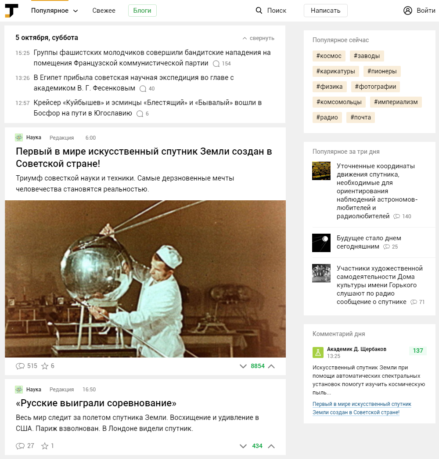
TJ dated October 5, 1957
The first World Triumph of the Soviet Cosmonautics is to launch an artificial satellite from the cosmodrome in Baikonur. He made 1440 revolutions around the Earth and showed that the cosmic dreams of the Soviet people come true. After 3.5 years, another triumph will occur - the flight of Yuri Gagarin.
Revolution in Chile
RT of September 13, 1973
The struggle of foreign workers has always been under the attention of the Soviet press. In the 1970s, the world was divided into friendly socialists, where the workers won, and enemy captrances, where the workers are still not easy. The overthrow of the socialist government in Chile in 1973 was perceived very painfully.
The military coup in Chile led to power the military junta Augusto Pinochec. Socialist President Salvador Alende died, thousands of opponents of the junta were subject to repression. The Soviet people massively expressed solidarity with the Chilean people.
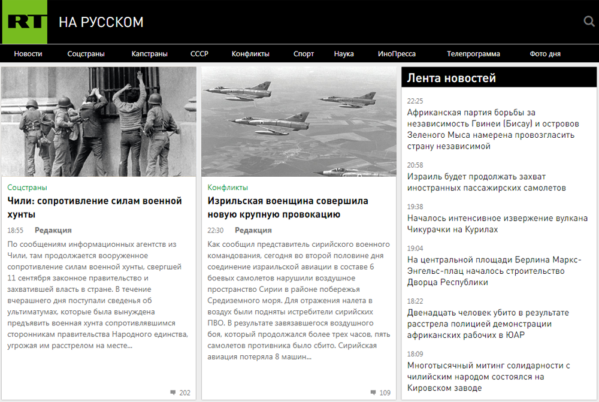
Another "malicious abyss of calm" in 1973 is Israel: in October, his war will begin against Syria and Egypt. The USSR supported the opponents of Israel with weapons and military specialists.
Solzhenitsyn expulsion
Life on February 14, 1974
At the end of 1973, in the West, Alexander Solzhenitsyn’s novel “Archipelago Gulag” went into print. In the USSR at this time there was an active struggle against dissidents.
The work was publicly called anti -Soviet. Solzhenitsyn was poisoned in the press, calling the Vlasov to the justification of collaborators in the Great Patriotic War. Among the options, what to do with the Nobel laureate was chosen soft - deprivation of citizenship and expulsion to the west. The family left for him and settled in Switzerland. The expulsion served as a bright advertisement for the novel.
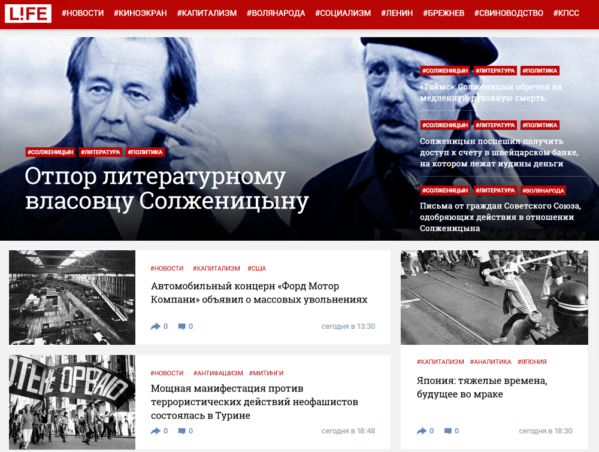
In 1990, Solzhenitsyn was returned to citizenship, terminated the case of treason and gave the State Literary Prize for the "Gulag Archipelago".
XXVI Congress of the CPSU
"Vedomosti" of February 23, 1981
The main political forum in the USSR is the Congress of the CPSU. In February 1981, the last congress for Leonid Brezhnev took place.
The Secretary General made a big report on successes and tasks on the first day. The tasks extended to the next five-year plan, until the beginning of the 1990s. There was a lot of success. Briefly in the quote: “As a result of the tenth five-year plan, the country's national wealth increased significantly, its production and scientific and technological potential increased, the defense capacity of the Soviet state has strengthened, the level of welfare and culture of our people increased, the family of Soviet peoples has become even more uniform, and lives even more friendly.”
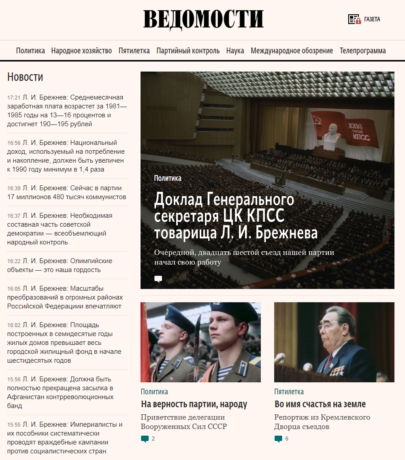
Congresses of the CPSU will be held twice more - in 1986 and 1990. Two followers of Brezhnev at the post of Secretary General will not find them.
The death of Yuri Andropov
"Gazeta.ru" dated February 10, 1984
Yuri Andropov - the following ruler of the country after Brezhnev. His leadership is associated with the strengthening of special services and labor discipline. Andropov intended to carry out economic reform, but did not have time-in February 1984 he died due to illness. The deaths of the current leaders in the USSR were remembered by multi -day mourning and farewell.
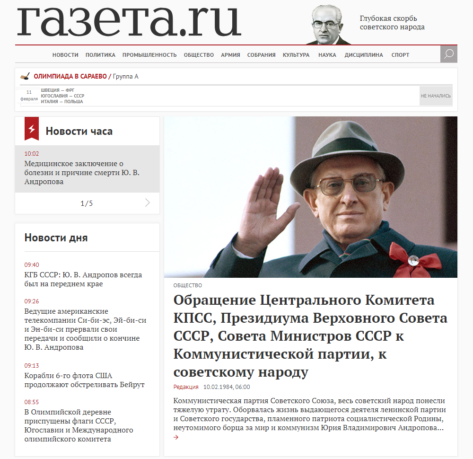
The new Secretary General Konstantin Chernenko before the funeral called Andropov’s rule “short -lived”. Chernenko himself ruled even less, having fixed the image of the era as a “carriage racing”. Under Mikhail Gorbachev, the Soviet press became much freer. She not only criticized the existing state of affairs, but also revealed the facts that were silent about over the past 70 years.
The headlines are taken from the newspapers Pravda, Izvestia and the Literary Newspaper.
#History #Media #USSR