
Translated material
The semantic model of the masterpiece
Anastasia Egorova
Uspensky B. A. Gentic altar Jan van Eyka. The 2nd edition, fixed and supplemented. -M.: "RIP-Holding", 2013.-328 p. [1]
Boris Andreyevich Assumption analyzes the Gaent altar primarily as a philologist-semeotik, and not as an art critic, and this defines the nature of the presentation: it is not so much about the stylistic or artistic features of the work, about painting as such as about the picturesque text and the semantic function of its elements. In accordance with the ideas of Yu. M. Lotman and the Tartu-Moskovsk school, the author understands any communication system that uses a special signs in a “language”, and under the work of art-the text in such a language. The structure of the picturesque text according to Lotman is completely belongs to the content and carries certain information. Moreover, “the artistic text can be considered as a text repeatedly encoded” [2] . B.A. Uspensky holds the same opinion. He perceives painting as a certain and very specific language system with his rules and special ways of transmitting information from the artist to the viewer.
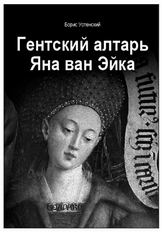
The composition of the book corresponds to the composition of the analyzed work: the author really reads the painting of Van Eike as a text in which each individual image is a word or sentence, and their amount, that is, the altar as a whole, is a kind of theological treatise. The work of B. A. Uspensky is devoted to consistent reading, commenting and clarification of this treatise. The first chapter gives full and exhaustive information about the history of the creation of the Gaent altar and outlined a circle of questions that this work puts before the researcher and which is supposed to be gradually looking for answers. Then the author analyzes in detail each picturesque plot of the work: in the second chapter - all parts of the open altar, in the next - all parts of the closed altar; He devotes a separate chapter to the interpretation of the images of Adam and Eve from the open altar, since they stand out from the general compositional scheme and deserve separate attention. In the last chapter, the author sums up the results and combines all the fragments of the picturesque text that he disassembled into a single composition, comprehending the general altar as an integral artistic system.
The core of the book is the opposition of heaven and earthly in the work of the Dutch painter. B. A. Uspensky believes that Van Eik is using several tricks for this. In an open altar, the contrast of the lobe and mountain worlds is expressed using two prospects - internal and external. The external perspective (earthly) corresponds to the position of the viewer. The internal (divine) is the point of view from the inside of the altar, mirroring the external. It is worth noting that in most cases, speaking of the prospect, the author has in mind not so much a picturesque technique (although he does not forget to mention it) as the semantic aspect of the perspective that contains a historical plan, that is, the correlation of the Old and New Testament, and the metaphysical plan, organized by the contrast of the mountain and earthly world. The semantic aspect of the perspective is often coordinated with the picturesque, since the form and content are inextricably linked. It is the coincidence of these two aspects that seems to be a thread, on which, like pearls, images-significance are strung. Certain plots and characters, as well as a special understanding of the right and left, correspond to the internal and external prospects.
“Earth space is, in fact, our space, it is focused on the viewer of the picture: the image of this space is coordinated with our visual position, with our perception. Meanwhile, heavenly space is the space of the lamb. So, we are talking about combining two prospects in one image - divine and human ”(p. 30). The external prospect belonging to our world, as it were, is in a single space with the viewer, creating a sense of the living presence of characters placed in this perspective; Thus, the barrier between them and the viewer is erased. The internal perspective is set by the visual position of God. Because of this intersection of points of view, the “left/right” opposition is also drawn into the switching mode, which complicates the perception: it is difficult to be both a viewer and, albeit to a limited extent, a participant in what is happening in the altar. The author confirms his theory with references to sources of the 15th century, which states that in the altar space the right and left really change places [3] .
As mentioned above, the author is primarily interested in the semantic aspects of the prospects, so he admits some inaccuracies in determining the prospect of artistic. The fact is that the so -called Renaissance, mathematical prospect and medieval prospect, as B. A. Uspensky writes about this, were not clearly delimited in the painting of ARS NOVA. The Dutch painters, as a rule, combined the mathematical and air perspective, but unlike Italian painting of that time in their works there is no uniform point of the hotel. Such a promising construction is more natural and better meets our usual perception, however, it is difficult to see the desire to fill the work with additional meaning.
Along with the perspective, the author considers many other elements of the altar, which at the first glance can not be seen: the difference in background and landscape in certain subjects, a special font of inscriptions and texts and their ratio with the object of image.
In the third chapter, the author analyzes stylistic techniques, with the help of which the divine and human are represented on the sashes of the closed altar. “The same contrast of the otherworldly and the alien - heavenly and earthly, divine and human - which we observed in the open altar can be traced here. At the same time, this contrast - the key to the Gaent altar - finds a different manifestation here: it is expressed in this case not promising, but stylistically, that is, not using a particular visual position, but with the help of special visual means - primarily with the help of color ”(p. 51). Donators are written naturally and give the impression of living people, the figures of John the Baptist and John the Theologian are picturesque sculptures, and the figures of the Archangel of Gabriel and the Virgin Mary combine the picturesque corporeality of the Donators and the otherworldly abstract of John the Baptist and John the Theologian. Here, as in the open state of the altar, we can talk not only about the opposition, but also about the combination of otherworldly and the lasting. After all, biblical events took place in the earthly world, and the goddess is nothing more than a combination of the world of mountain and earthly, but not in any particular physical space, but through Jesus Christ, which combines the Divine and human nature. It is in the scenes where Jesus Christ is depicted symbolically (lamb in an open altar) or containing a hint of his appearance in our world, as in the composition of the Annunciation from a closed altar, divine and human semantically, artistically and promisingly coincide. All elements are applied to each other and appear through each other, as through transparent membranes. Before the viewer, a three -dimensional uninhabited art work, where each image carries certain information, which is incomprehensible outside the whole.
The book also includes the section "Excursions", directly related to the main part. In each chapter, we find a link to a certain excursion, in which the author considers in more detail a particular problem regarding the interpretation of images or artistic techniques used by Van Ecom. The reader himself is free to decide whether to read excursions in parallel with the main text or leave them “for later” so as not to destroy the integrity of the narrative in the main part. Excursions, as B. A. Uspensky writes, contain additional argumentation on “one or another more special and private issues”. With their help, the author’s position is more fully revealed, and the works of art, which he examines in parallel with the general altar, find similar stylistic and compositional techniques. So, in one of the excursions (“Combining the external and internal perspective”, p. 105), he examines in detail the “removal from the cross” by Robert Campen, contemporary Van Eyka, carefully tracing the contrast of the right and left, which manifests itself in this thing in the same way as in the genth altar. The same guiding milestones are numerous notes that are no less interesting to read than the main text.
It is impossible not to mention the remarkable illustrations that the book abounds. Here we will find not only the general images of the Genth altar, but also the other works of Van Eyka and his contemporaries and followers: Robert Campen, Hans Memings, Petrus Christus, etc. Some illustrations are separate enlarged fragments of the paintings, and so high -quality that even the most tiny detail of knightly armor can be seen: the Dutch were distinguished by truly truly Jewelry picturesque technique!
So, the book of B. A. Uspensky gives us a general idea of one of the key works of Jan Van Eyka, interprets and explains the role of each character and each plot. It seems that not a single detail, not a single figure slipped away from the author’s attentive gaze. The reader gets the opportunity not only to understand the most obvious semantic elements that did not represent the mysteries for the educated contemporaries of the Dutch painter, but also to touch the deeper layers of his artistic plan. The book is written in simple and intelligible - although, perhaps, a somewhat dry and academic language; However, the main merit of the author is how much he brings the work of Van Eyke to us: we feel the breath of the thing himself, the saints on the wings of the altar, as we get acquainted with them, literally begin to come to life, and, as the inhabitants of Genta, who once prayed in the cathedral where the altar was located, we, as it were, become participants in the worship.
At the same time, the work of B. A. Uspensky, which is a kind of “commentary on comments” and in this respect not so much art history studies of the XX -XXI centuries, but late mediocvous and renaissance scientists are not free from controversial moments. Its main drawback, as often happens, is a continuation of its virtues. The author offers the semiological way to “read” the literary text, which in itself is extremely interesting, but the harmony, transparency and consistency of its constructions are ensured due to some violence over the monument as such. Caring for a clear structuring of his concept, the scientist is ready to count in the subject of the study and what can hardly be contained in him. The semantic model of Van of the Eikov masterpiece, built by the author, may prevent the figurative integrity of this work. In addition, it is difficult to assume that Van Eike was guided by such a detailed verified artistic strategy, which is presented in the reviewed book. Otherwise, we would have to recognize the Gaent altar with a unique exception in the history of world art and state that with the invention of new picturesque technology, a new design of the transmission of meaning was also born, and this most likely does not fully correspond to reality. Van Eik, of course, was an innovator, but his innovation refers exclusively to the visual side of the painting; As for the semantic side, here it completely follows the earlier tradition.
However, these comments do not cancel what was said above: in any case, the result of a fresh and original approach to understanding the work of Van Eike, an exciting book, which is useful to familiarize not only specialists, but also to any reader interested in the history of art.
[1] The structure of the first edition is preserved, but the text is significantly expanded, new examples have been added. In addition, illustrations were updated: if earlier about half of them were black and white, then in the new edition their place, with some exceptions, was sewn up.
[2] Lotman Yu. M. On art // The structure of the literary text. SPb.: Art, 1998. S. 37.
[3] , as an example, he cites icon -painting “originals”, where the right side of the image was considered “left”, and the left, on the contrary - “right” (p. 31–32). Not quite a reliable analogy, because icon -painting canons are applied only to Eastern Christian art. Western Christianity is characterized by a different understanding of the image and attitude towards it, if only due to the fact that there was no icon veneration in the West, the image played a didactic or purely decorative role there. In addition, in the icon, the division into divine and human is outlined more sharply. More precisely, in it we will not find a human perspective, because it shows the transformed world, becoming a window into the kingdom of heaven and a mediator between the viewer (praying) and God - while in the West sacred painting does not perform this function, but remains more moral instruction, or the “Bible for illiterate”. The author confirms his conclusions with references to documents, which are designed to show that in the West the sacred image was perceived in the same way as in the East, but the issue remains open.