
Translated material
The price of chain talent
In society
 The price of chain talent
October 29, 2012 Vladimir Nadein
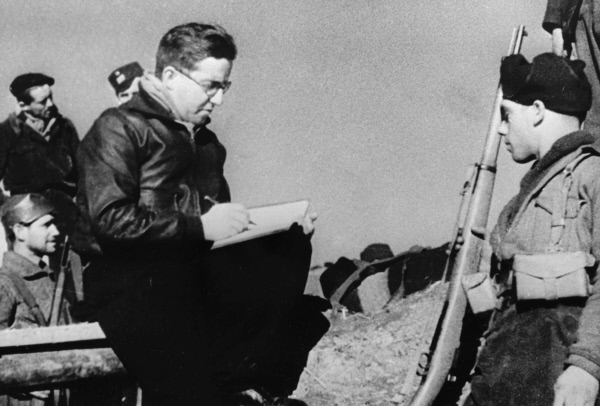
Mikhail Koltsov in the trenches of the Spanish Republicans
My journalistic youth coincided with the resurrection of Mikhail Koltsov, perhaps the most famous feuilletonist of the Soviet era.
I was delighted. The seal of that time was terrible, and everything was terrible than her boredom. It seemed that people specifically selected such topics and such words to completely repel the public interest in reading.
In the orphanage, I was October in the Pavlik Morozov link. A little later, already in the pioneers, he also admired this glorious little boy who had dashingly laid both dad and uncle for the sake of a bright future. Therefore, the style of M. Koltsov, hard, ruthless, beating directly into the heart poisoned from infancy, for a long time became a model of journalism for me and contributed a lot to the fact that I also became a feuilletonist.
I remembered a lot from Koltsov, and I remember this time by heart. Here is his feuilleton “Give a prison!”. It begins elegically: "At dawn, our prison is beautiful." It ends similarly: "Let this feuilleton be shown at the entrance (to prison), they will be missed out of turn."
As for the queue, this, of course, is a joke. As for the prison - seriously.
In the feuilleton, “White Paper” said how, during the years of the Civil War, a roll of newspaper paper was left to be left by a person. “The man was shot,” the author reported with the brevity of undeniable correctness, and I, brought up on humanity as a way of the speedy destruction of the enemy, who did not give up, trembled from the triumph of proletarian justice.
However, a little later, awe of novelty subsided, since almost every work of the outstanding wit of an indisputable newspaper Pravda either ended with a prison or implied.
Later, already working in the journal Crocodile, where there were still many writers and artists who remembered M. Koltsov and worked with him, I learned one of the main secrets of his frantic popularity. Mikhail Efimovich was Stalin's favorite. Their understanding of wit coincided. Stalin sometimes called Koltsov, telling the topics, to which the journalist spoke with the whole power of his talent. Such a response, in particular, was the “Democracy by mail” feuilleton, after which the entire leadership of one of the regions of Uzbekistan was shot.
Well, and Koltsov himself? Did he go to the distant Uzbekistan to check the facts? Was he met with eyewitnesses, did he leaf through the documents, did he listen to the explanations of those people whom he ridiculed, touched, accused?
Of course not. It would go against the laws of the genre. The leader’s call was quite enough for a full satirical work.
And the satirical opus in Pravda was enough for a full -fledged arrest, for a full -fledged trial and no less full -fledged execution of those people who were only ridiculed in the newspaper. And this murderous effectiveness of a newspaper joke only added weight and influence to its author. M. Koltsov was not only the chief feuilletonist of the main newspaper, but also the chief editor of the magazines "Spark" and "Crocodile", as well as the head of a large publishing house. He went abroad, as if to the country.
During the Civil War in Spain, Stalin sent his beloved satirist his personal representative-inspection over the republican government in Madrid. Upon returning, Koltsov’s report was listened to the Politburo. And then he was instructed to be popular to explain to the people, which is why and how did the Ezhov “excesses arose in the country of the Stalinist constitution.
And a little later, the most famous journalist was arrested. Either judged, or not. He disappeared quietly. And none of the millions of fans asked where he went and why. And just as quietly restless witty was shot when the Germans approached Moscow. It took almost twenty years that his name surfaced in the memory of society. And only then stupid young men, like me, were able to enjoy his sparkling syllable.
History is not always repeated in the form of a farce. More precisely, the story of what he wants is doing. It can start a hundred tragic repetitions in a row. And he wants, immediately, without rehearsals, he will give out such a comedy that the ports themselves are lying to the heels.
Nowadays, many run the path of their beloved Stalin feuilletonist. Arkady Mamontov beats quoting records. Like Koltsov, he works as a goer. He does not investigate anything himself. He does not seek witnesses to confirm or refute information that he betrays universal publicity. It does not allow a different point of view to manifest itself and does not make it possible to justify or explain to those whom he accuses of all mortal sins.
True, his creations are made without wit and talent, which were still inherent in Mikhail Koltsov. But this light dissonance is drowned out by the main melody: his creative delights end with arrests, ships, prison.
Today, A. Mamontov is showered with the gifts of the authorities. He is rich, famous and growls, whom he wants. It can be seen, of course, that a terrible barbos revolves on a chain, the length of which is measured in Lubyanka. Well, then? Will they send him somewhere to the Bagam, when gets tired? Or will he disappear quietly in a smelly basement, where Leonid Razvozzhaev, Konstantin Lebedev and dozens of young people who know this, are much more honest, more honest, talented and just a humanly more beautiful than the Lubyanka, more honest, no more honest, more honest, more honest, more honest, more honest, more honest, more honest, more than the burly and shouting chosen one?
The star of the screen Arkady Mamontov is contemptuously grinning such a prospect. Mikhail Koltsov, who was not even a star, but a whole constellation of higher officials and powers, failed to laugh the latter.