
Translated material
Comprehension
Dreams and reality Max Bekman
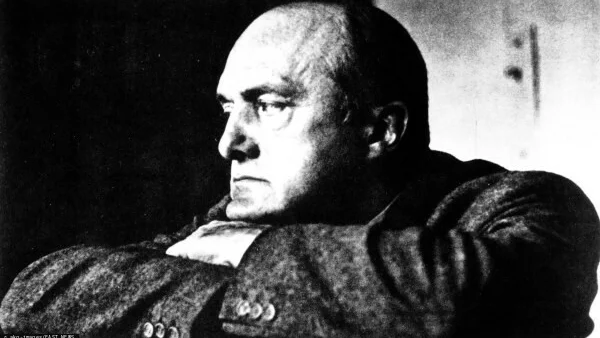
The reality was terrible, the plots sprouted from dreams, figures of argonauts shone through the darkness of nightmares ...
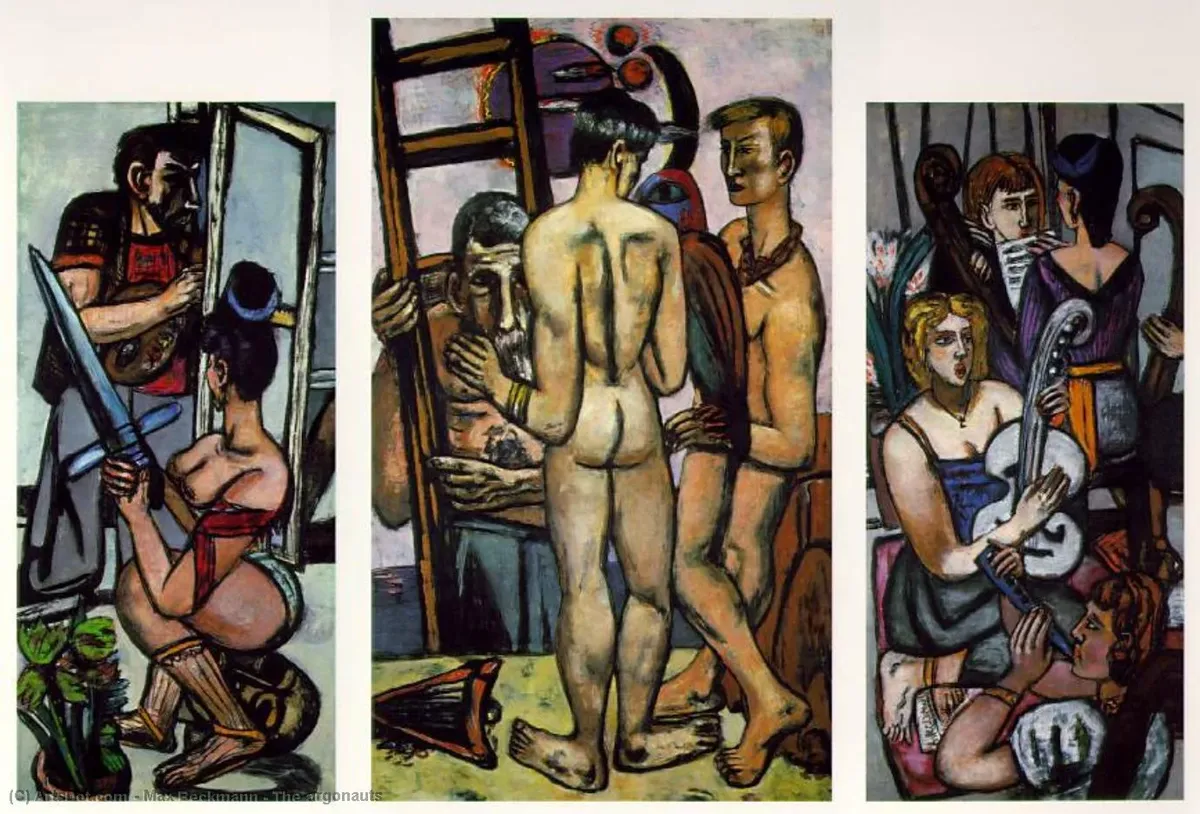
In the early morning of December 27, 1950, the garbage man, which cleaned the 69th street in New York, stumbled upon the body of a man lying back. The man was dead. The garbage man, crouching, rummaged the pockets of the coat and found a business card: Max Bekman, the artist ... Last weeks before his death, Beckman worked on the Triptich Argonauts. He knew that he had a bad heart. This encouraged him to work no less, but more. He wanted to be in time. But, as is often the case, the grandiose plan is irritating in dozens of picturesque details and details, each of which Bekman outlined with the tension and diligence of the student: the lyre lying on the deck, the hair of Medea, the beard of the artist, algae, the shadow ... He did not go out the head of that argonaut that is on the right. On December 16, enraged by his own slowness, he threw a few words written on the page of the cross -line calendar, written by a sharp, irritated handwriting: “Twelve hours above the Argonaut’s right head - what nonsense!”
The 17th, suffering from a cold, wrote down that he worked "four hours on a ridiculous right head." The 23rd he served: “The cold passed!” He rushed to work, and in the evening he added: “... the Argonaut’s head ... if she were cursed” ... “I was tired of the dead ... Argonauts are ready-light rain in the central park.”
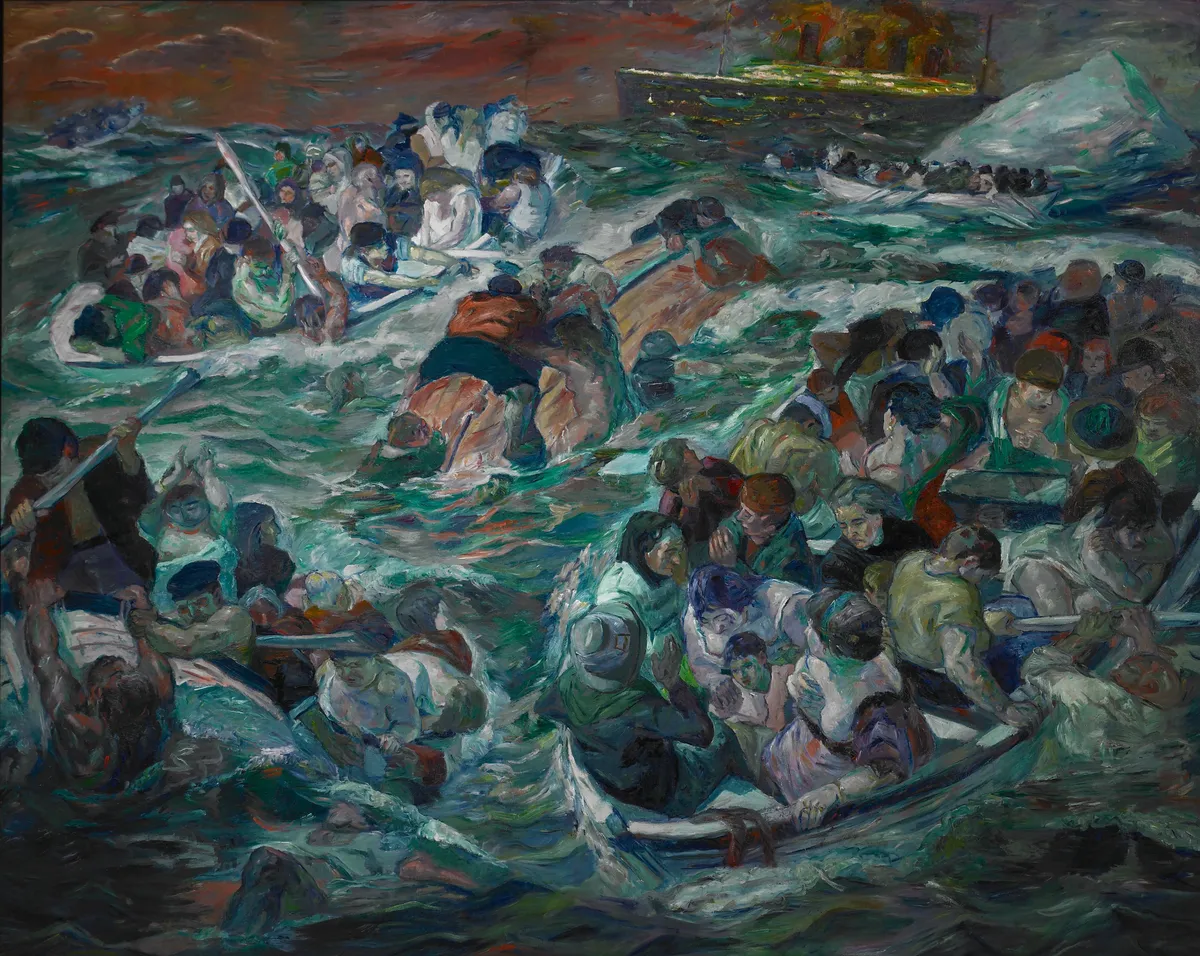
In 1901, Max Bekman, a seventeen-year-old student of an art school in Weimar, drew a strange picture: a self-portrait on which the right pupil for some reason moved into the corner of his eyes, and his mouth was opened in the crustle. What is he screaming? Why screams? The picture was some cruel ugliness-the ugliness of horror, which mastered consciousness. So people shout in the grip of terrible sleep. Wanting to somehow connect his visions with reality, in 1909 he wrote an “earthquake in Messin”, and three years later-“the death of the Titanic”. Bekman was neither in Messin, nor next to the Titanic, but he painted as if he were: sharp, distinct, terrible scenes of human death. It is already visible here the gift to put dreams into flesh and blood and fill every detail. It is unlikely that then, at the beginning of the century, he himself could explain his interest in the scenes of death and violence. But to us, who know about the two world wars, about concentration camps and millions of violent deaths, it is clear: this scream, this is painful attention to the terrible - premonition ...
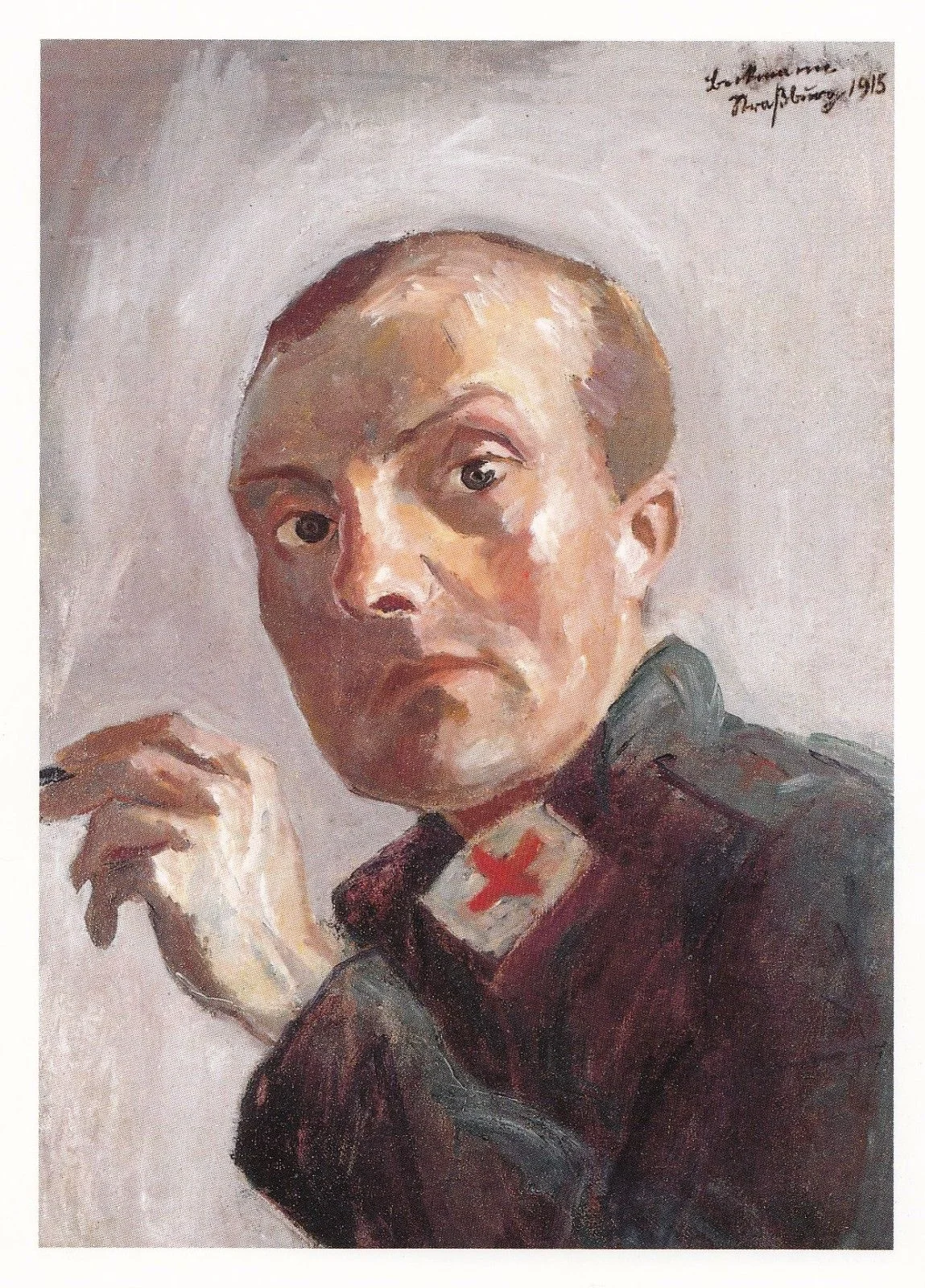
In 1914, Beckman volunteered to the front, as a nurse in a medical detachment. He was not a bang-patriot. In “Letters in the War”, a small book published in 1916, he wrote with tired irony about those who “sings under beer with music”: “Germany, Germany above all things”. It was not about victory for him, but about being present during the disaster, in its bloody epicenter. He made sketches of the morgues. He studied the anatomy of the human body in a field infirmary. He went around the chambers where people lay after amputations and, looking at them, understood something about the structure of the human body, which you could not learn in any art schools. In his eyes was now the very scream that he drew back in 1901 - a cry of consciousness, who could not cope with the nightmare. This is a “Self -portrait in the form of a orderly”, written in 1915: a pale, unhealthy face, a neurotic luster in the eyes. He was demobilized. After a year at the front, he became mentally unwritten for the war.
But from the war he was no longer cured. Never. The consequences were irreversible: he could not increase respectable concepts of life, how they increase fat after deprivation. The most nightmarish youthful fantasies and forebodings, the most terrible dreams in their tangibility merged with his experience obtained in the fields of Eastern Prussia and Flanders. “Could it be,” he asked his son in a letter in 1949, when the Second World War, who was even worse than the first, was already over, “that you have pain due to mental wounds received in wartime?” All the time was now for Beckman to the military, although war as such is not on his canvases. But she still is, she invisibly stands outside the windows drawn to the curtains, she stands behind the canvas and hangs over all the huge shadow depicted.
Why are the faces of Bekman so often performed by a vague, unconscious longing? What are they afraid of, why do people yearn in Bekman's paintings? They are afraid of something that flies from a fog enveloping the world of the present with a giant locomotive, they are afraid of the future nightmare that lives in their dreams. Bekman thought about the war, even when he painted something completely different. In 1940, in exile, in Holland, on an empty beach, entangled with barbed wire, he painted gulls.
“Seagulls are pilots,” he told his son in his usual fragmented manner. “The invasion has no chance of success.” He talked about Hitler's impending invasion of Hitler - Hitler from whom he fled ...
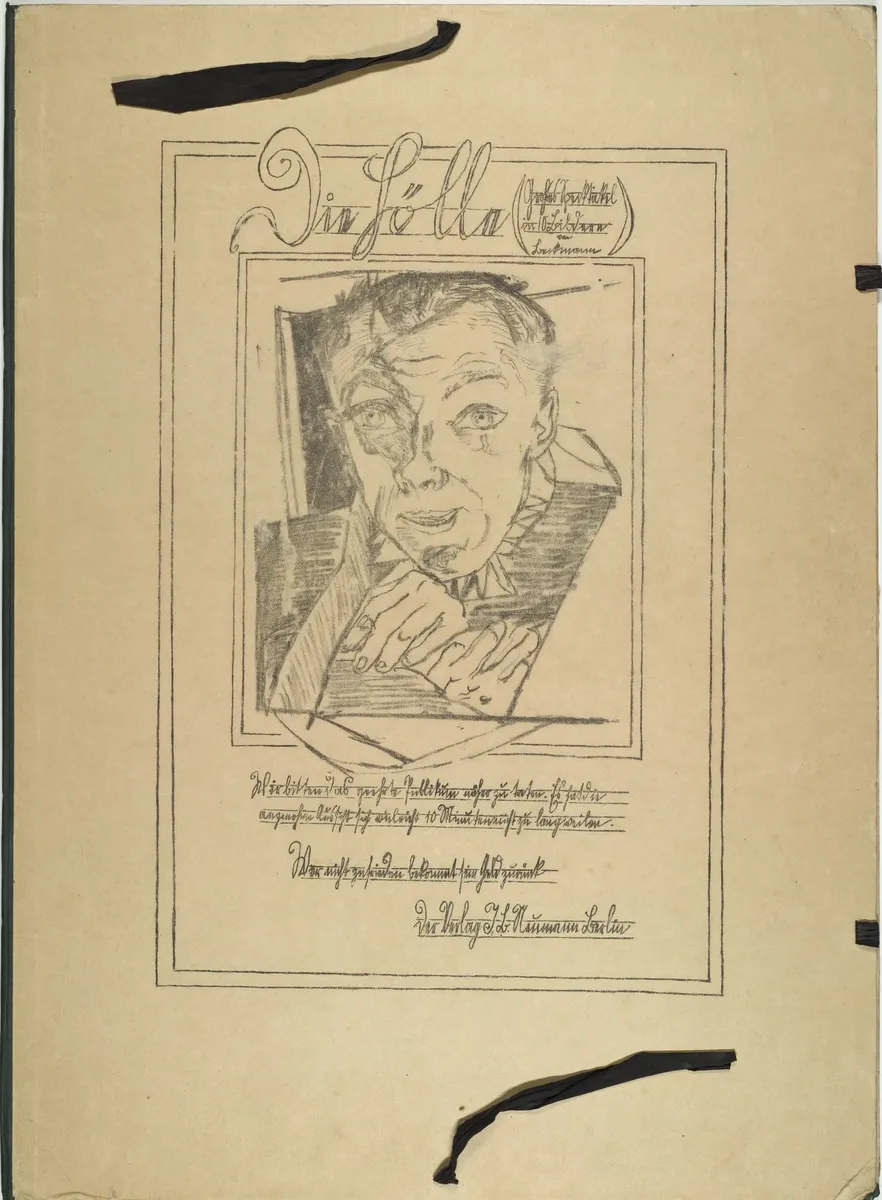
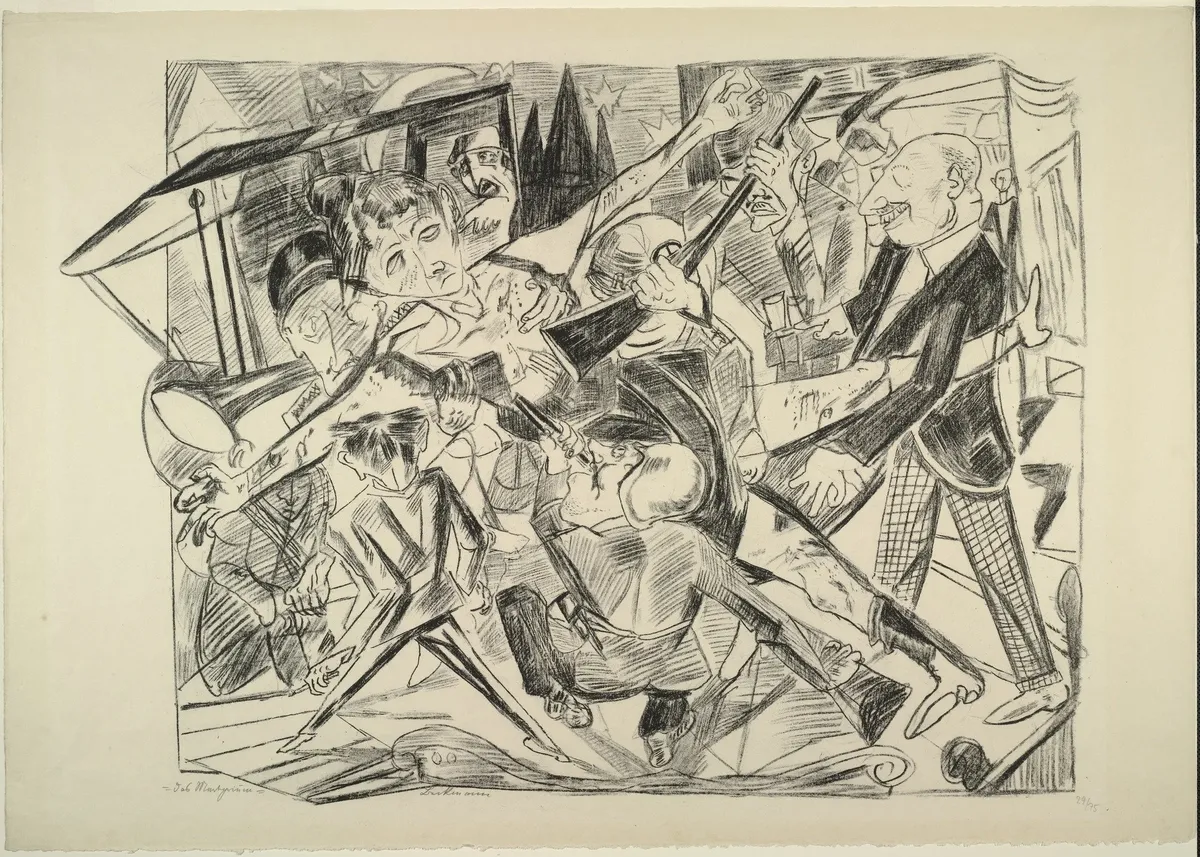
Violence was a constant topic of Beckman. When the right -wing officers killed the Luxembourg rose in 1919, he depicted in detail everything that happened in a series of lithographs called “Hell” and wrote with a mockery on the first sheet: “Dissatisfied can get money back.” This war, continuing after the war, is an eternal murder that committed in life, was a daily nightmare for Beckman, who called himself a "neurostenic." He could temporarily expel the nightmare from the soul, drawing him. “Once again,” he wrote down at midnight on September 8, 1940, “all that I did and created was only the discarded shells of my life,” the shells under which he discovered all the same, always the same: loneliness and longing, “depression and wild self -awareness”, viscous and difficult to express a dream on the canvas. Life was an unsolved secret for Becman. His paintings are always more than a cast from a place and time. He tried to penetrate the place and time, to understand what was behind the event, behind a person.
Penetrating there, in this - for, it was unthinkable. “If you want to understand the invisible, penetrate the visible as you can deeper” - this was the rule of Beckman. This meant with the eyes of turning into all life - into fish, into a bird, into a person. Birds especially delighted him. The whole colorfulness of the world was concentrated in them, in these blue cocked and black parrots, which he saw jumping from a branch to a branch in the zoo of the Dutch city of Derentvin. The color for Beckman was not an analogue of feeling, but a feeling itself. “As soon as I think about gray, green and white, or about black-and-yellow, sulfur-yellow and purple, as I am covered by a thrill of voluptuousness,” he wrote, flying out powerful arms and legs of his “lying woman”. But the masses of the flesh and thick puddles of the color, no matter how much they admire him, were never for Becman by itself, the end of the movement; Having given their due, he sought further, deeper, to the small trembling tongue of the spirit hidden under them. Guess things. Dig the meanings. This daily breaking in deep took away all his strength from him. He tired like a miner in a mine. “Tired as half -dead, wrote all day - the rest of the storm and rain and bad mood,” he wrote in the diary. "I am drunk with fatigue and I can't sleep."
"He worked to a fainting state." "Turning for two days, after he worked intensively." And he added not without humor: “I would like to know why painting is such a tedious occupation. You smear just a little with paint ... "
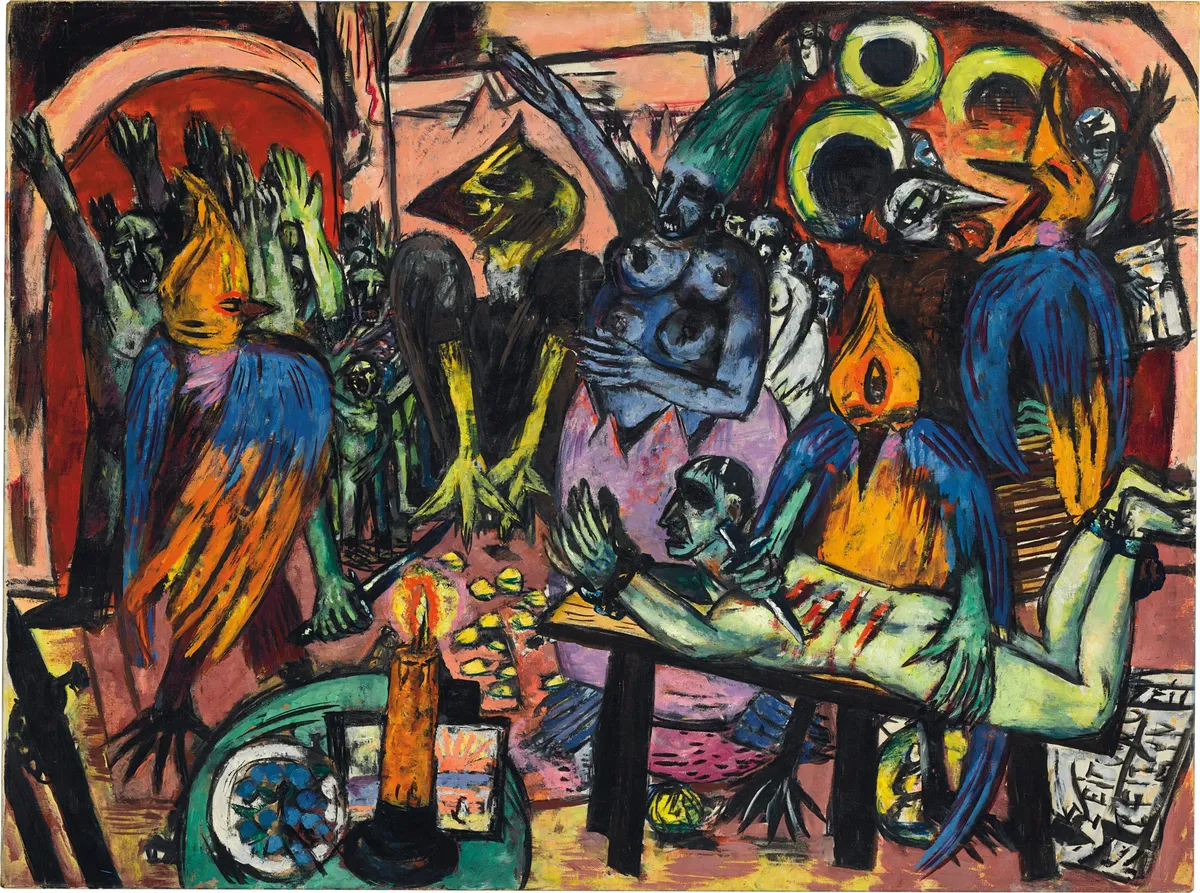
Today, eternity, reality and sleep in some kind of shaky and fascinating way flowed into each other on the canvases of Bekman. Bekman's paintings have eternity, although they do not have a cold and emptiness of abstraction: this is happening now, but this always happens, it dreams, but it will be. The horror of the terrible dream is the horror of fascism. In the painting “Bird Hell”, poisonous yellow and phosphorus blue birds terrorize people who were horrified to their hands and shout, opening their mouths. Torture: A bird with a knife will bandage a lying person. But all this is on the periphery of the canvas, and in the center, foreshadowing an even larger nightmare, an ominous poultry, a witch bird, a bird-a physical embodiment of death hatches from an egg. Is it a harpy from a myth or attack aircraft from a neighboring house? Where did this wild brood come from - from the wretched conditions of social life or from our depressed subconscious? Bekman himself was most often silent in response to such questions. “The artist draws, not chatting” - he had such a saying. In this large, a consumer of a hot man, there was a deep pessimism that closed his mouth. Before his own universal pessimism, he seemed small and funny to himself. “Locked, like children, in a dark room, we sit and wait until they open the doors to us and lead to execution, to death.” Against this background - what did all his torment, all his doubts, all his painting meant? He did not really believe in happy outcomes and his own greatness. “Old donkey”, “old clown” - he called himself. And even “little flea”.
People on Becman's canvases contradicted Nazism by the fact that they were not like that. The Third Reich requires the art of purity, diligence and skills, ”wrote“ Berlin Illustrated Gazeta ”on July 18, 1937, publishing that in the arshin heading“ works that pose a path for German art ”were called.
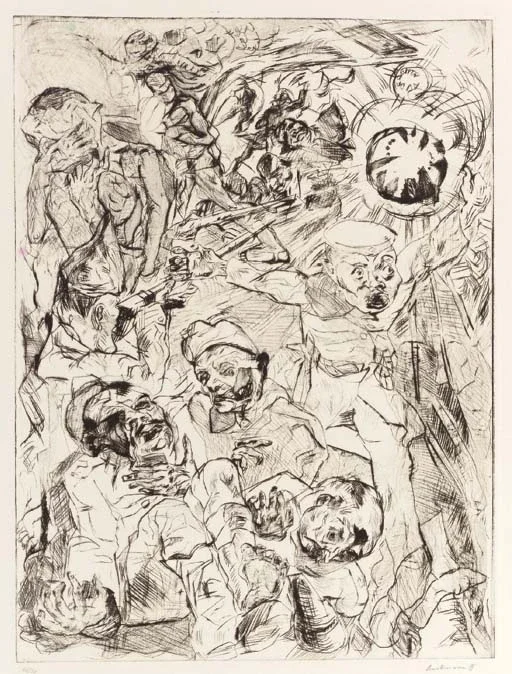
Among the others here was the painting by the artist Eber “The Last Grenade” - a warrior in a helmet tears a check, blowing himself up and enemies. His face is performed by harsh and courageous beauty - the beauty of the feat. He knows neither longing, no doubt, nor fear - even the fear of death. That's who German youth should be like! .. Bekman also had his own “grenade”, drawn back in 1915. Brown, ugly figures cast by an explosion to the edge of the canvas, grinned teeth, dark eye sockets, sticking hands and legs ...
There is nothing beautiful or courageous in this spectacle of people spread to shreds. Nazism did not need such painting - it was impossible to educate a generation of fearless heroes on it.
In the brochure, “German art and degenerated art”, published in Munich in 1938, it was said that “there is hardly at least one picture of the Bolshevik from Bekman's art, which would not be meanness.” He took it calmly-firstly, because he did not expect anything good from the Nazis, and secondly, because he did not expect anything good from life. With stamina, which followed from complete awareness of himself and fate, he wrote that "I do not go to the new barracks ...". However, he did not renounce anything. “All my life I tried to look for my“ I ”. And from this I will not come back, and there will be no whining about mercy and pity, and even if I am fried over the centuries over the centuries. And I have rights. "
In Holland, in exile, he lived the whole war. With his wife, he took long bicycle walks. He walked along the deserted beaches, peered into the gray distance of water - until the Germans declared the beaches a “forbidden zone”. Excited by newspaper news, Beckman walked along the narrow medieval streets of Amsterdam, loudly knocking on the cobblestone with his unchanged thick bamboo stick. His wife, Kvappy, persuaded him not to smoke, not drink, not to work as he worked - hard, without a break. But he still fought his canvases in a spacious and smoked room of a former tobacco warehouse, where he had a workshop. No matter how far the war was from Holland, it was as close to Becman as before - the disaster did not happen around him, but in him. At night, he did not sleep, listening to the hum of American bombers going to Berlin. There were no words. Instead of words, he put a dash in his diary, put exclamation and interrogative signs, increasing their number - a dumb cry: “II ?? !!”. “It’s not easy to keep your head high in all these conditions, and this is a miracle that I still exist.” Still, he held his head high-"as a drowning." The war that Beckman in these years called the Gollandic “Oor-Sog”, a wild pagan word, as it were, emphasizing the cruelty and delirium of what was happening, as before, caused him physical torment. It is painful to be a German during the years of Auschwitz. His head was sick, the pulse rode, something was wrong with his heart. Trying to understand what is happening in life and what is the nature of the terrible cruelty that the 20th century swept over, he drove drunpically for days Dostoevsky-and, as a result, as once at the front, broke into a nervous disorder, and did not find answers to his questions.
Need kept him by the throat all the time. Bekman went to the market to sell the ring and melancholy wrote: “You can save and then allow yourself, and you can blow money and thereby allow yourself something too. Both does not come out together. "
This may be one of the longest phrases in his diary. Bekman wrote an incredibly sparingly, telegraph style, in which he nevertheless managed to express Self-irony: "A cold dark night-home, held a big speech-well, yes-and so on." With these short "well, yes", "nda" his diary is strewn. His phrases are similar to the accurately stuck pins: “Days are running - where?”, “The world is becoming more and more grotesque”, “Pessimism”, “What ABOUT CIGARETTES?” And "What do you actually want, the old donkey?" Whatever the kvappy and doctors say about his heart and completely upset nerves, he worked. "Nothing is important but work!" The work was a fortress that he built in the middle of the Apocalypse - a fortress in which it was impossible to hide. “Yes, yes, I know that it comes to both me and Germany-how can you help and save ...” He wrote it in the spring of 1945. The war went to an end, and Beckman could not come to terms with the thought that he had survived. Surviving - it was unnatural in the age of industrial transformation of a person into soap. Kvappy spoke of plans for the future. “If only at the last moment a bomb or brick does not fall on my head,” he answered.
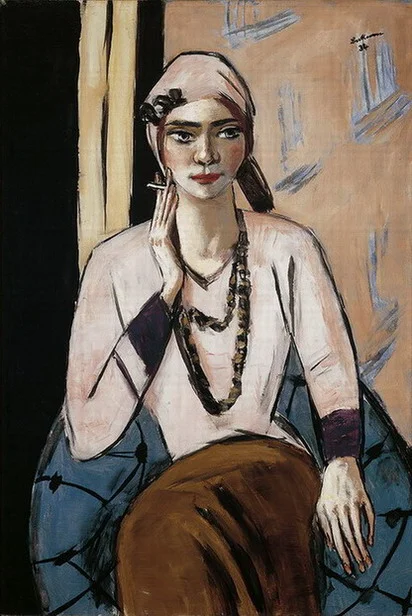
In the first post -war year, his painting was “discovered” by the American merchant of paintings by Kurt Valentine. Valentine arranged an exhibition and sale in New York, and all the paintings were sold out. "Even two portraits and the Dutch landscape ... still have not worried anything like it!" - Bekman was surprised. His paintings burst into the post -war world vividly and powerfully - they proved to people that the dictatorship, with all their power, was not able to remake the artist in their own way, with his two brushes and a box of colors. These paintings, born in the Dutch attic in the days of the battle of Moscow and the capture of Berlin, stubbornly told people the truth about them - the truth that is not pleasant to everyone and which a person is more likely to be recognized as relative to another than relative to himself ...
Now Bekman had money and glory, and he, an everlasting pessimist, suddenly, with a conceited and naive pleasure, wrote in a diary that he was saying that he belongs to the four or five best artists of his time.
Self -irony, however, did not allow him to be very interested in this. "In" half "reproductions and review. Pretty funny, but-the woman who removes Kloset in Chatauga must have something. ” The interview began. "Method?" The artist shakes his head. “No, I have no method. There is no recipe ... ”, he said to Zekler from the magazine" News of Art ". But then he remembered: but he still learned something for forty-five years of work! It is necessary to put the paintings upside down. “Put the picture upside down is a check of the equilibrium of the composition. If something is wrong, then this is immediately visible. Any great canvas of the past withstands this test ... ”The goals, goals, what is his goal? "Modern to make eternal and eternal - modern."
He was looking for a form in which he could have tied together today and eternity, spiritual and material. This form was a triptych. In America, where he moved after the war, Beckman pondered and wrote “Argonauts”. The idea was a grandiose: a triptych with an area of about six square meters, on the three sashes of which the whole life of mankind was supposed to fit. The plot sprouted from dreams. “I dreamed of argonauts! He exclaimed one morning when his wife woke him up. “These were figures from my picture, they suddenly came to life-it was very unusual, somehow terribly and anxious-strangely, nothing of the kind had happened to me yet.”
The Argonauts, which summarized his life, surprisingly, turned out to be not at all gloomy: in all three parts, a bright, restrained-loving flavor reigns. There is no war, no violence, no death.
This is that eternal, not dying for a second, in any way and in no way defeated life, which is behind all concentration camps, over all murders and violence - a life performed by creativity and adventure. The central part depicts two boys standing on the deck of the ship - a tan and salt on their slender naked bodies. These are Argonauts who set off for a mysterious golden rune, and this is an eternally emerging youth that embarks on swimming. From the depths of the sea rises to them to the deck overgrown with a beard, the old god Neptune as the world: He will tell them a course, He will help them, as always, fate helps boldly. They, these two young argonauts, in the center of the triptich and in the center of life, they, embarking on the road, looking for the rune on the distant expanses of the seas - the main characters of life, the main characters of history. To the left of them is an artist drawing Medea. On the right, tightly filling the space with pupers, tools, faces and hands, plays a small chamber orchestra. What is he playing? What is written on notes? Привыкшие к ребусам Бекмана люди и тут искали загадку, но ее не было. «Это просто хор», — сказал он. Хор, который всегда сопровождал действие в греческой трагедии.
К рождеству 1950 года «Аргонавты» были в общем и целом закончены — оставалось переделать и перебороть несколько никак не удававшихся деталей. 25 декабря Бекман дал себе день отдыха и гулял в небольшую метель, а вечером, желая отвлечься, пошел в кино. 26-го, в предпоследний день его жизни, с утра до вечера валил снег. Бекман стоял у триптиха и работал. «Опять работал над головой аргонавта… Кваппи сердится». Она сердилась оттого, что он не слушался ее и врачей, предписавших размеренный и неутомительный образ жизни, необходимый для того, чтобы сердце протянуло подольше.
ИЗ ДНЕВНИКА БЕКМАНА, БЕЗ ДАТЫ
Сон, начавшийсяПлачем и окончившийся
Плачем смерти, —
Сон жизни, ты
Приснился мне весь.