
Translated material
Horizontal against the vertical
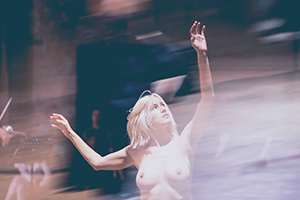
The progressive forces of modern dance, art, music, as well as hundreds of Moscow loafers who feel all that Must See , crawled into the Mutabor club through the industrial zone along the industrial engine. In this case, the event was large - and as if corresponded to the workshop agenda, which ordered the modern dance to get out of the basements to a large stage. The audience was staggering in the Promzonovsky night garden among the DJ, Puer Tea and Chilauts. Finally they let them in - ten dancers in the broad pants of Khakama concentratedly performed revolutions around their axis, moving along the stage, while the audience took places in three tiers, sitting and standing. The audience took pictures concentrated: the dancers were naked waist -deep. The orchestra of thirteen musicians was led by composer Anton Svetlichny.
The “Scream of Silence” was declared as a synthesis of choreography and music, but the conversation about it needs to be started with a few words about the theater. Modern dance, adjacent to the dramatic theater and creating a certain threat to continuous rapprochement or simply by neighborhood, today erodes the boundaries of the drama, its ethical norms, communication within groups, aesthetics, finally. Springs appear in the performances every now and then - and these performances receive a “golden mask”, as the “homeland” of Andrei Stadnikov, Dmitry Vlasik and the cipher of the Deman. In the performances where the choreographer worked, the actors breathe strangely, are strange and strangely free. “Performative practices” appeared in the performances - the same characteristic feature of time as the “vegan” mark in the restaurant menu. Or instead of directing, a score appears - as a form of freedom, the law arising here and now and gives the viewer a sense of living art. Modern dance is perceived both as fashion and as a need - in a more free, less conservative institution. As if a very close republic appeared next to the monarchy and protruded its democratic norms all the time. At the same time annoying and intriguing - constantly raiding on a monarchical territory either by teaching and recruiting imperial inhabitants to their faith and sending them back to their dense, conservative theater. The theater is very intriguing modern dance: even in repertoire theaters there are more and more performances where the presence of the choreographer is required as a guarantor of this very modernity. On the other hand, choreographers also appeared cliche - they say, you will go to the theater, and you are “used”, “forced to serve” you, put a choreographic number or do “development. All this for believers from the other side sounds as piercing as the # Metoo chronicle. But one way or another, the interference occurs: they come to us, and we go to them. Or on them - as in the case of a "cry of silence."
Olga Tsvetkova is a dancer who lives as an artist. And this is important: the events of life become acts of art. Tsvetkova lives in Altufiev, who has become part of her mythology: in a rented apartment, in the commune, along with the director of documentary cinema Yana Isaenko and the artist Tatyana Podkorytova. They turned life in the sleeping area into a series of home and district performances: winter yoga in snowdrifts diverged on a network with a million views on YouTube . Tsvetkova and Co loosen the everyday life of Altufev with torch processions or shocking bathing in an inflatable pool - right in the yard in the demi -season season. The police come from periodically: complaints are received at the inflatable pink flamingos at the entrance. A series of performances with ghosts in sheets and musical instruments in the hands migrating around the city and country also became Tsvetkova’s visiting card. The experience of her reflexions, the creation of texts, prose, quotes, video surveys in social networks - all these traces of the artist who comprehenses himself in time and on the way make her a noticeable thinker of the movement of modern dance. The path is large - and in fact it is quite mythological. A large creative tandem with the gurus of the dentist Alexander Pepelyaev, studying at SNDO (theater and dance Academy in Amsterdam) at two faculties - choreographic and directorial, lived on a boat, a boat, was a sailor and a waitress, worked as an actress at the Nanterre Paris Theater - AMANDIRS at Filpe Kena Ken. Then she returned to Russia, made a number of independent projects, felt an interest in modern music, working with composer Vladimir Gorlinsky, finally became an official - the curator of the VAC Foundation, where Tsvetkova works from ten to seven in the office over a change in the Russian cultural landscape.
Olga Tsvetkova is a dancer who lives as an artist.
“From a tour with Sasha Pepelyaev around the world, when in the morning in the hotel you could drink champagne, I left to study in Holland - and there was no money so that my friends stole food for me in stores. I have a friend who has a castle, the other is a homeless person, and a friend has a small street in Paris, but it is important for me that it is behind a person: Altufevo gives me more than anything. I have already passed a large path both in the movement around the world and in the dance: from the desire to be a virtuoso dancer, the search for technicality, the rejection of the dance, the real impossibility of dancing-to the desire to rethink a modern dance. And so today the project “Tao de Jing” is just about me, standing at a crossroads. I am interested in how it is possible, being in the paradigm of collective power, the strength of the whole movement, to be capable of your own solo. If all childhood we fought in the basement in Eburg for who is in the first line and who the teacher looks at, then in SNDO I had the need to be an outsider, and then be yourself. ”
This, probably, is the difference between modern dance - Tsvetkova, like everything in the horizontal of modern dance, drings for the values of movement. In this sense, her unwillingness to integrate in the hierarchy in tune with the actions of dozens of choreographers - I will name several names to the whale, although there are many more: Tatyana Gordeeva, Alexander Andriyashkin, Tatyana Chizhikova, Dina Khuseyn, Alexander Lyubashin, Taras Burnashev, Albert Alberts and Alexander Kontnikova, Vera Glovkoy, Alena Papina, Alena Papina, Alena Papina, Alena Papin. Kostya Chelkaev, Vika Bryzgalova.
The desire of Tsvetkova is not to become a star, but to draw attention to the dance with his projects. Pretty honest and consistent: to create a dance outside the hierarchies, to maintain ethical norms - for example, in the payment and assessment of the work of performers. Find support for institutions. Raise the dance from the basements to large scenes.
I remember how I once came to the Master class of Tsvetkova in the “workshop”: “We sit in a circle with performers in front of the project and exchange tools with each other, set the contract.” I returned to my rehearsal, I was determined to sit in a circle with actors and was generally full of loyalty to them, but the actor X was late, was incredible, and also brought a steamer with wine, bread and sausage - and the rehearsal went hastily, everyone squinted at the striking, it was not possible to establish an agreement again. In the drama theater, not all glory to God.
What happened in this “Big event” in Mutabor? At some point, Tsvetkova came to the meeting and frantically talked about Taoism as a guide to life-direct and direct. I’m already used to the fact that Olya is looking for confirmation in philosophy or works of art-so, he says, I am escaped, I find something that helps me live. Then Lao Tzu, after the months of quoting, resulted in a project-a techno-bi with an orchestra. Last August, Tsvetkova scored for him as Open Call .
In the combination of the music of the light, the score of the movement, the existence of performers and Taoist philosophy, I saw the struggle of the vertical and horizontal. The music was completely European - symphonic, everything that we love in it was: the will to life, sappress, growth, nibelungs, blows and pauses, tension, tamtama, bells, lyrics - and, of course, narrative. That is, everything that Taoism is completely deprived of is with his Nedelaus, coming and leaving. The performers rotated, made turns, it was clear what kind of endurance marathon it was. Then they froze in a pause. They committed microcomotions according to completely incomprehensible laws. They made throws over his head. They danced frantically on the rave. They freezed again. The music asked, drove, dictated - it really was already like an impressive Shaolin training. I asked Olya why some performers were real cool and technical dancers with experience in studying in the same SNDO , work in the troupe - and some were not so physically strong.
Taoism is suitable for a modern dance as a symbol of faith.
“I did not need perfect Swiss watches or ten propagated me. I realized that I want to combine super-technical and super-sensitive performers who are able to understand the practice, not know what they are doing, and without the knowledge of the choreographer to do something: for example, in pauses they were waiting for impulses from their own body. Often virtuoso dancers are not able to feel so acute. I believe that performers are not some eccentricians who go there-and-and-go and take part in anything for free. These people really live strangely by common standards - but they change the world with their sensitivity. I believe that someone or something says something through our body. The artist understands his work when he meets him: not you create, but through you. And here the same thing: the body leads you, and not you lead. And not that “how cool we move - look at us!”
She is interested in finding a rejection of the ego and not Olya Tsvetkova, but with a pure movement. Therefore, Tsvetkova works with strong, vertical, European music of light - so that the dancer can withstand her nearby, without illustrating or making a dance to the support of the musical score.
Why, I ask, the dancers are naked - more precisely, half -naked? Half measures?
“Part of the performers left without receiving a clear answer from me,” says Tsvetkova. - I relied on the irrational. For me, the very effect of flickering of bare skin in the industrial zone was important for me - and the girls were not enough for me alone. Yes, the whole world has already undressed and dressed back, this is not a question. Hakama’s professional pants on a naked body are the right scheme for working with Lao Tzu about the connection of things: you cannot see soft or super-fiercely separately, we can only perceive the world in dialectics, in a combination of low and high. ”
There was plenty of this in the performance: silence and raves, sweat and pauses, breasts and frantic movements, strings and techno-bi (Tsvetkova gave the task of dancing as if you were already in the club for six hours, so as to change the injustice of the world, which is outraged by your dance, the dance is turning into a social protest). The violinists lying on the floor. The performers crashing into each other in somersault - unplanned, to the bruises.
All this was really like Shaolin and martial arts. The struggle against European vector, Nietzscanism, will, hierarchy and the desire of the victory that appeared in music. The dialogue with the theater - which looks like a food pyramid, where yesterday’s young rebels and applicants for theatrical happiness are rapidly living, and really makes modern dancers Shaolin monks. Humility practices, collective ethics, joint actions and irreconcilable codes turn the community into an enviable young power - in this sense, Taoism is suitable for modern dance as a symbol of faith. The drama theater has long been reminiscent of a Catholic mass - with dignified canons, disassembled by obese dioceses, lush liturgies. And, perhaps, the drama will also benefit the common cause, and not to loosen the soil in their monastery.
“Today you can’t just go on stage and dance modern as nothing happened, because the cultural and historical train stretches for you,” says Tsvetkova. “But this turn will end - and the dance will allow itself to be on stage again, going out into large spaces.” It's time to change the geography of “high” art and avant -garde, which huddles in the basements. It would be interesting for me to see, for example, Kostya Chelkaeva and Anya Kravchenko on the scene of the big-if they did something of their own there, what they do in the dance halls. This has already done this one hundred times Jerome Bel - he destroyed this barrier, and we still have to do it. ”
Subscribe to the COLTA.RU channel in Yandex.Zen to miss nothing