
Translated material
About the art of choosing enemies
Around Russia
 About the art of choosing enemies
May 28, 2008 Alexander Golts

When the Mission of UN observers in Georgia presented its report, claiming that it was the Russian fighter who shot down the Georgian drone, I immediately felt sorry for the sweetest and most intelligent Vitaly Churkin, who now celebrates the position of Russian representative in the UN. Immediately introduced him in the position of the Soviet representative Valerian Zorin, who forty -five years ago at a Council of People's Commissars angrily denied the presence of missiles in Cuba. At some point, the employees of the State Department brought shields with attached photographs of Soviet missiles. And this allowed the American representative to Edla Stevenson to drive Zorin into the corner: “Mr. Ambassador, tell me, are there any Soviet missiles in Cuba of the middle and intermediate radius of action, tell me, without waiting for the translation: yes or no?” To which the ambassador of the great power did not find anything better than say: "I am not in the American court, Mr. Stevenson."
I'm not even about that Moscow was directly convicted of a frank lies. Then in 1962, at least the enemy was worthy. And today, a representative of little Georgia will carry us on the table. I must say that forty -five years ago, and now Moscow was brought up by a tremendous underestimation of the political will and technical capabilities of the enemy. In 1962, after the Americans did not force the Berlin Wall, Khrushchev considered them unable to adequately respond to the deployment of missiles. And the military promised to reliably hide the missiles from reconnaissance aircraft. Today, Georgia’s readiness for a diplomatic conflict was clearly underestimated, and most importantly, its technical capabilities to justify her accusations in detail.
The report of the Oon mission gives the impression of extremely verified and painstaking work. First of all, the Oonites emphasize the qualifications of specialists involved in the examination (specialists in radars and unmanned aircraft and aerial photography, as well as fighter pilots). The authors of the report meticulously explain why they consider the Georgian video to be authentic. Here you have a clear binding to ground objects and the terrain, fully corresponding to the radar and the testimony of witnesses (including the peacekeeping forces provided by the headquarters). It is emphasized that video shooting has no changes in the color reproduction and abilities of the image, which could indicate falsification.
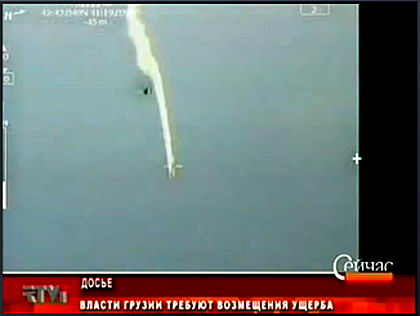
The same can be said regarding the data of the radar in Poti. They meticulously explain why falsification is impossible in this case. It turns out that the recording of the flight of the drone and the fighter who has shot down his fighter is replete with small changes in the course. And when trying to make a fake, courses would inevitably be a continuous movement in a straight line. They even explain to us why the fighter flew up to the drone so close that he allowed himself to be filmed. It turns out that this air battle was started almost in the air corridor, according to which civilian aircraft constantly fly. Therefore, the fighter’s pilot had to see the goal so that, God forbid, not to get along the passenger liner.
In order to refute all this, some firm statements by the Air Force representative stating that on April 20, our military aircraft had no flights near the Russian-Georgian border will not be enough. You can argue with Georgian data only by providing their own data - I hope that our air defense locators are monitoring this area. In the end, you can get information from civilian dispatchers who were aircraft on the above corridor.
Instead, they decided to once again brand Georgia, as in 1962 stigmatized America. Then, after embarrassment at the Security Council, Soviet newspapers wrote that “V. A. Zorin exposed the alleges extracted from a pile of all sorts of rubbish by employees of the State Department of the United States allegations of the so -called "establishing Soviet missile bases" in Cuba. " Now the Ministry of Foreign Affairs pretended that the naive Oonites deceived the insidious Georgians: “We are not talking about doubt the competence of the UN mission. The point is more of the tendentious and biased materials on which its investigation was built - the video film and the testimony of some radars. This video film, which has long been a conversation and which the Georgian side replicated on television, but did not dare to show to the UN and provide the Russian side, as we have already noted, raises serious doubts. Yes, and the data of the radar used by Moning do not coincide with those that we have. ” From this it follows that in Moscow they decided to run a fool. To pretend that there seems to be a report, but at the same time assume that the argument cited in it does not exist at all. "Near slander, bastards"
As if the Oonites did not devote almost all of their report to clarifying how they came to the conclusions so unpleasant for Russia.
Everything that happened in the distant 1962 was, of course, humiliating for Soviet representatives-it is not very pleasant when the state whose interests you represent is caught by the hand. But then it was possible to write off everything to the confrontation of the two systems, on an uncompromising confrontation, during which the fate of the country is decided.
Now, when Georgia was able to convict us in lies, Russia is not only in a humiliating, but also just in a ridiculous position. And the inability to give at least any intelligible explanations makes her doubly funny.