Translated material
Sunny tender
Bloggers expose linden tenders

Sunny tender. An attempt to make the process of public procurement transparent and free from corruption schemes once again failed. In October, there was a whole fireworks of “linden” contests, about which taxpayers learned exclusively thanks to the activity of Internet users. Will new scandals and exposures follow - the New Times found out in the scandalous market of public procurement - a truly significant event: not the last official, director of the Department of Informatization of the Ministry of Health and Social Development Oleg Simakov, was resigned. The precedent was not the fact of resignation itself, but the fact that it actually occurred "at the request of bloggers."
Oleg Simakov, CAZUS Simakova, who answered the Ministry for IT-procurement, announced a competition at which it was necessary to develop a powerful portal for 55 million rubles-a social network in which health workers and patients would communicate. And although the money for these purposes was allocated in 2009, the official took the applicants to complete the assignment for only 16 days. As soon as the conditions of the competition became known, the Internet exploded indignant and ironic comments on experts, which came down to one thing: it is impossible to do such a large -scale work in such a short time. So, the only purpose of the competition was to transfer the order to the company, which was engaged in the development of a medical social network long before the announcement of the competition. From the moment this competition was discovered and described by Evgeny Lerner, the head of the Internet agency Artus, not even a week has passed before the day of the unexpected resignation of Simakov.
Apparently, the Minister Tatyana Golikova was very unnoticed by the scandal that erupted in the summer with the purchase of high -tech tomographs (see The New Times No. 31 of September 27, 2010). The General Prosecutor's Office, the Presidential Control Department, the Accounts Chamber are engaged in that story. Another scandal was least needed by Golikova, which probably predetermined the fate of her subordinate.
But the competition is not an exception for Simakov, and the rule for Russian departments. Now the same experts and bloggers are discussing the competition on the Ministry of Education. For 12 calendar days and 48 million rubles, his winner must develop no more and no less, as an “holistic innovative educational environment” with comprehensive educational resources and services. They will ensure the “availability of innovative education” and “effective use of information and communication technologies” for ordinary people and people with disabilities. Despite the obvious inconsistency of the conditions, terms and prices of the competition, no resignation in the educational department has yet been heard: apparently, Minister Fursenko is less concerned about his reputation than the Minister Golikova.
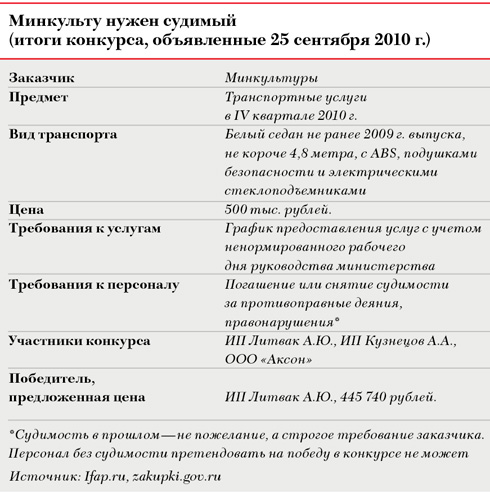
The “benefit” of the double account last week is another expert, Evgeny Altovsky from the inter -regional public organization “Information for all”, discovered another “exotic” competition. It was announced by the Ministry of Culture: the development of the portal "Cultural map of the North Caucasus." The term is a month, the price of the issue is 16 million rubles. “It is obvious that either the price is overlap with an order of magnitude, or the terms unrealistic for something except frank hack,” says Altovsky. And most likely, as in the case of a medical social network, the contractor has long been chosen and works, and at the competition he only needs to be “legalized”. The expert drew attention to such a detail: the department of Alexander Avdeev intends to spend almost 16 times more to the Caucasian Cultural Portal than on the target program “Cultural Heritage of the South of Russia”. That is, what this portal should tell about. In the press service of the ministry, in response to The New Times, the words of the Director of the Department of Science and Education of the Ministry of Culture Oleg Neretin that the competition was legal that the web resource is not related to the process of creating a tourist cluster in the North Caucasus: “The site is done on the initiative of the ministry-to inform citizens about the cultural values of the region”.
According to the observations of Yevgeny Altovsky, the departments of the department often use the following technique: they pay twice for the same work. For example, on October 21, the Ministry of Culture announced a competition for the cataloging of Russian cultural values lost during the Second World War, and the pre -printed preparation of the catalog. The price of work is 5.6 million rubles. But a year ago, the Ministry of Culture already conducted an auction for the same, only larger work - the preparation and release of exactly this catalog. Then all together cost 1.5 million rubles, the Iris publishing house, which offered the price of 7,500 rubles. Below starting. The second (and last) participant of the competition was the publishing house "Quality of life". In the new competition, of course, they also take part. And even now we are not talking about the publication of the catalog.
Often, departments and state -owned enterprises order “on the side” work, which the employees of the ministry should be carried out logically. For example, to grow up a competition, during which the “Concept for the study of the problems of maintaining digital information” and access to them a wide range of users should be developed. That is, not the right to conduct research, but the right to develop its concept. “You tell us what and how we want to explore, and we will give you 700 thousand rubles for this,” Altovsky ironizes. “But you will not be able to explain - it doesn’t matter, we ourselves do not know where we are itching.” From the same series - the Ministry of Culture to create an information resource containing “necessary data” for the analysis of modern Russian musical art (2.5 million rubles). What is this data, the Ministry of Culture does not specify.
Small tricks among government agencies and organizations belonging to the state are not “not like people”, that is, not like commercial companies. For the latter, the result of the work is profit, the difference between income and expenses. Firms strive for maximizing profit, it affects the size of bonuses and bonuses to managers, on the amount of payments to shareholders. They do not have a profit of profits, but they do not fully manage their income, since they should be sent to the budget. Therefore, departments and state -owned companies are interested in maximizing not income, but expenses.
In recent years, the authorities have been trying to take some steps so that state expenses become more transparent to external observers. At first, officials were forced to carry out the main purchases through contests and auctions, the information about which, by definition, is published. This did not change anything: it was possible to give the contest “your” company by a quietly publishing an announcement in some little-known media.
"
So far, it has not been possible to achieve a public discussion
scandalous competition ended with the inevitable
punishment of guilty officials
"
Then the state procurement portals appeared. There were many of them, and officials had a rich choice, where it is better to hide the announcement of the competition - so that only one who knows where to look. Therefore, in 2006, the government took the next step by assigning the official website of the public procurement portal Zakupki.gov.ru developed by the "computer".
At first, the search system on this portal was even less perfect than now. For example, as Ivan Beatin discovered, one of the leading experts in the field of “Electronic Government”, by 2009, officials learned to effectively deceive the search engines, replacing, for example, the Russian “O” with the Latin “O”, or even with the number “0” (in some fonts it is slightly different from the letters). Or, say, the Russian "p" on the Latin "p". The eye will not see the difference, and the search engine simply will not see the competition. And in which case you can always refer to the accident, the error of the operator of the machine set. Blagtin managed to attract the attention of other bloggers to the problem. They “woke up” the Federal Antimonopoly Service that controls public procurement. As a result, measures were taken, and today the manipulation portal with font is no longer held.
Without the consequences of runaways, Altovsky and other enthusiasts have done the most important thing - they attracted the relentless attention of civil society to state procurement. Inlapped with a gold bed in the house of receptions of the Ministry of Internal Affairs, the super -expensive watches, which Kemerovo Governor Aman Tuleyev intended to give women to women, tomographs at a price of the manufacturer at a price ... These stories have become widely known, and now not only responsible persons, but also many interested “lovers” are monitored.
However, the main thing has not yet been possible - to ensure that the public discussion of the scandalous competition ends not only with the healthy laughter of bloggers, but also the inevitable punishment of guilty officials. In approximately 90 cases out of 100 there are no consequences at all, and in the rest (except Simakov), the department justifies each other or simply “blur” the issue.
* * At the requests regarding dubious contests, the press services of the Ministry of Education and the Ministry of Culture answered approximately the same way: "Competitions are held in strict accordance with the law, and the conclusions of your experts are their personal opinion." As for the Federal Antimonopoly Service, it mainly checks the compliance of the procurement procedure with formal requirements. They mostly learned to observe their officials. Even the gilded bed corresponded to these rules. And Simakov resigned not because he violated the formal rules, but rather because he did not act quite “according to concepts” in the difficult moment for Minister Golikova.
The Ministry of Economic Development insists that the public procurement system should become more “smart”. Now the main criterion for the selection of a supplier who is guided by the official is the price. The ability to lay qualification requirements (to allow only those who can perform work to the competition) and “subtly configure” the conditions of the competition are practically absent. Therefore, officials have to go to incredible tricks, filtering out undesirable candidates, even when this is not connected with corruption. As a result, there are incidents, for example, similar to the one that was described in The New Times Andrei Yakovlev from the Higher School of Economics: a plant is selected as a power supplier in school, whose children do not eat products. But it is cheaper than that of the supplier who worked last year.
In the meantime, timid attempts to correct the cursed by both officials and suppliers of the law on public procurement (94-ФЗ) tolerate collapse. Something will change only if you steal, finally, shameful and dangerous. Neither one nor the other is yet observed.