
Translated material
The terrible secret of the defense industry
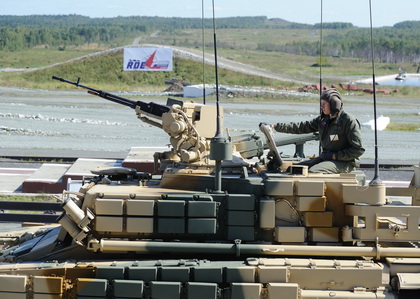
The other day, the head of state gathered a commission on military-technical cooperation with foreign states (under this euphemism, weapons trading have been hiding since Soviet times). Since by the end of the year it is supposed to report on successes, Rosoboronexport rolled up joyful numbers to the president, which he immediately voiced: “This year we reaches a record level for export supplies of military products. Their volume exceeded 14 billion US dollars, that is, the plan for a year is overfulfilled. ” Further, the head of state said that these remarkable successes would make it possible to create a “confident resonation for the future, the opportunity to create jobs and update the material and technical base of production, conduct large-scale research work and implement advanced technologies in their work as a whole.” Ahead and completely shining prospects. After all, Russia, firstly, began the production of weapons jointly with other countries, as well as to joint research and design work. And, secondly, our defense-industrial complex begins work on modernizing and repairing Soviet military equipment, which will give even more opportunities for earnings.
Note that, according to experts, Putin’s victorious relations are not quite, to put it mildly, correct. So the interlocutors of Kommersant suspect that the total amount was included in more than two billion dollars, which India was supposed to pay for the Vikramaditya aircraft carrier (Admiral Gorshkov). Because during the running tests of this wonderful ship, which was redone for ten years, the energy installation came completely unusable. According to the most optimistic forecasts, the Indians will be able to transfer the aircraft carrier only at the end of 2013. But even if you subtract the amount of this contract, the volumes are impressive.
All this could inspire if it were not for a problem whose solutions Putin did not portend Putin. It is completely incomprehensible how the remarkable successes in the weapon trade business were achieved simultaneously with the same defense industry in the year after year of state defense order. If I were, like Vladimir Putin, I am sure that foreign agents are teeming around, I would be interested in why native defense plants from the same are still executing contracts for the supply of military equipment to foreign states, and to ship the ordered and paid equipment, they are not at all rushed.
But I do not believe in the theory of conspiracies. Therefore, I know: in its current state, domestic defense, in principle, is not able to establish serial weapons production. That is, each defense enterprise is able to manufacture only a limited number of units of military equipment. To change this state of affairs, it is necessary to start the radical restructuring of industry. Either it is necessary to create a specialized production of components, or to go through the Stalinist industrialization - to revive the so -called "civilian" production in order to make components for complex military equipment on its base. If you believe the president, they decided to go just in the second way. “To renew industry, for the development of science and technology, we intend to fully use unprecedented means allocated for state defense order and modernization of the military-industrial complex. Almost all sectors of the Russian economy will receive access to these funds through adjacent orders, ”says Vladimir Putin. If he is seriously, then we are talking about an attempt to new industrialization according to the Stalinist model, when a huge number of “civilian” enterprises were built, the main goal of which was the production of weapons. An attempt to implement such a strategy will inevitably lead to a rapid and irrevocable depletion of state resources. After all, it can be effective only in the conditions of Autarchy - a ban on the purchase of foreign goods (which is unlikely to be connected to the WTO). The idea of the privatization of enterprises that would lead to the creation of multidisciplinary corporations capable of producing both civilian products and components for weapons, so far does not come to bossy brains.
I suspect that it is not by chance that the beginning of serial production according to the latter, estimated at 20 trillion rubles, was postponed until 2015. As in a well-known parable-either a ishak or a padishah ... or, the third option, the corresponding Deputy Prime Minister will take another, even higher position. And someone else will be responsible for disrupting the next rearmament program.
As a result, it is unable to produce weapons simultaneously for foreign states and for the beloved homeland of our defense industry prefers foreigners. Maybe it's all about price? Conflicts between the defense industry and the military department are memorable to everyone regarding the true price of the “products”. It would be logical to assume that foreign contracts are more profitable, that the sophisticated negotiators from Rosoboronexport are imputing such a wonderful price in foreign contracts with which our Ministry of Defense simply cannot compete. Why, then, three years ago, Vladimir Putin, at that time, the prime minister was angry with the leaders of the aviation industry, claiming that foreign orders do not bring any profit at all? There is no reason to believe that the situation has changed since then.
Thus, we are dealing with a very specific industry, which, according to official statements, does not extract income from foreign or from internal contracts. I would venture to assume: the income is reliably “hidden” in costs. These are not income of defense-industrial corporations. In the sense that these are not income from which employees and taxes must be paid. These are specific income of specific respected people. Despite the fact that the price of foreign contracts is approximately equal to internal, with all political risks, preference is given to foreign. For one simple reason. There, kickbacks are allowed officially. True, they are intended for foreign intermediaries. Well, who is there, in an atmosphere of complete secrecy, he believes that where it went ...