
Translated material
Time of assessments
65 years ago, the trial of Nazism began
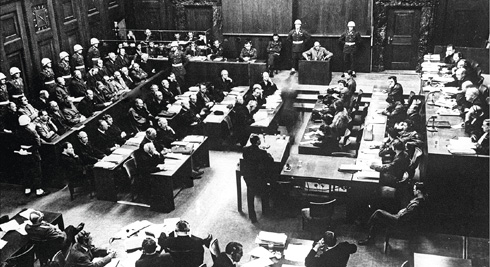
The state of the affect. On November 20, 1945, the trial of the top of the Third Reich began in Nuremberg. Why are the indisputable, seemingly decisions of the International Tribunal, after 65 years, they cause disputes - the next meeting of the Yalta conference thought the next meeting
* * Yalta (Crimean) Conference of the heads of the state of the Anti -Hitler coalition (Great Britain, the USSR and the USA) took place on February 4-11, 1945. It was devoted to the development of a common post -war policy. It came to an end when unexpectedly Winston Churchill raised the question of the fate of the leadership of Nazi Germany and its satellites. According to the English prime minister, “first of all, you should make a list of such persons, with the right to replenish it in the future ... It would be best to shoot the main criminals as soon as they are caught.” Stalin, in turn, insisted on court. The meeting protocol retained the discussion that followed. What should be the court procedure: legal or political? - asked the clarifying question Churchill. Franklin Roosevelt answered him: the procedure should not be too legal. Churchill agreed: the trial of the main criminals should be a political, and not a legal act: “I would like to have clarity on this issue between the three powers. However, nothing on this topic should be published so that the main criminals do not take revenge on the union prisoner of war in advance. ” Stalin did not mind.
* Yalta-45. Drawings of the new world. M.: Veche, 2010 The court and the case of attempts to in advance to determine the principles of justice over Nazi criminals were undertaken until 1945. We can recall the declaration of punishment for crimes committed during the war signed on January 13, 1942 by governments in exile - Czechoslovakia, Poland, Yugoslavia, Norway, Greece, Belgium, Holland, Luxembourg, as well as the French National Committee. In it, in particular, it was said that the signing people “declare a punishment one of their goals, through organized justice, those who are guilty and responsible for these crimes, regardless of whether the latter are committed by their orders, either personally, or with their complicity in any form.” And at the Moscow Conference of Foreign Ministers of Great Britain, the USSR and the USA (October 19–30, 1943), a declaration of the responsibility of the Nazis for the atrocities committed was also adopted. But finally, the architecture of the Nuremberg process took shape during the London Conference (June 26 - August 8, 1945). Then the main accusations were made. They amounted to 4 sections of the indictment (see certificate on page 59).
The choice of the city for the trial was symbolic. It was in Nuremberg that the NSDAP congresses were held (1933–1938). In Nuremberg, laws on citizenship and race (1935), which became a prelude to Shoa (in Hebrew - the disaster of European Jewry) were adopted.
Representatives of the four great powers were delegated to the International Military Tribunal: the chief judge Lord Jeffrey Lawrence (Great Britain), Deputy Chairman of the Supreme Court, Major General of Justice, Jonah Nikitchenko (USSR), former Prosecutor General Francis Biddle (USA), Professor of the Criminal Law of Henri Donnedier de Vaber (France).
The main prosecutors were directed from each of the four countries: Hartley Shoucross (Great Britain), Roman Rudenko (USSR), Robert Jackson (USA), Charles Dubost, and later Shampting de Rib (France).
I am an old soldier ... 23 people were on the bench. Accusations were also brought against the military, political and party institutions of Nazi Germany: SS, SD, Gestapo, the leading composition of the NSDAP, the Nazi Cabinet of Ministers, the General Staff and the Supreme Command of the Wehrmacht.
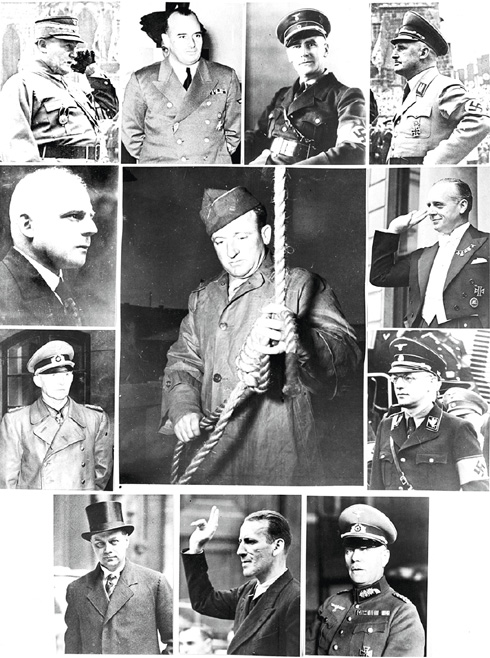
Sentenced to death: (upper row, from left to right) Goering, Frank, Frick, Streicher; (second row, from left to right) Zaukel, ribbentrop; (third row, from left to right) iodl, Zeiss-Iskvart; (lower row, left to right) Rosenberg, Caltenbrunner, Keitel. In the center is American sergeant John Wood, a death sentence
The court interrogated 240 witnesses, about 300 thousand written certificates, numerous trophy documents, film and photographs were used. The evidence base of the prosecution is huge.
The main line of protection, concisely formulated by Keitel and Jodl: “I am a soldier, I followed the order,” she could not stand criticism. “There are no circumstances mitigating guilt. Orders from above, even for a soldier, cannot be considered as mitigating circumstances where consciously, ruthlessly, without any military necessity or goal, such amazing and widespread crimes were committed, ”the international tribunal said.
During 403 meetings, the fault of the defendants was determined, and on October 1, 1946, a sentence was announced.
Goering, Ribbentrop, Keitel, Caltenbrunner, Rosenberg, Frank, Frick, Streikher, Zaukel, Zeiss-Iskvart, Bormann (in absentia) and Jodl were sentenced to death. Hess, Fun and Reder were sentenced to life imprisonment. Shirah and Speer - to 20 years in prison. Neurat and Denitz - by 15 and 10 years of imprisonment. Frice, Papen and Mine were justified. Lei, in a state of withdrawal caused by severe alcohol dependence, committed suicide before the sentence, four days after receiving the indictment. Goering, Keitel and Jodl asked to replace the hanging with “honest death from gunpowder and lead” - execution. The petition was rejected, and Goering accepted the poison a few hours before the verdict (execution took place on October 16, 1946).
The court recognized the criminal organizations of the SS, SD, Gestapo and the management of the NSDAP. The Nazi Cabinet of Ministers, the General Staff and the supreme command of the Wehrmacht were not recognized by criminal organizations.
And who are the judges? Nevertheless, both the process itself, and its results caused criticism not only from the side of protection or representatives of neutral states, but also among the anti -Hitler coalition. For example, the prominent theorist of the tank war (it was on his works that Heinz Guderian and Charles de Gaulle grew up) Major General John Fuller called the Nuremberg process a "parody of justice steming from hypocrisy." Such statements, alas, are not without foundation, were caused by several reasons, both political and legal.
Political reasons include “skeletons in the closet” - facts that were disadvantageous to the side of the prosecution, primarily Stalin. By the beginning of the process, the Soviet delegation was brought by a list of nine undesirable issues approved in November 1945. One of them concerned the secret protocol to the Soviet-Germanic Agreement on non-aggression and everything that was connected with it. Questions on Western Ukraine and Western Belarus and the problems of Soviet-Polish relations were also lowered. The British and French, in turn, were unprofitable to recall the 1938 Munich agreements. As a result, an agreement on issues to be discussed was reached in advance between representatives of the USSR and the allies, and a list of topics that should not have been affected during the trial was agreed. The Soviet Union also insisted on recognizing Germany guilty of the mass execution of Polish officers in Katyn.
However, the process in Nuremberg went through his logic, which did not want to take into account the winter -culuer agreements. So, Ribbentrop’s lawyer Dr. Alfred Zaydel published the secret protocols of the Hitler -Stalin Pact, and the skillful defense of Goering and his lawyer Otto Stamer questioned the Soviet version of the Katyn atrocity. Already during the process, all this entailed a new tragedy. The Soviet prosecutor Nikolai Zorya was killed-according to one version, special services, precisely because of the failure of the Moscow position. Indirectly, such an assumption is confirmed by conflicting versions of the death of Zori (the family reported suicide, and officially announced death as a result of careless handling of weapons).
And the legal side of the prosecution was not always correct. The proceedings were carried out on behalf of the Allies, that is, the victim. Thus, the principle of adversariality of the parties, as well as the presumption of innocence, to which any criminal has the right, was violated. The principle of accounting for mutual guilt was also violated, according to which the prosecution cannot judge the crimes that were committed by herself. In this case, rightly accusing the Nazis of creating a concentration camp system, genocide and deportation of peoples, prosecutors ignored the similar acts of Stalin. Accusing Goering of the leadership and the organization of air raids on Warsaw, London or Coventry, as a result of which the civilian population was primarily killed, the allies turned a blind eye to the carpet bombardment of Germany, organized by the English marshal of aviation by Arthur Harris, who said about Berlin: “I want this mocking city to be incinerated from end to end.” It should be noted that the number of victims of the raid on Dresden on February 13-14, 1945 (perfectly described in the book of the American prisoner of war, Kurt Wonnegut “Milia number five, or the crusade of children”) was about 30 thousand people, the vast majority of civilians or wounded military personnel.
By the way, the accusation against the Führer No. 2 Admiral Karl Denitz about the illegitimacy of the total underwater war was rejected on the initiative ... Admiral of the US Navy Chester Nimitsa. He stated that a similar method was used by Americans in the war with Japan since December 8, 1941. Another ambiguous accusation is connected with Denitz: in the development of the occupation of the occupation of Spain (plans "Isabella" and "Ilona"). Conviction for intention was more subject to Soviet justice (Article 119 of the Criminal Code of the RSFSR of that period). The Soviet justice also borrowed the rejection of the cross -interrogation of witnesses, adopted in most legal proceedings.
Therefore, it is not surprising that in 1953, the court in Munich satisfied the lawsuit of the widow of Jodl Louise and, on formal grounds, rehabilitated Colonel General. This is that Jodl was in control of the implementation of Hitler's directives, including those directed against humanity (laws on Jews and commissars).
Probably, procedural miscalculations were caused by inevitable bitterness, a reaction to the atrocities of the Nazis. In the same way, the shock from concentration camps forced both ordinary and generals to commit acts far from the rule of law. Therefore, the American soldiers shot the surfaced guards of Dachau, and General Leclerk, without a trial, executed the captivity of the SS "Charleman". Friedrich Nietzsche was right when he wrote with sad irony: “If you fight with dragons for a long time, you yourself will become a dragon, and if you look at the abyss for a long time, the abyss will begin to look at you.”
The Nuremberg Tribunal appeared: the head of the party office of the NSDAP Martin Bormann (in absentia), the Reichsmarshal Luftwaffe Herman Goring, the deputy Hitler for the party Rudolf Hess, the former head of state and the commander-in-chief of the Armed Forces of Germany from April 23 to May 23, 1945, Gross-Admiral Karl Denitz, commissar for worker in a worker in a working worker Fritz Zaukel, head of the German Foreign Minister Arthur Zeiss-Iskvart, Konstantin von Neurat and Joachim Ribbentrop, chief of staff of the Supreme Command, Colonel General Alfred Yodl, head of the Main SS Secretary General SS Ernst Caltenbrunner, chief of headquarters of the High Command Studies, and chief of headquarters of the High Command, and the headquarters of the Supreme Command, Wehrmacht General Field Marshal Wilhelm Keitel, Head of the Labor Front Robert Lei, Vice Chancellor of Germany Franz von Papen, Glavkom of the Navy Admiral Erich Reder, the occupied territories Alfred Rosenberg, the Reichslyaitor of Poland Gans Frank, Bohemia Reichsliytor and Moravia (Czechoslovakia) Wilhelm Frick, Head of the Broadcasting Department of the Ministry of Education and Propaganda of Hans Frice, Economics Ministers Walter Fly and Yalmar Shakht, Hitler -heading Baldur von Shirah, head of the weapons Minister Albert Speer and the editor -in -chief of the Determer newspaper Julius Strayher.
The main points of the prosecution: plans of the National Socialist Workers' Party of Germany (NSDAP) (unleashing wars and supporting aggression of the Union States of Berlin); crimes against the world (planning, preparation, unleashing and conducting aggressive wars in violation of international treaties, agreements and obligations); war crimes (murders and cruelty against the civilian population, the deportation of the civilian population, the use of slave labor, murder and cruelty to prisoners of war and military personnel with which Germany was at war); Crimes against humanity (persecution, repression and extermination of enemies of the Nazi government.