
Translated material
Scientific oligarchs
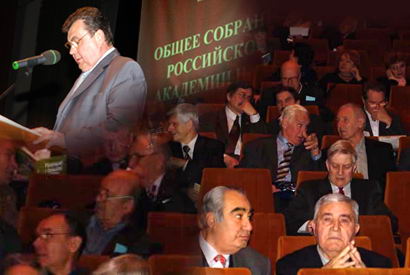
In Moscow, the session of the Russian Academy of Sciences (RAS) ended. It occurred on it the most living and piquant event for the scientific community - the elections of academicians and members of the scam. Once in Soviet times, these were the only elections in the country that earned their name: they were not a public struggle, but at least an intrigue. Then political elections appeared temporarily, now they ended again, and the elections in the Russian Academy of Sciences remained elections - with an ever -unpredictable result.
The attention of the audience is riveted to the “fried” - how many bosses climbed into the wounds, and how many “buying up seats” were really crawled as a result. In general, the “department of incidents” in newspapers loves such scientists as “economist-member” Khasbulatov or “mathematician-member” Berezovsky.
Well, on the obligatory tedious side dish, the eternal song since 1990: science is dying; a little more, a little more; Of course, we still save, but if we do not increase funding, we will not save, although in fact our land is great and abundant, and in the deposits of natural talents it has no equal, but the deposits are poorly developed ...
For these patterns, to write an article “About Science and Minnauki - RAS” can simply be closed with your eyes closed.
But since science, in fact, suggests at least some facts, except for pure la-la, I will try to imagine some of these facts for those-I believe, few readers who all this scientific subject may be interested in.
Better less, but better
First of all, about one universal phenomenon.
The significance of science in the economy increases - the achievements of fundamental science fall. This is a world trend. As science is industrialized, as it is made increasingly large and more and more bureaucratized, as the number of scientists increases, the mountain ridge (sorry for the pathos) of science is increasingly turning into the plateau. This, by the way, applies to all areas of culture: “Progress! Now in the Tula writing organization 183 member, and before the revolution there was one Leo Tolstoy. "
About a similar picture in science.
As you know, the whole world science is “nothing more than advanced comments on Plato”: in tiny Athens, where only a few thousand were of competent citizens, namely, Plato and Aristotle worked at the Plato Academy of Plato!
In the XVII century, when the population of all Western Europe was less than now the population of France, and literate people were probably several hundred thousand, among several thousand (or several hundred?) Scientists, university teachers without cramped were accommodated - Newton, Leibniz, Descartes, Pascal, Spinoza (the latter, by the way, did not teach, pebbles for himself granl).
The beginning of the twentieth century. The number of professional scientists throughout Europe, the USA, Russia (and there were no more of them anywhere) is measured from the strength of tens of thousands. Among them are Einstein, Bor, Rutherford, Planck, Arrenius, Pavlov, Mechnikov, Mendeleev, Freud, Koch.
The beginning of the XXI century. Millions of professional scientists in the world, today there are many times more of them in Japan than in the whole of Europe in the 1930s, crazy budgets ...
And which of the great can be called among the living?
Watson discovered the DNA structure (the last discovery of the Newtonian scale in the history of science), Towns is one of the creators of the lasers (along with the deceased Prokhorov and Basov. And that is a giant, revolutionary discovery, but rather applied, not fundamental). Gell-Man (quarks). And more, by and large, there is no one to name. There are several more great mathematicians - Atya, Serra, Witten, Gelfand, Arnold, Hirceprob, but experts interviewed by me (I hope that I give the assessments not on my own behalf) even in the most general form to explain what they are doing. And their assessment is this: there is no modern Newton or Gauss among them, but at the level of Hilbert or Poincar (the great mathematicians of the beginning of the last century), comparison are possible.
Why does scientific progress go through scientists with a steam rink, “even” to some average level? (Humanity has hardly become “just stupid” over the last hundred years!) A separate topic - not to discuss it in a newspaper note.
But in this regard, one more question: if the stars go out, then, does anyone need it? Or rather, it means that these stars themselves (great scientists) themselves are not painful in the modern knowledge economy?
Sounds like a deliberate paradox. In the economy of knowledge (high-tech, biotechnology, pharmaceutical industry), fundamental scientists are not needed-but in the slave-owning economy of ancient Greece, in the age of manufactories (Newton), during the coal economy and the beginning of the 20th century, great scientists were in demand, so what?
No. Not so. It’s just that then science (fundamental) and the “worlds” who were engaged in it had nothing to do with the economy at all - they lived in a tower of ivory and stars looked at the stars. Science was separated from the economy and from life - and this has benefited it. And now mass science is really in demand by the economy - and the economy with a vacuum cleaner sucks brain from science, sets science with its rhythm, its goals, its own rules of the game. And mass science/culture and high science/culture are two completely different toys.
Maybe this is the answer. Maybe it's different. Don't know. But the facts, as they say, is a stubborn thing: as 180 Tula writers will not write “Anna Karenina”, so a small article “to the electrodynamics of moving bodies” will not be released from enormous research centers, in which a special theory of relativity was presented on several pages.
And yet. Countries with a fairly low fundamental science are very successful in the modern economy-including programming (India) and modern technologies (Southeast Asia). Yes, and the fact that, say, about the great scientists from the Netherlands, Canada or Finland, somehow you can’t hear it today, does not prevent them from being super-technological countries with a high standard of living. Need scientific results? There is no problem-take others, the world is open! The United States - the only world scientific superpower - pave the way along the virgin lands, and we calmly follow them.
Moral: fundamental science and really large scientists are not too connected with the modern knowledge economy. As for the human need to expand knowledge, it, one way or another, is satisfied by scientists from the USA for all mankind. Why humanity experiences and demonstrates the USA its human gratitude ...
So why does society need science then in any particular country, if you can’t smoke a sandwich?
For national vanity (“ours”!) There will be enough those whom society really knows and loves - those who whirl their fillets on the stage and tears muscles in stadiums. But, nevertheless, the social significance of science seems very great to me.
The scientific community ozones the air.
In life, I had to meet people of different professions, mostly, of course, intelligent. So, sometimes the Leninist formula “intelligentsia is the brain of the nation? Not a brain, but shit! " Involuntarily came to mind. When communicating with scientists - almost never.
This is understandable. The habit of some intellectual honesty, neatness (remembering facts and logic), of course, and scientists often fails - especially when they fit into the areas alien to them. And, nevertheless, scientists, researchers set the society some standards for thinking (wider-intellectual behavior) and even some moral standards (weak? Without questions! But no longer a single group of the population will ask).
The trouble is only in one thing-it should still be scientists, not officials, businessmen, just gaming, hung with scientists.
Artificial plants are beautiful - but the atmosphere is not cleaned.
And here we are really bad.
No longer exists
According to a well-known legend, in the 1930s at one reception, Goebbels asked the rector of the University of Gettingen, the very David Gilbert: “Is it true that after the departure of the Jews and their friends, your university lost a lot?” “No,” the calm Gilbert snapped. - The university has not lost anything. There is simply no more university. ”
I do not believe in the veracity of beautiful shoes, but this is curious.
From Germany, in fact, an insignificant number of intellectuals - several hundred people emigrated. True, these were selected people. By January 30, 1933, there were 19 Nobel Prize in the field of science in Germany - the first place in the world. Six emigrated of them (by the way, two “semi -Jews” Warburg and Herz remained in Germany, were directors of institutes and safely survived Nazism). In addition, from among the emigrating scientists, eight more received Nobel prizes.
But be that as it may, most of the German scientists, including giants such as plank, Geisenberg, Laue, remained in Germany, with their scientific schools.
Therefore, “University is gone no longer” - this, of course, is a great exaggeration. But the fact that the level of intellectual life in Germany was no longer restored, the atmosphere remained sparse is true. Although today German science occupies strong positions. According to EU experts, she shares the first or second place with English, although the flight of minds in the United States continues.
The situation with Russian science now, it seems to me, is much more dramatic than with German in the 1930s.
We will not play adjectives, we will leave the cries about the “death of Russia” for Karaulov and Prokhanov and try to turn to the facts. Once again, we proceed from the fact that science is piece product and 100 gray academicians do not cost one real scientist. If we take formal criteria for the scientist’s rank - prestigious international awards, membership in the best academies of the world, etc., then the picture loomed as follows.
Among the fundamental sciences in the USSR, biology and chemistry were always relatively weak; Mathematics and physics are traditionally strong (especially theoretical, Landau School, Bogolyubov School, Tamma School).
The total number of scientists who emigrated from the USSR-RF in 1980-90 is unknown to me (I am not sure, by the way, that the exact figure exists at all). Assessments are said about several tens of thousands. Which of them is suitable for the concept of “creators of schools”, “world -class scientists”?
Among the academies of the world, according to the general opinion, royal society in London is valued above all, in second place is the National Academy of Sciences of the USA. Members of the Royal Society are three Russian scientists (Ginzburg, Shafarevich, Khaletnikov), three scientists who emigrated from Russia (Gelfand, apricot, barrenblatt), and one (Arnold) occupies an “intermediate” position - mainly lives and works in Paris, but remains a citizen of Russia, the president of the Moscow Mathematical Society, periodically travels to the President of the Moscow Mathematics. Moscow, tries not to lose touch with students.
In the National Academy of Sciences of the US, the picture is even more interesting.
Among the 350 foreign members of the Academy are 11-from Russia, four more foreign members are former citizens of the USSR-RF (two from Israel, one of Germany, one from France). And among 2000 members of the Academy working in the United States - 18 of Russia, this is almost 1%. The giant “donor infusion” becomes even more noticeable if we turn to individual sciences. So, among 85 members of the national mathematics department of national AN - 8 from Russia, which is almost 10%! No wonder in the USA they talk about the "Russian mathematical mafia."
In general, if we take the National Academy of Sciences of the USA, among its members of the “Russians” are represented as follows: 11 people live and work mainly in Russia, 18 in the USA (some “with raids” for their homeland), 4 in other countries.
Take another criterion - the most prestigious international awards.
Nobel laureates in the field of science from the USSR-RF-three people. Ginzburg and Alferov live in Russia, apricot in the USA.
The Fields Prize, which is called “mathematical Nobel” (as you know, is no less prestigious, Nobel prizes are not awarded in mathematics). Over the entire period of existence of the prize, 44 scientists received it, of which 6 of the USSR-RF. I will list all: Novikov (USA, University of Maryland, is simultaneously listed at the Mathematical Institute of the Russian Academy of Sciences), Margulis (USA, Yale University), Drinfeld (USA, Chicago University), Zelmanov (USA, California University, San Diego), Kontsevich (Parisian University), Voivodsky (US Princetone). Moreover, it is especially important that almost all of them are actively working scientists, the oldest (Novikov) 68 years old.
Another superpretable award is Dirac medal from the International Center for Theoretical Physics. In total, 41 scientists received it, of which 8 of them are of the USSR. Of these eight, five are currently alive: Poles (Princeton), Fadeev (St. Petersburg branch of the Mathematical Institute of the Russian Academy of Sciences), Sinai (Princeton), Zakharov (Arizona University, is also listed at the Institute of Theoretical Physics of the Russian Academy of Sciences), Linda (Stanford University).
Finally, I will name another award in the theoretical physics of the Nobel level - Haineman Award. In total, 60 scientists were awarded with it, of which six Russians: the deceased Bogolyubov, already named Fadeev, Poles, Sinai, Arnold and Podolodchiks from the United States Rutgers, USA.
Each reader is free to draw conclusions himself. My conclusion is trivial - you can’t remember such a defeat in the history of European science. You can choose our academics as much as you like, give them state bonuses and orders, increase salaries. Yes, among them the Khasbulatov-Berezovsky, of course, make up a vast majority. But not to be a jindle in science - this does not mean to be a world -class scientist. The whole excuse of hundreds of thousands of scientists is that among them there are dozens of scientists of the highest world category. If they are not there, then science turns into a horseman without a head.
In the USSR, scientists of the first world class were - this can be seen even from the above stingy data. There are practically no left in the Russian Federation (except for very elderly people or people who are in Moscow by raids, a couple of months a year). The best, strong, located in "scientific and retroductive" age, have left our country.
However, it was not by chance that I started the article with the reasoning that for real life in the country, for the economy, even for high technologies, the presence of first -class fundamental scientists is not necessary. They are successfully replaced by the presence of the Academy of Sciences.