
Translated material
By kings and Secretary Generals
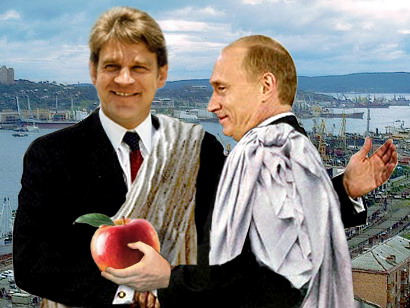
The Kremlin begins a reform, the result of which will be the administrative collapse and bankruptcy of the country. One or almost as happened in 1917 and 1991.
This week, the president introduced the candidacy of Sergei Darkin, still the current Governor of Primorye, for approval of the Legislative Assembly of the region. So the first appointment of the head of the region from the Kremlin took place. From now on, Darkin is not reported to the residents of the region, but is responsible in his decisions and actions exclusively to Moscow.
It was according to this scheme that the leadership of peripherals was built during the time of tsarist Russia and in the Soviet Union. It ended, as you know, the muzzle of the table. They decided - little, they decided - we must try again and the same subject. Moreover, in the worst of the possible options, in which the managerial structure of the USSR will seem like a miracle of bureaucratic thought.
And that's why.
In the Soviet Union there were two vertical structures that permeated the country from Moscow to the very outskirts and designed to provide the center with information, on the basis of which decisions were made. One such structure was the Central Committee of the CPSU and its units in the republics, regions and regions, the other - the KGB of the USSR with offices in the same territorial formations. These two structures passionately fought with each other for power and functions, which ensured some kind of competition and thereby allowed the state to survive for the time being.
The task of the party bodies was the development of politics and its implementation in all areas of the country's life, the task of the Chekists is to control the mercers of citizens, so that citizens with slim rows move in a bright day after tomorrow and do not claim a larger piece of political, social and economic pies than the top that was allocated by the top that shared the pie among themselves.
An indicator of the success of the party functionaries (and, accordingly, their advancement to the possession of the most part of the pie) was the execution of five -year plans. An indicator of the activities of state security guardians (and, accordingly, the achievements of the drunk dachas, grocery feeders and other things that are not available to ordinary citizens) were silent humility and non -resistance of the population.
This is the distribution of functions and the struggle between party and Chekists for their multiplication and ensured at least a relatively objective awareness of Moscow about the real state of affairs in the regions. While in the Central Committee of the CPSU there were blowing numbers about the execution of five -year plans, the KGB of the USSR received data on possible unrest in the regions provoked by failures in the economy, that is, lack of products, services and so on. Of course, the Chekists did not want to bear responsibility (and, therefore, deprive places and feeders) for everywhere and there, here and there, on a larger or smaller scale, the existing Novocherkassk, and therefore warned the country's leadership about the catastrophic state of the economy and threatening troubles. It is no accident that it was the KGB that was the first customer of economic reform plans in the country for the Yugoslav and Hungarian options. However, the more the fusion of the Central Committee of the CPSU and the KGB of the USSR, which was begun by Yuri Andropov, when he was the head of the Lubyanka, the less real information entered Moscow, to the decision -making center. So we came in the eighties.
As a result of information aspixia, the patient first died the brain, and then, when oil prices fell, the apparatus of artificial maintenance of the activities of other organs also turned off. In 1991, the patient was declared dead: the Soviet Union ceased to exist.
Left without a parent, Russia, having passed a series of clinical deaths, was nevertheless reanimated by market reforms and the fantastic ability of former Soviet citizens to survive.
The Putin administration decided to strangle the country again. The goal, no matter what declares, is the same: to concentrate control over the pie in the hands of a narrow circle of people loyal to the president personally.
However, unlike how the power system was arranged in the Soviet Union, now party (presidential administration and appointed governors, and the mayor) and the Chekists are concentrated at the same large power institute.
Destroying the mechanism of election of the heads of regions, the center deprives itself of information about the real state of affairs on the periphery. On the one hand, the appointed governors lose any interest in their inhabitants (which arose at least once every four years, during the election campaign), on the other hand, their promotion will directly depend on how competently they report their successes to the Kremlin. In the absence of a competing power institute, free media and in a situation of destroying economic groups of interests capable of competing with the authorities, the Kremlin is doomed to information asphyxia. Oxygen starvation has already begun: evidence of how reform was prepared to monetize benefits.
The only question is only how quickly the apparatus of maintaining other body organs under the name Russia will cease to work, namely, when the world oil conjuncture will change. The result will be the same as in 1991-the muzzle of the table.