
Translated material
Five calm years
In society
 Five calm years
May 23, 2012 Alexey Makarkin
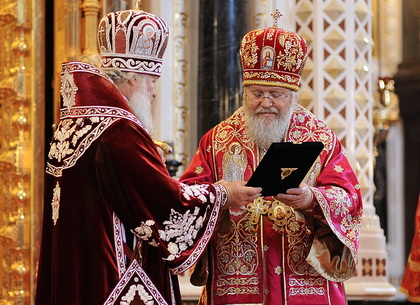
The main result of the fifth anniversary of the presence of the Russian Orthodox Church abroad (ROCS) as part of the Russian Orthodox Church is in the absence of sensations. No sharp steps, no one clapped the doors (the active minority of the "foreigners", which opposed the unification, was not part of the Russian Orthodox Church from the very beginning). The Primate - Patriarch Alexy and Metropolitan Lavr, who set their signatures under the Act of the Union, but their course, the successors - Patriarch Kirill and Metropolitan Hilarion, died.
It seems that the "foreigners", which are now part of the Russian Orthodox Church, feel more comfortable than before. For believers, everything remained almost as before - only in the temples they began to remember the Patriarch of Moscow, but there was an opportunity to pray with their compatriots and the Orthodox from other countries. The patriarchy does not intervene in their internal affairs, the same bishops control the dioceses, and the same priests serve in the temples as before (adjusted for inevitable personnel movements). There are no political disagreements between “foreigners” with modern Russian power - living in the West, they did not become “Westerners” in spirit. The current “inadvertible” Russia, in which gay parades are not allowed and there is no question of the legalization of same-sex marriages, which is closer to them than the modern West. The same applies to the Russian priests who went to the ROCI in the 90s and remaining there-the most famous of them, Bishop of Domodedovo Evtihiy, directly campaigned for Vladimir Putin as a guarantor of stability during the presidential election campaign. Indeed, Putin, who erected the tombstones of Denikin and Ilyin on personal funds at the cemetery of the Don Monastery, is immeasurably closer to the "foreigners" than Udaltsov or Nemtsov.
The gap between the Russian Orthodox Church and the ROCZ was due to political reasons, but led to the fact that the “foreigners” were out of communication with the main Orthodox churches, with the world Orthodox community. Most of the “broken” believers are ready to accept this state of affairs under two circumstances: if they are moved by a strong national-religious idea or if they have reason to believe that the church from which they left no longer leads to salvation-the main goal of any Christian, but, on the contrary, impedes him. The first factor, known for the experience of the Bulgarian and Georgian churches that achieved recognition of their autocephaly after decades of isolation from world Orthodoxy, was originally irrelevant for the ROCZ. She united the descendants of the Russians who left Russia after the Bolshevik coup, and not adherents of the national movement, seeking to separate (or already separated) from the metropolis.
But the second factor for decades fully retained its significance. It was impossible to be “foreigners” in the same church with clergymen who adapted to life in an atheistic state who glorified the policy of this state, both internal and external. The approving reviews of the Orthodox hierarchs about Stalin, the receipt of orders from his successors, awkward attempts to combine religion and communist ideology were perceived in the ROCZ as a betrayal of unshakable principles, apostasy from the purity of creed. At the same time, most “foreigners” were not ready to reject the Russian Orthodox Church completely - condemning the “collaborationist” hierarchy, they admitted that pious priests remained in “Soviet” Russia, who zealously and righteously nourish their flock, although they are forced to be in the jurisdiction of the Moscow Patriarch.
Such duality fundamentally distinguished “foreigners” from the Russian Old Believers and Greek old -style, for whom the official church is completely unacceptable, since the differences between them are deeper, not related to the current political situation. The rite all the time remained the same, as well as the church calendar. “Foreigners” prayed by the same words and at the same time (adjusted for time zones) in New York, as the clergy and parishioners of the Russian Orthodox Church in Moscow. Thus, if some political cataclysms led to separation, others could contribute to the unification - which happened. When the Russian Orthodox Church canonized the royal family and many other new martyrs, and state power recognized the dignity of Stolypin and Solzhenitsyn, Denikin and Ilyin, then the “foreigners” had few arguments to remain in the “separated” state. The strongest argument in favor of the unification was the personal experience of visiting the restored ancient monasteries and temples, which seriously influenced the mood of many bishops and clergy of the ROCZ.
Another “church-political” circumstance was added to this. In the early 90s, “foreigners” launched active activities in Russia, perceiving the territory of the former USSR as a field for catechizeric activity. But very quickly it turned out that the believers were accustomed to their old priests and did not at all expect replacement from abroad. The ROCZ itself, who has experienced not the best times (reducing the number of parishes and clergy, the departure of many famous hierarchs and theologians, internal disagreements), has not become a model for Russian Orthodox. Moreover, the first attempts to gain a foothold in Russia led to failures - the “foreigners” did not always move the best priests, and political inexperience led to a short, but significant rapprochement with the extreme right -wing forces from “memory” (which caused considerable irritation in the moderate part of the ROCZ). The ROCZ very soon did not have real prospects for development in Russia.
However, in the ROCZ in recent decades there was a minority, confident in the complete gravity of the entire Russian Orthodox Church - from the Patriarch to any rural parish. This more radical part of the church abandoned the unification with the Russian Orthodox Church, but could not offer a clear single alternative to the integration process. Over the past five -year, “fragments”, which were separated at different times from the “foreigners”, did not agree among themselves, remaining in marginal condition and accusing each other of apostasy from the only right path. Which further strengthened the supporters of the unification process in the correctness of the choice they made five years ago.
Author - First Vice President of the Center for Political Technology
In the photographs: the celebration of the fifth anniversary of the reunification of the Russian Orthodox Church in the Fatherland and abroad
Photos from the site www.patriarchia.ru