
Translated material
The results of the integration of Eastern Europe
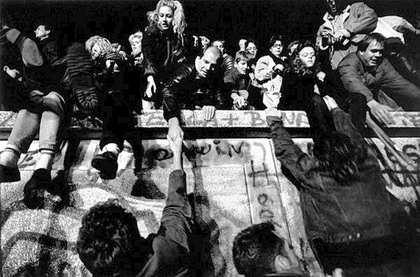
We are experiencing a historical moment: 19 years of reunification of Germany, 20 years of the fall of the Berlin wall and, most importantly, the approval of the Lisbon Treaty of Ireland (which the leaders of Poland and the Czech Republic were guided by).
In Russia, there is practically no calm and balanced analysis of European integration: usually simply an introductory description of advanced European experience (with separate, temporary, in some places existing shortcomings), often on euro-graders, or, in contrast to this, are tough attacks with losing failures. In one case, impartial analysis is perceived as blasphemy, in the other - as an indulgence of a strategic competitor. Both are ideologized and politicized, which interferes with analysis.
Meanwhile, a wide and impartial study of European experience is necessary for the last 20 years to find out what happened and what hopes and why did not justify; I hope we start this work today.
This material does not claim to be finally, I ask you to consider it as an invitation to the broad discussion necessary for all of us.
20 years after the symbolic fall of the Berlin Wall, this is half the time that Moses drove Jews in the desert. A worthy deadline for summing up at least preliminary results. A significant part of the hopes for “the return of Eastern Europe to Europe” did not materialize - and it is time to understand why. On the other hand, all the hopes of 20 years ago that could be realized are already implemented-and we, as neighbors not only in geographical and economic, but also in a cultural sense, it is important to understand what will happen next.
Our problems are much deeper than European ones, but Europe, as usual, will have a strong influence on the path of their development and solution.
Why do we need to think about Europe
This is necessary not only because the European Union, along with the United States and China, is one of the three world “power centers” and our largest trading partner, and it is important for us to have something to trade with it (now cargo transportation will be reoriented at the work engaged in work, and not the moralizing of Southeast Asia). It is important for us to understand whether the enmity of Russia will remain in Eastern Europe a key criterion of democracy and whether Poland will be, when it will have to choose, consider herself a 27th member of the European Union or the 52nd US state.
It is more important that in Russia the idea of Europe as a center, the quintessence of civilization and democracy, as the highest expression of "freedom, equality and brotherhood" is alive. Russia has been living in a disaster for 20 years, called "liberal reforms." In conditions of rapid barbarization, we desperately need our desire for civilization and culture there is something to rely on not only in the past, in the memoirs of the Soviet Union, but also in the present, in Europe, but instead of the seemingly unsuccessful European values, we are increasingly relying on the air.
Since the time of ancient Rome and Karl the Great, Europe has survived a lot of integration projects, and the importance of the European Union is not so much in its relevance as in humanity: the last pan -European project was implemented by Hitler.
Europe is needed by Russia precisely as a vaccine in humanity - and the inability to perform this function requires an in -depth study, because this is another threat of our civilization.
Moreover, European integration and expansion of the European Union contributed not so much to the solution as to aggravate its problems.
Internal heterogeneity: like in the USSR
The key problem of the European Union is the deepest internal differentiation associated not only with the level of economic development, but also with the cultural factor. The carriers of different cultures, even such close ones as French and German, react differently to the same managerial mechanisms that complicates their unification. The situation was aggravated in 2004, when united Europe expanded, in fact, beyond its cultural borders.
The pull-up of the Eastern European economies to the level of developed members of the European Union in 1992-2008 is impressive. However, one cannot but pay attention to the following important aspects:
1. Despite the significant pace of pull -ups, only Slovenia crossed the line of half the French level for GDP per capita, and it came close to this level back in 2003. The lag of other countries, although it was reduced to the crisis, remains qualitative, not quantitative. These countries are still not so much “Europe” as “Eastern Europe” in the traditional sense of these terms.
2. The steadfastness of pull-ups to the level of "old Europe" is largely due to disaster of the late 80s-early 90s. Only Hungary exceeded its “relative” level of 1980 already in 1996, that is, after 16 years, and confidently increases the indicators. The Czech Republic exceeded its “relative” level of 1985 (that is, almost on the eve of market reforms) only in 2008, and in 2009, due to the crisis, it again “failed” below him, Romania approached him only in 2008, but then receded again, Poland reached it in 2003, after 18 years, and Bulgaria seems to not reach the next decade.
3. The uneven development of the countries of Eastern Europe is preserved, although the outsiders partially changed (Bulgaria took the place of Poland, Romania remained in the penultimate place). The gap in the per capita GDP between the most and least developed of the five countries of Eastern Europe (without the Baltic states, Slovakia and Slovenia) decreased, but after rapid growth as a result of the 1992 disaster and the subsequent exit from the crisis, it reached the level of 1988 only in 2008 (when the market destabilization of Poland has already begun).
4. As the 2009 crisis shows, the progress of the Eastern European countries is unstable in nature: in addition to Slovakia (possessing powerful oil refining and chemical industry with the small population, which leads it out of the total row), all of them (including, as far as can be understood, the territory of the former GDR) suffered relatively more much than France taken as a “reference point”. At the same time, the regression was insignificant in the most (Slovenia and the Czech Republic) and the least (Bulgaria) developed countries; The rest receded very significantly.
The great vulnerability of the Eastern European countries, like all of the above, is due to the model of European integration itself, which we will now consider, but so far we will fix the main thing: the deep internal differentiation of the European Union, although it is reduced, is nevertheless its fundamental feature and in the visible future will be of qualitative rather than quantitative nature.
Colonial model of European integration
The preservation of the gap in the level of development and the chronic need for new members of the European Union in assistance is predetermined by the most economic model of European integration.
The orientation of the European Union to the domestic market, and not on export, is a consequence of a rational desire for sustainable development, protected from external shocks, reproducing the economic models of the Soviet Union and China. However, for the new members, this turned into a requirement of the reorientation of foreign trade in the domestic market of the European Union, which, along with the crisis, contributed to the breakdown of trade ties with Russia.
Since the high -tech products of new members, as a rule, were uncompetitive in the domestic market of the European Union, their European orientation contributed to the deindustrialization of these countries. “Hypercarence” by European firms led to mass unemployment and declination of labor, displacing the population into sector with high self -e -operation (small trade, small business and agriculture), as well as in its migration to the developed countries of the European Union, where it significantly “spoiled” the labor market. In addition, excessive “grinding” of business objectively reduces national competitiveness.
Eastern European economies (primarily banking systems remaining weak) have passed under the control of the global corporations of the "old" Europe, which preserved industry, as a rule, where there was highly qualified labor force. In countries with less qualified labor (Romania, Bulgaria, the Baltic States) there was a genuine industrial disaster. At the same time, qualified workers fled at the opening of borders (in 2007-2008, 20-30% of the economically active population left Romania-2-3 million people), creating a shortage of labor and increasing the cost of the remaining ones, which largely deprived the countries of the cheapness of qualified labor. Her preparation has almost stopped.
The preserved industry is largely engaged in the assembly of products, including exporting to capacious markets of Russia and Ukraine.
There was a two -sequentary economy characteristic of the colonies.
It is fundamentally important that Western capital, as a rule, did not create new ones, but used the resources that existed in Eastern Europe, giving modernization a “reflective” character.
The additional cost is withdrawn to the countries of the basic of global corporations, which determines the paradoxical combination of export orientation (in Romania 85% of investment imports is to ensure export) with a chronic deficit of the current payment balance (largely due to high investment income).
The Czech Republic President Vaclav Klaus admitted that the entry of the Czech Republic into the European Union turned her into a “boost of money”. This applies to all countries of Eastern Europe: their balance of current payments of payment balance was much worse before the beginning of the crisis than in 1990, the last year of the existence of the socialist system. (In Bulgaria, it decreased from -8.3% of GDP in 1990 to -25.5% of GDP in the latest pre -crisis in 2008, in the Czech Republic -from 0.00 to 3.1% of GDP, in Hungary -from +1.1 to -8.4% of GDP, in Poland -from +1.9 to -5.5% of GDP, in Romania -from -4.7 to -12.4% GDP; for 1992-2008, it decreased in Slovenia from +5.8 to -5.5% of GDP, from +5.3 to -11.6% of GDP, in Latvia -from -0.3 to -12.6% of GDP in Estonia; GDP.)
The negative balance of the current payment balance can be maintained for some time by the inflow of foreign investment, however, in a chronic character, it means “life-debt” with high dependence on external shocks and risks of devaluation or if they are impossible (for example, due to the entry into the euro zone), and the deterioration of social protection.
At the same time, the structural funds of the European Union determine the allocation of funds with rigid conditions, which are difficult to comply with. So, in 2007, Romania could get 2 billion euros, but was able to use only 400 million euros from the Fisheries Fund. At the same time, its contribution to the EU budget amounted to 1.1 billion euros (1.8% of GDP), that is, Romania became not a beneficiary, but by the Donor of the European Union, and there were fears of consolidation of this situation.
Throughout Eastern Europe, we see a massive purchase of assets, during which Western corporations become the owners of not only banking systems, but throughout the economy, and through it - the entire policy of Eastern European countries. The failure of an attempt to develop a strategy for the development of the Romania economy is indicative: it turned out that its future depends solely on the corporations of "old" Europe. If this is a sovereignty, then what is dependence? And where is the sovereignty that is required to be recognized from us?
Developed countries (including in the framework of the Eastern Partnership) act (possibly unconsciously) on the principle of "take our standards, and we will take your resources and destroy what you can compete with us." In general, this resembles not a fair, but neocolonial model of cooperation.
The managerial crisis of the European Union
Internal differentiation turns out to be the difference in the interests of members of the European Union, which turns all significant solutions into the fruits of the most difficult multi -level compromises. The entry into force of the Lisbon Treaty will facilitate this process (by introducing a formal criterion for the sufficiency of support when making decisions), but at the same time exacerbate internal tension in the European Union, as some countries will often be in the minority, and small countries will become noticeably less significant.
However, a multi -level compromise as the main tool for developing solutions will remain.
So, it will be extremely difficult to adjust them after development, which will retain the striking inflexibility of the European Union. Since it is developed without the participation of third countries (for example, Russia), it, as a rule, turns out to be inflexible at our expense.
Pre -accepted and not subject to adjusting the decision make it difficult to fruitful discussion with EU representatives. The Euroborocrates resembles a tape cassette with a recording of the directive and lengthy discussions about compromises, tolerance, mutual understanding and other emasculated European values. Democracy and compromises are understood as unconditional subordination to the requirements of the Euroborcrat, that is, as a direct and peremptory dictatorship. At the same time, Europeans do not see the internal inconsistency of the categorical preaching of tolerance and authoritarian imposition of democracy.
The need for ideologization
The cultural and economic heterogeneity of the European Union determines, as in the Soviet Union, the need for high ideologization of the management system, since it is ideologization that creates a system of over -values, for the sake of which you can sacrifice current material and other interests.
However, ideologization is fraught with a decrease in the quality of decisions, as we saw on the example of the Soviet Union.
In addition, at present, the basis of this ideologization - European values and the expansion of the scope of their application, that is, the expansion of the European Union - is faced with two fundamental challenges.
The contradiction between the political equality of its members and the different level of their development, both economic and cultural, is weakened by the Lisbon agreement due to equality. The hopes for the quick “pulling up” of the new members to the leaders turned out to be as groundless that similar hopes of Soviet civilization - thus, the European Union took a step back from equality, which seems to be an essential erosion of European values.
At the same time, the crisis, apparently, stopped the expansion of both the European Union and the eurozone: developed countries no longer have resources for expansion, and candidate countries cannot fulfill the requirements. (Exceptions are possible, but insignificant.) “Eastern partnership” is only a palliative, a way of binding the elites of the elite countries and clearing the legal space for the expansion of European business.
Thus, the European Union, this expansionist and aimed at a steady expansion project, from extensive involuntarily becomes intense - and this should very soon change its entire appearance. Do not forget how much another integration, Soviet, project lived, after under pressure from external circumstances, he abandoned territorial expansion.
After all, the refusal to impose their values, from their expansion by itself, automatically raises the question of their justice and undermines them, and with them - the identity of their carriers. In fact: the refusal to impose their values automatically means the recognition of their unreasonable, that is, inferiority in the modern world.
The weakness of self -identification and morality
The painful problem of the European Union is the weakness of European self -identification, even at the level of elites - unless, of course, focus on strategic decisions, and not to toasts and other official assurances.
The rejection of the continental aggression against Iraq in 2003 created for its leaders a unique opportunity to free himself from American intellectual custody and begin to independently determine their development. It is amazing that the responsibility associated with this freedom mortally frightened the then European elites, weaned from it. Their panic return to the comfortable control of the "older brother" (which can be exposed and blamed in all mortal sins, including own mistakes) became the essence of the "transatlantic renaissance."
Significant for the leadership of the European Union-perhaps due to high ideologization-and the problem of morality. Reducting history, planting democracy in Afghanistan and Iraq with tolerance to its “deficit” (by official wording) in Latvia and Estonia, connivance of the practice of apartheid and state resuscitation of fascism in some members of the European Union, trafficking in people (the sale of Miloshevich for the promise of Jingjich’s government - they are both without this sale - both of them. would be alive), the approval of the coups under the guise of popular will. - All this is deeply immoral and fundamentally contradicts European values in the form in which we are used to recognizing them.
The manifestation of the moral crisis of the European Union is the a priori unequal of cooperation with other countries. When, after September 11, 2001, President Putin in the Bundestag in good German proposed the European Union Pact “Energy for Technology”, there was no official answer. Неофициально же России дали понять, что она от Евросоюза никуда не денется, ее энергия все равно будет работать на Европу, а свои технологии Евросоюз оставит себе как гарантию конкурентного преимущества над Россией.
Понимание диалога с нашей страной как диалога всадника с лошадью обусловлен, с одной стороны, выработавшейся за 1988-2003 годы привычкой к отсутствию у России каких бы то ни было национальных интересов, а с другой — пониманием, что критически важная часть личных активов нашей «правящей тусовки» находится именно в юрисдикции стран Евросоюза.
Однако он не способствует развитию сотрудничества, толкает Россию к Китаю (что для нас не может кончиться хорошо) и еще раз подтверждает, что всякая аморальность неминуемо подрывает жизнеспособность как отдельных людей, так и сообществ наций.
Кризис выявляет четыре «сорта» членов Евросоюза
Мировой экономический кризис усугубляет проблемы Евросоюза.
Неожиданно обнажилась недостаточная жизнеспособность даже относительно старых его членов: чего стоит одно только появление у фондовых аналитиков аббревиатуры PIGS — Португалия, Италия (иногда называют Ирландию), Греция и Испания! Даже в этих странах, получивших колоссальную поддержку и породивших огромные надежды, проблемы удается лишь несколько смягчать — что же говорить о Восточной Европе?
В 2009 году только в Польше ожидается продолжение экономического роста (на 1,0%; поскольку это достигнуто девальвацией, отставания по ВВП на душу населения избежать не удалось). Во всех остальных странах Восточной Европы спад отчетливо сильнее, чем во Франции (-2,3%), однако слабее германского (-5.3%, что, возможно, вызвано «бременем» Восточной Германии) в трех наиболее успешных странах — Чехии (-4,3%), Словакии и Словении (по 4,7%). В Болгарии и Венгрии спад ожидается в 6,5 и 6,7% (а в 2010 году еще на 4,5% и 0,9%), в Румынии — 8,5%. Хуже всего положение в Прибалтике: в Эстонии ожидается снижение ВВП на 14,0% (после прошлогоднего его уменьшения на 3,6%, а в 2010 году еще на 2,6%), в Латвии — на 18,0% (после прошлогоднего на 4,6%, а в 2010 году ожидается спад на 4,0%), в Литве — на 18,5% (и в 2010 году ожидается спад также на 4,0%).
Принципиален отказ развитых стран Евросоюза от существенной кризисной помощи новым членам. Он правилен: и на себя денег нет, а благополучие зависимых стран определяется состоянием развитых, поэтому для выживания возможно большего числа слабых в замкнутой системе надо помогать сильным.
Однако этот отказ зафиксировал разделение «единой Европы» на страны даже не двух, а четырех сортов:
• крупных доноров;
• развитых стран, обеспечивающих свои нужды (как правило, небольших);
• крупных получателей помощи;
• неразвитых стран, не имеющих политического влияния для получения значимой помощи.
Это крах основополагающей идеи Евросоюза об однородной, равно развитой и соответственно равно демократичной Европе.
* * *
Думаю, не только нам, но и самим европейцам исключительно важно понимать, что придет на смену этой идее.
Возможно, ассоциированные с Евросоюзом страны или новые его члены, принимаемые на принципиально новых условиях, станут «пятым сортом» стран Евросоюза?
For reference. Динамика развития некоторых стран Евросоюза
(ВВП на душу населения, долл., по отношению к уровню Франции)
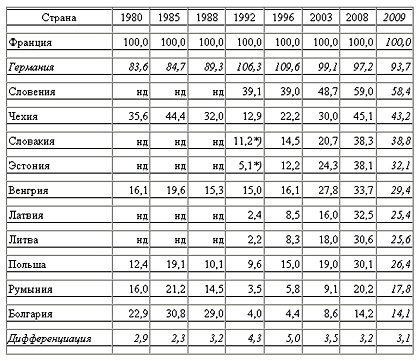
Источник: МВФ, октябрь 2009.
Примечания: Страны ранжированы по ВВП на душу населения в 2008 году.
Относительно низкие результаты Германии до 1988 года включительно вызваны учетом ее в современных границах (включая ГДР).
Относительно высокие результаты Румынии до 1988 года при низком уровне жизни вызваны сверхконцентрацией и неэффективным использованием «нефтедолларов» режимом Чаушеску.
Чехия учитывается в современных границах.
Сопоставление данных различных лет может быть некорректным из-за колебаний покупательной способности доллара.
Франция выбрана для сравнения в качестве символа «старой Европы» как наиболее развитая и крупная страна Евросоюза, не испытывавшая значительных политических потрясений (в отличие от Германии, включающей в себя часть Восточной Европы, что и обусловливает ее относительную уязвимость в условиях текущего кризиса), руководство которой придерживается проевропейской ориентации (в отличие от Великобритании).
Индекс дифференциации — разрыв в ВВП на душу населения между наиболее и наименее развитой из пяти стран Восточной Европы, существовавших в 80-е годы.
*) Данные за 1993 год.
Author - Director of the Institute of Problems of Globalization, Doctor of Economics