Date
Author
Source

Preserved copy
Translated material
Children of Putin
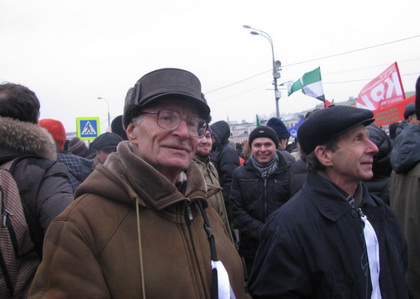
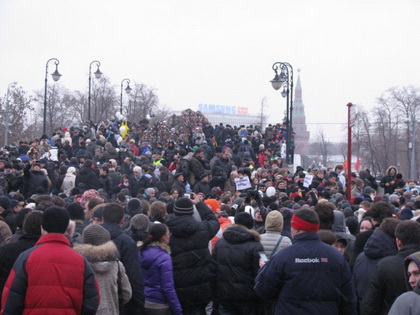
Last Saturday, for the first time in the 21st century, we saw a new Russian middle class not in cafes and restaurants of the family type, where they usually spend weekends, but on squares with posters and slogans. Of course, in the crowd in Bolotnaya there were radical anarchists, and human rights activists, and journalists - those who have been visiting rallies and disagreement rallies and marches, making up a couple of thousand people in the last years - but they simply dissolved in a stream of completely new faces. Most of them went out to the spent for the first time in their life, some part forgot when they did it for the last time.
It is quite natural that the opposition experienced an unprecedented surge of enthusiasm and decided that she gained a new electoral base that shares its political views and methods of struggle. However, these expectations are unlikely to be met.
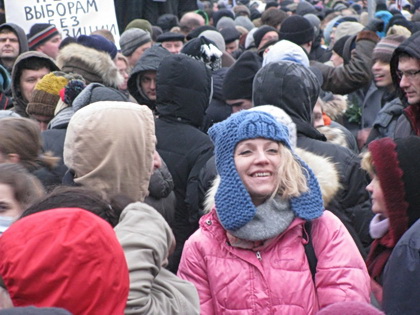
In Bolotnaya Square, we saw the already formed metropolitan middle class - non -poor people, for the most part educated, spending enough time on the Internet, owners of “Mazd”, “Fords” and “Nissans” bought on credit, many of which also pay a mortgage for the apartment in the area remote from the center. Cute and non -aggressive, more similar to visitors to the cinema or hypermarket than inspired revolutionaries, they first massively showed their interest in politics.
In the 2000s, they, being economically active, almost did not declare themselves in the cultural and political space. The agreement, which Vladimir Putin proposed, having come to power, was simple: the opportunity to make money in exchange for non -participation in politics. This pact fully supported the middle class: frightened by a sharp decrease in the standard of living after the 1998 crisis and explosions of houses in Moscow in 1999, people themselves started talking about a pinochet and rejection of democratic and liberal freedoms, "since this leads to a mess."
For many years, Putin complied with the conditions of an unspoken pact. Over ten years, the middle class has grown and obviously became richer, used to relax at foreign sea and ski resorts, in its interests a low (13%) rate of income tax was adopted.
Nevertheless, now the middle class has violated the contract and went to the square. At the same time, it is obvious that not only the election violations were the cause of the growth of political activity. The middle class remembered politics in September, immediately after Putin announced his desire to become president. Now he massively signed up for observers in the elections, and it was the results of these observations that made it possible to recreate an impressive picture of manipulations in polling stations. Suddenly, Putin lost his main support among the economically active population.
Many of our friends who came to Bolotnaya, in the early 2000s, considered Putin the figure of Putin an adequate difficult situation, the majority did not outraged that the United Russia uses state opportunities in the elections, violating the constitution. It was believed that this does not interfere with the business and career of a professional in the corporation, and those who are outraged and participate in protest promotions are losers, who have found their place in their lives. Even a passive interest in politics was reduced - newspapers read less and less, and on television the most popular middle -class program was Leonid Parfenov’s program “The Last Snight”, masking political news of an entertainment presentation.
As a result, the political culture that had just begun to emerge was again unclaimed. In particular, our middle class has not mastered the culture of political discussions. In Russia, there has never been a tradition of political disputes in a cafe (in the USSR, everything was discussed in the kitchens)-in the 2000s, the cafe opened massively, but they did not become a place for the debate.
Remembering now about politics, the middle class rushed to exchange opinions on social networks. Facebook has become much more important than Twitter precisely because today it is not only a means of mobilization, but also a platform for communication, and the source of news - the lack of political culture has led to a decrease in interest and trust in the traditional media, including opposition.
As a result, today the incredulous middle class is ready to perceive only the simplest solutions. This is one of the reasons for the popularity of Alexei Navalny, a master of simple answers: the middle class suffers because they steal and steal, because, firstly, there is corruption of government officials, and secondly, to feed the North Caucasus.
The lack of experience in political discussions is one of the main reasons why those who came to Bolotnaya Square are not very ready to support the leaders of the political opposition: the leader of Parnas Boris Nemtsov, the head of the NBP Eduard Limonov or the defender of the Khimki forest Yevgeny Chirikov.
Comments on Internet sites supporting the movement for honest elections are full of fears about these figures. The middle class scares not only the uncompromising lemon and the glamorous look of Nemtsov, who had already worked in the government in the 90s, but also the defender of the Khimkinsky forest of Chirikov, the flesh from the flesh of the middle class. It is amazing that even Navalny, who invented the main protest referee about “United Russia” as a party of crooks and thieves, and he is perceived as a person who can involve dangerous and incomprehensible games. “Do not let Nemtsov and Navalny to microphones, not making sure that they can express their thought instead of just screaming. Call Parfenova, ”writes Svetlana Shapovalyants on the forum of the capital's magazine“ Big City ”. The word "politician" remains abusive.
Yuri Saprykin, who has been the most popular in Russia for the pre -trial magazine for the Middle Class "Poster", was best formulated in the article "Update the page" of the mood of the masses that came out to the square: “But there is one news unpleasant for non -system politicians. People gathered for a rally did not come to you. You saw them for the first time, you do not know who they are and what they have on their minds, you have nothing to talk about with them and, it seems, there is nothing to offer them. ” Among people who have received the support of the crowd, he calls the popular author of detectives Boris Akunin and TV presenter Leonid Parfyonov. It is characteristic that Boris Akunin in his speech narrowed political demands before the restoration of the right of Muscovites to choose the mayor and re -election in the capital. Nevertheless, these people are not politicians, and are unlikely to be going to become them.
So far, one thing is clear - the middle class requires new leaders, but he is not capable of raising them. People are outraged by violations in the elections, but do not know who they would like to choose and what are their political requirements. At the same time, the non -playing opposition, at the cost of incredible efforts for many years reminiscent of society about the possibility of street protests, they do not trust.
Meanwhile, the intellectual weakness of the middle class coincided with a similar weakness of power, which for the first time since the time of perestroika was in intellectual isolation. Previously, during crises in the Kremlin, they could always count on the support of the oligarchs who were ready to provide not only financial, but also brain support. It was the intellectuals delegated by oligarchs that helped defeat Yeltsin in 1996 and Putin in 1999. Today, equidistent oligarchs are in no hurry to share their knowledge with Putin.
In addition, over the past 25 years, there have always been elite groups, who believed that it was much more effective to carry out reforms if they cooperate with the authorities, and not with a backward and poorly educated population, and supported the most stringent political decisions of the Kremlin.
However, after the refusal of Medvedev, the presidential ambitions of such groups became much less. After all, the return of Putin to the Kremlin for elites means that the change in the generation of managers will not occur, there will be no new places and there is no incentive to provide support.
Photos of Evgenia Vlasova