
Translated material
PROSEDATE PANOVOVA
In uniform
 PROSEDATE PANOVOVA
January 13, 2014 Natella Boltyanskaya
Precedent - a decision made by the court in a particular case, the justification of which becomes a rule that is mandatory for all vessels of the same or lower instance in solving a similar case (from the Great Soviet Encyclopedia).
On the third day, you and I watched the precedent with the capital “P” - the decision of Judge Taranenko in the case of Aksana Panova. One of the points of the sentence is the ban on working in the media- periodic printed and network publications, television and radio channels, television and radio programs, as well as in video programs, film-core programs and other forms of periodic mass media under the constant name.
What does it mean? Well, firstly, that the opponents of Panova did not bother to find a witness more polarly. They found one who was already condemned by the same court for False -Born. Secondly, a precedent has been created, which is a danger to any journalist: any unpleasant statement to someone’s address can lead after a time to the statement of the indicated person about an attempt to extort, the failure of which led to the publication. Nobody will evaluate the truth of the publication itself. The investigation is convenient for such a witness, and the court, as a rule, does not doubt it. In recent years, there have been practically no cases when the court did not agree with the investigation in the processes in resonant matters. Instead of the separation of powers, the executive and judicial branches are intertwined in ecstasy, issuing a typical result. Such a result tomorrow can hit each of us - you are a journalist or not ... This is a precedent. Now let's try to figure it out rightfully.
So, labor activity is a conscious appropriate activity of a person, requiring the application of efforts and aimed at transforming the surrounding world to satisfy certain needs of the individual or society, including the production of certain goods or the provision of services (from the encyclopedia of sociology).
Now about the ban on her.
Article 47 of the Criminal Code of the Russian Federation .
1. The deprivation of the right to occupy certain positions or engage in certain activities is to prohibit the position of positions in the public service, in local authorities or engage in certain professional or other activities.
2. The deprivation of the right to occupy certain positions or to engage in certain activities is established for a period of one year to five years as the main type of punishment and for a period of six months to three years as an additional type of punishment.
Now we look carefully at Aksana. She is a journalist and manager, and for a relatively short period of time she managed to bring two network regional publications into full -fledged media. She is good or bad, she is an excellent organizer who is engaged in this work for the next two years-no, no.
It is forbidden to manage the “sign” that she created, because the “sign” is an Internet newspaper that has a license and the “current number”.
Chapter 1, Article 2 of the Media Law : “The media refers to a periodic print publication, network publication, television channel, radio channel, television program, radio program, video program, film -cinema program, another form of periodic mass media under the constant name (name);
The periodic print publication is understood as a newspaper, a magazine, almanac, a ballot, another publication that has a constant name (name), the current number and the publishing room at least once a year. ”
By the way, the witness, whose testimony was so destructive for Aksana herself and for the entire community as a whole (for a precedent) did not at one time enjoy the right to refute false information ( media law, chapter 4, article 43 ):
“A citizen or organization has the right to demand from the editorial office of refutation that does not correspond to reality and the honor and the dignity of information that were discredited in this media. The legal representatives of a citizen also have such a right if a citizen himself is not able to demand a refutation. If the editorial office of the media does not have evidence that the information that has prevailed by him is true, it is obliged to refute them in the same media. ”
The witness did not take advantage of the Panova case with his right because of being in places not so remote or because of ignorance of this law, it does not matter. It is important that from now on, instead of butting with intractable editions, which, do not give Gd, also have evidence of their own rightness, will be addressed to the prosecutor’s office with a statement of extortion. It is extremely convenient for Russian officials, who are not a day in lies, corruption and inefficiency.
But back to Panova.
Article 47 of the Media Law, Chapter 5 .
The journalist has the right: 1) to seek, request, receive and disseminate information ... 9) state their personal judgments and assessments in messages and materials intended for distribution for his signature ...
And, finally, Article 52 of the 5th Chapter of the Law on Media : “The professional status of a journalist established by this Law is distributed:
On the full -time employees of editors engaged in editing, creating, collecting or preparing messages and materials for large -type newspapers and other media ...
The authors who are not related to the editors of the media with labor or other contractual relations, but recognized by her by their freelance authors or correspondents, when they fulfill the editorial instructions. ”
Aksana is going to appeal. As I understand it, for all instances. Success to her, for her story, in the light of the above articles of different laws that contradict each other in places, is this a story from the series “Are you still opening your mouth? Then we go to you. " The precedent is created. And he can affect judicial practice.
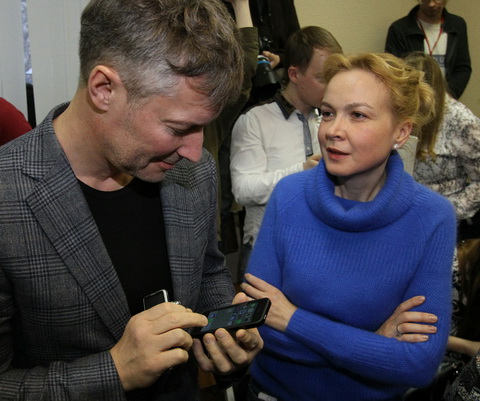
In the photo: Russia. Yekaterinburg. January 9, 2014. Yekaterinburg mayor Yevgeny Roizman and former chief editor of the Ura.ru news site Aksana Panova, accused of extortion, fraud and abuse of official powers, during the announcement of the sentence in the Leninsky District Court.
Photo by ITAR-TASS/ Donat Sorokin