
Translated material
Behind the recipe for longevity
Around Russia
 Behind the recipe for longevity
May 30, 2012 Arkady Moshes
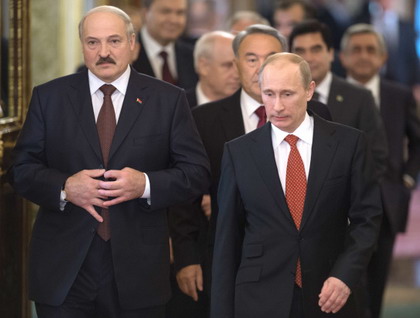
As in 2000, the first foreign trip of Vladimir Putin, after entering the presidency, is a visit to Belarus. True, then Minsk was a point on the way to London and Kyiv. But with Ukraine over the past two years, pots have been beaten, it seems, completely. As for Great Britain, a decade ago, there were big claims to the Kremlin, which was due to which it fell out of among the priority partners of Moscow, for which it was more convenient to deal with Berlin and Paris. The latter are still invited to demonstrate mutual understanding and interest, but it is clear that neither sincere faith in cooperation with Russia from the times of Chancellor Gerhard Schroeder, nor illusions about Russian modernization in Berlin have virtually neither, and therefore it is becoming increasingly complicated to achieve foreign policy results in Europe.
And Belarus, as before, is in the top list. Moreover, its significance, that is, the significance of outwardly trouble -free relations with neighbors, has only grown for the Kremlin foreign policy.
In the domestic political context, it has long been noticed that the regime of Alexander Lukashenko has copyrights for a number of inventions, which were later imported into Russia. Let us leave the brackets for the court hockey, which was introduced by the Belarusian president, although he, in my opinion, did not go out on the ice under the television and the inauguration. But he debugged the mechanism for the neutralization of political protest by tightening the nuts to such an extent that he was able to survive the sharp deterioration of the economic situation in the country and the fall of ratings, and much more. Belarus after the elections managed to “freeze”, and the Belarusian experience is probably carefully studied today in the relevant structures of Russia. Moscow cannot but perceive Lukashenko as an ally in the restraint of “extremism” and a like -minded person, which she has a few today. Actually, this is the main content of the visit: demonstration of mutual support and solidarity. Indeed, not to go to Kemp-David for her.
The foreign policy aspect itself is also important. Everyone understands that without Belarus there will be no post -Soviet reintegration. The Customs Union, Eurasian mechanisms should earn money, otherwise the price of all the conversations about the leading regional role of Russia is worthless, and this depends largely on the loyal behavior of Alexander Lukashenko.
The difficulty, however, is that the Belarusian president also understands all this perfectly. He knows that today Moscow is needed more than before, and his requests are therefore only growing.
What is the source of self -confidence in Alexander Lukashenko? The fact that Moscow has repeatedly tried to put pressure on him, but he went out of the blow over and over again. Recall the iconic stages.
Firstly, Lukashenko survived the campaign in the Russian media, the numerous series of the “godfather” and support, which is believed to have received some opposition representatives from Russia during the 2010 presidential election, without much domestic political damage. This campaign did not work on his electorate. Now try to prove that Moscow can shoot and appoint a ruler in Minsk.
Secondly, the system of Russian subsidies in the form of cheap gas and access to the Russian market, previously partially dismantled, was restored. At the same time, no strategically important concessions of Russia were made in terms of transferring property. The sale of the remaining share of Baltransgaz for Russians for good money is a win, not a loss, and oil refining and potassium fertilizers, as before, are owned by the Belarusian state. Yes, probably, various kinds of sanitary restrictions on the import of Belarusian agricultural products in principle can be again extracted from the arsenal of Russian foreign policy. But so far only an increase in exports to Russia was observed.
Thirdly, Minsk was able to maintain independence in foreign policy. The non -recognition of Belarus of the independence of Abkhazia and South Ossetia spoke a lot, but good relations with Georgia went much further. And, by the way, they served Minsk in relations with the EU. When Brussels tried last year to persuade the Eastern partnership countries to the position of formal condemnation of the Belarusian regime, the attempt failed largely precisely because of the disagreement of Tbilisi. What once again emphasizes the old truth, that the task of diplomacy is to multiply the number of friends, not enemies.
And today Minsk seems to begin to gently go on the offensive. During a recent visit to Belarus of the President of Kazakhstan Nursultan Nazarbayev, the point of view clearly sounded that Russia, for its partners in the Customs Union, is also a transit territory and that only after equalizing the conditions for the transit of goods (that is, the equality of railway tariffs and the discovery of access to Russian pipelines) is opened further reintegration. If these conditions are really fulfilled, it will be just right to talk about the true geo -economic revolution in the post -Soviet space. If not, Lukashenko will have an excuse in order to play back yourself. It cannot be said that Moscow was not warned.
And most importantly, Lukashenko remains faithful to himself in his extreme inconsistency. Who else can afford to declare to the parliament in the message that “neither Russia nor Putin have resources to strangle Belarus” and that exactly Russia realized that pressure on Belarus would lead to the loss of an ally, and therefore retreated? And Lukashenko can. Because he knows that even after these words the head of the largest regional power will come to him on a visit.
True, there is a point of view according to which Moscow decided to play for a long time. Allegedly, recognizing her inability to find Lukashenko to replace in the near future, Moscow decided to wait for time, through the mechanisms of the Customs Union and the WTO, on which it is founded, nevertheless to obtain control over the Belarusian economy, to create a new loyalty system, not necessarily connected with the current president, not in a hurry to choose a candidate and only then shoot.
Well, such a point of view has the right to exist. Her fidelity or fallacy will be shown by time. However, until now, in a long -term game, Lukashenko invariably turned out to be a winner, replaying Russian leaders one after another.
Photo by RIA Novosti