
Translated material
Fast water stones
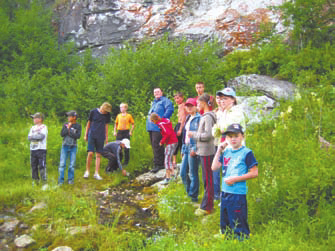
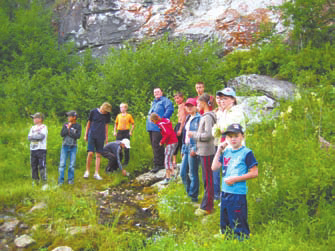 The Chusovaya River - the left tributary of the Kama - is legally considered the place of pilgrimage to water tourists from all over Russia (which have Ural rivers in a high price). Travelers here are waiting for not only an impressive, but also to a large extent instructive sight. By storing guidebooks, you can delve into the comprehension of geology, botanical, ethnography and history of the region, pass by Ermak and merchant barks and burglars loaded with iron. And if desired, to plunge into the world of Bazhov’s fairy tales or the super -modified modern writer Alexei Ivanov, the author of the “visionary” guide “Message: Chusovaya”. During the holidays, local school teachers (like Ivanov at one time) often turn into guides, their students go into weekly swimming on catamarans that replace them with pioneering camps. It is surprising that parents run the risk of letting go to the completely deserted places of their offspring (in a place, “corners”), when these offspring, for example, have just moved to the fifth grade. However, the kids here, I must admit, are quite lively ...

The Chusovaya, in a sense, is a completely unique phenomenon - this is the only river flowing at once in two parts of the world - Asia and Europe. It takes its beginning in the north of the Chelyabinsk region - on the eastern slope of the Ural ridge, from Lake Sura. In his middle reaches, whimsical for seven hundred kilometers, he was twice from the Sverdlovsk region to the Perm Territory, ruthlessly cutting out mountain ridges, and ends his way in the Kama reservoir. The name of its Chusovaya may have received from the distorted Komi-Permyak "Chus-va", i.e. “Fast water” (although it usually cannot boast of a particularly rapid current; in the Urals there are more violent mountain rivers). There are, however, many others - no less convincing - versions ...
The spectacularity of the banks give the rise here and here limestone and dolomite (and sometimes also anhydritic and shale) rocks - the so -called stones. There are hundreds of them. Wronging around from annoying biting river gadflies (they are called “spiders” here) and fried in the sun (if the matter is in July-August), travelers glide on the sedimentary strata of the late Paleozoic (Devonian, Carboniferous and, of course, the “titular” Perm periods). The most dangerous of these “stones” are also called “fighters” (the essays of Dmitry Mamin Sibiryak, dedicated to rafting in Chusova, are called “fighters”).

Limestone, as you know, is subject to weathering, sometimes they take very bizarre outlines, often stained in brown-nickered color and are covered with spots of lichens. There are grottoes, excavations and caves - they are mainly karst origin. The most extensive such a local cave is proud of the “Wonderworker”, it is considered a monument of nature, however, in the list of the most significant caves of the Perm Territory, it is still listed somewhere in the third ten (however, even other natural monuments are not counted here, even the beads blown up a couple of centuries ago). And a truly unique cave is waiting for tourists away from the route. This is the Kungur ice cave, which, after the end of the alloy and before returning home, tend to visit Muscovites (moreover, it is convenient to go home from the station in the city of Kungur) ...
One of the suitable points for starting an alloy in the middle reaches of the river is the village of Kyn-Zavod (Perm Territory). 15 kilometers from it is the Kyn railway station, with which there is a permanent bus message. However, it is not necessary to travel the “savage” and come with their own catamaran, in recent years many companies engaged in the organization of alloys have appeared, they, if necessary, supply not only equipment, but also instructors, and also bring the bus directly to the shore. Kyn translated from Komi-Permyatsky means “cold”, “frozen”. The village arose in 1760, together with the iron plant factory of the Kuptsov Stroganovs. Below the village on the right bank rises a stone stone, and then the border between the Perm Territory and the Sverdlovsk region passes.

At the bend of the river on the left, the multi stone rises near the massive block, and on the contrary, tourists often stop at a halt. Previously, the Multyk stone was a dangerous fighter, the rafting said that here they “have to be wrapped up”, that is, to work hard in order to turn away from the stone on a quick roll (hence the name).
Having crossed this place from the parking to the other side (where the spring with wonderful water beats) and raising the slopes overgrown with forest, you can admire the river bends on top.
Perhaps the most tense for pre-revolutionary barrels should be considered a S-shaped River bend after the mouth of the Kumysh River (Chusovaya is not a particular danger for modern light tourist ships). There are the most formidable “fighters”: potter, milk and robber (has a characteristic triangular shape, see photo). On the right bank in front of the robber at a fair height, a stone clicker is visible (in the form of some kind of bird or lamb head). They say that during the rafting, girls in red sundresses from the village of Kumysh came out, arranged some of their girlish fun in order to insidiously distract from the work of rafting and burglars. The crashed Barca crashed with the easy prey of local robbers. In 1877, for only one day, 23 barks broke in these places and more than a hundred people died (it is unlikely that all this should be written off for girls in red sundresses). In the end, the patience of the merchants ended, and the fighters were partially blown up (it should be noted that underwater explosions in those days were still very rare).

Behind the robber, again, rocks resembling the gigantic feet of the trolls rise on the right - these are four brothers (the option is five brothers, since one of the ledges is double). The stones of the robber and four brothers are considered monuments of nature.
The next wonderful site begins after the confluence (on the right) of the Rassol River. Behind her, one by one, the stones are bent, the tower and the most beautiful trapezoid gusel.
And then, after the left -bank mare ribs and a vessel, the so -called holey ribs (or owl) follow. It’s simply impossible to pass by an impressive stone arch and not to take pictures. You can immediately find small caves, and a little downstream will reach (on the right and left shores) of the village of Ust-Kokiva (before-a worker, now almost a summer cottage), there you can find the owners of a “non-working” private shop, which will open it at a special request. There is a connection with the “large land” in the form of an installation with a satellite antenna, however, there are no special cards for telephone conversations in the store or somewhere else (and mobile phones do not work to the very city of Chusovoy). To the right of the village in Chusovaya, the Koyva river (“Koy” in translated from Komi-Permyatsky-these are “spray”, “wa”-as already mentioned, “water”).
The remaining photos can be viewed at http://nauchnik.ru/chus/
Maxim Borisov
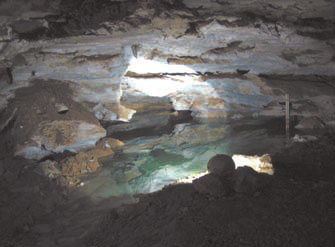 Lake in the Kungur cave
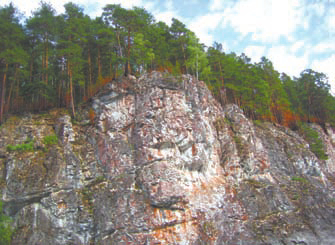 Stone wall
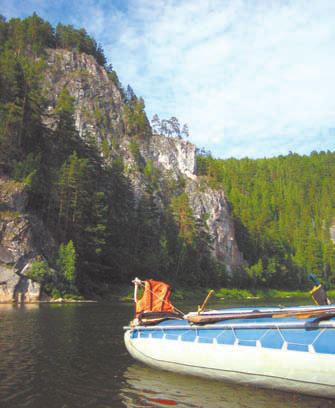 Stone multyk
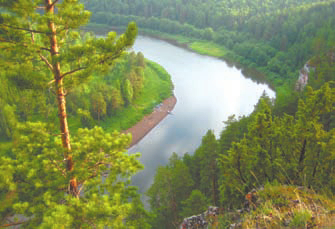 Chusy view from above
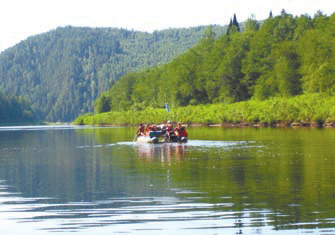
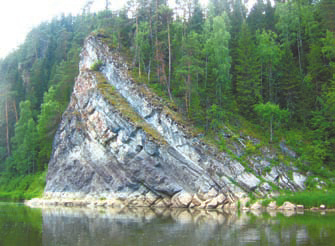 Stone robber
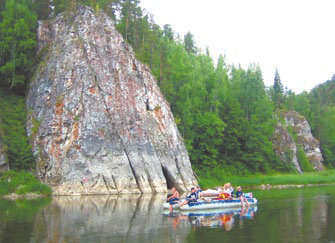 The stone is four brothers
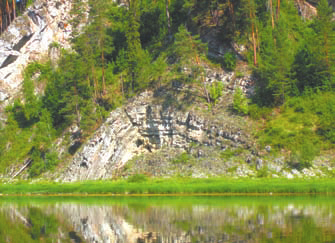 The stone is bent
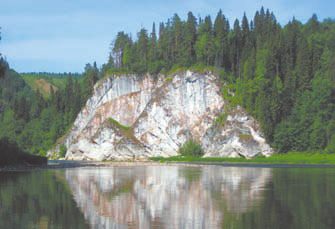 Gusel stone
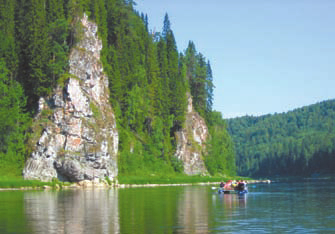 The stone of the mare's rib
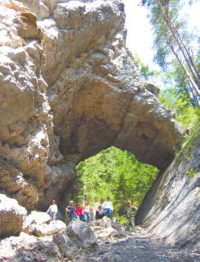 Give -shaped ribs - Arca "Tsar’s Gate"
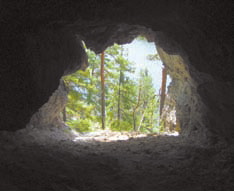 Cloudy ribs - View from the cave
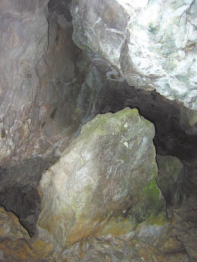 Cloudy ribs - inside the cave